19
COMMON BENDS LAYOUT INFORMATION — continued
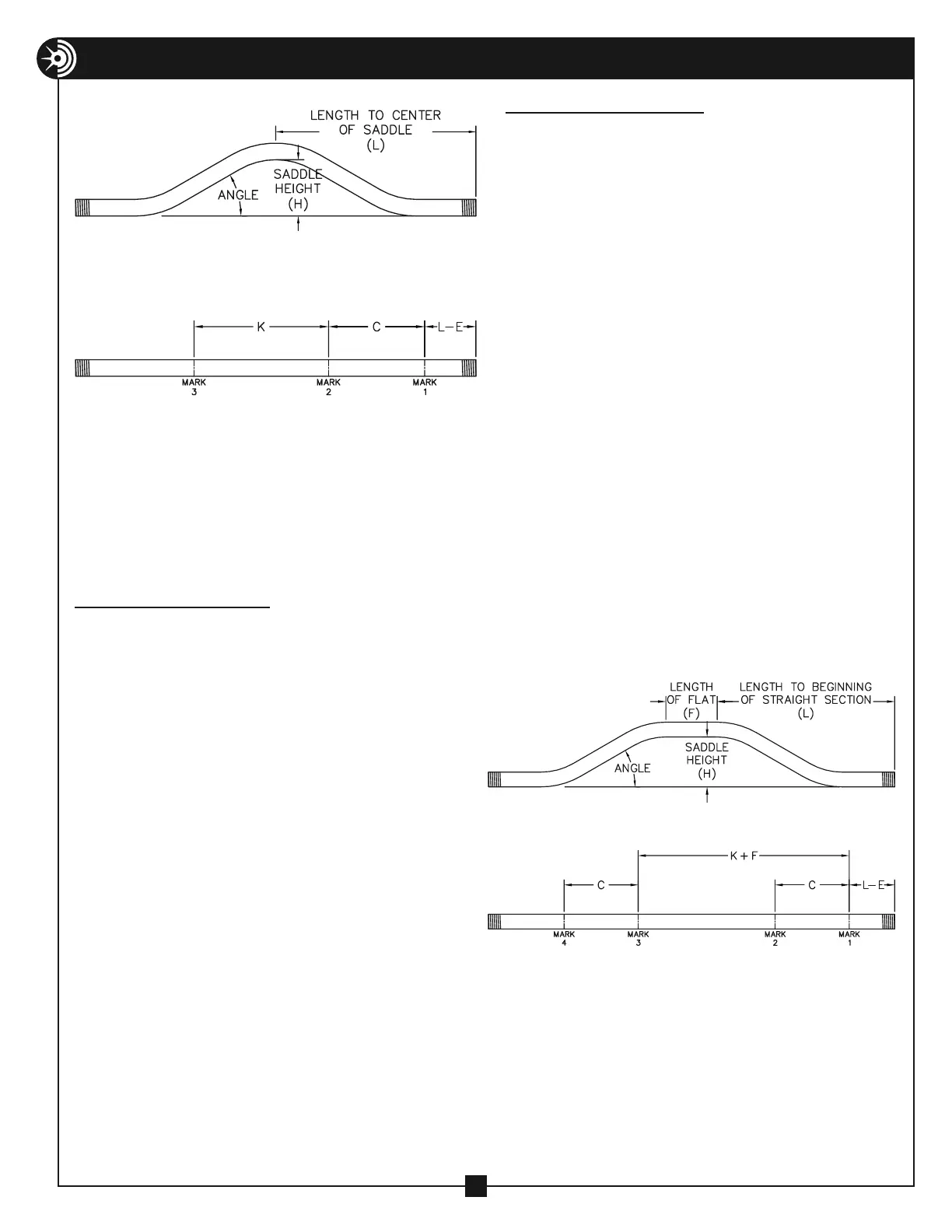
THREE-POINT SADDLES
1. Determine the length to the center of the
saddle (L), saddle height (H) and angle for the
saddle (See Figure 19A)
2. Locate the chart (see pgs. 20 – 23) that
corresponds to the size and type conduit you
are going to bend.
3. Using the desired angle, locate the “E” value
that corresponds to the desired height (H).
Deduct this value from the length (L) and
make a mark this distance from the end of
the conduit. This is your first bending mark
(Mark 1).
4. Next, locate the “C” value that corresponds
to the desired height of bend. Make a mark
the distance “C” from Mark 1. This is your
second bending mark (Mark 2).
5. Lastly, locate the “K” value that corresponds
to the desired height (H). Make a mark the
distance “K” from Mark 2. This is your third
bending mark (Mark 3).
6. You may now proceed with the bend.
FOUR-POINT SADDLES
1. Determine the length to the start of the flat
section (L), the length of the flat section (F),
saddle height (H), and angle for the saddle
(See Figure 19B).
2. Locate the chart (See pgs. 20-23) that
corresponds to the size and type conduit you
are going to bend.
3. Using the desired angle, locate the “E” value
that corresponds to the desired height (H).
Deduct this value from the length (L) and make
a mark this distance from the end of the conduit.
This is your first bending mark (Mark 1).
4. Next locate the “K” value that corresponds to
the desired height (H). Add this value to the
length of the flat section (F) and make a mark
this distance from Mark 1. This will be your
third bending mark (Mark 3).
5. Lastly, locate the “C” value that corresponds
to the desired height (H). Make one mark this
distance from Mark 1. This will be your second
bending mark (Mark 2). Then make another
mark the distance “C” from Mark 3 (see Figure
19B). This is your fourth bending mark (Mark 4).
6. You may now proceed with the bend.
FIGURE 19A
FIGURE 19B



 To Next Page