EasyManua.ls Logo

Curtis 1268-5411 - User Manual

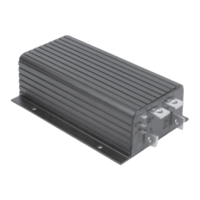
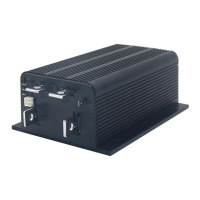
Curtis 1268-5411
6 pages
Print Icon
To Next Page IconTo Next Page
Loading...
Generic Golf (1268-5411) Install Sheet-370 Rev 01 05/24/18 Sheet 1 of 6
CHECK MOTOR WINDINGS:
Set your VOM to RESISTANCE (Ω).
To test the resistance of VOM leads, please touch the meter leads together.
Subtract this measurement from each test below to get your true measurement.
With motor disconnected, measure A1 to A2. This should measure approximately BETWEEN .2Ω and 2Ω.
With motor disconnected, measure F1 to F2. This should measure approximately BETWEEN .8Ω and 3Ω.
With motor disconnected, measure A1 to F1. This should measure OPEN.
With motor disconnected, measure F1 to motor case. This should measure greater than 5MΩ.
CHECK MAIN SOLENOID:
Disconnect all wires from the main solenoid.
Set your VOM to RESISTANCE (Ω).
Measure the solenoid coil. This should measure 100Ω - 250Ω (depending on solenoid type).
Connect VOM leads to the main solenoid lugs.
Attach jumpers from main battery positive and negative to the coil (small terminals).
Meter should jump from infinity to LESS THAN .3Ω.
Remove jumpers and reconnect solenoid wiring from the harness. (If suppression diode is present,
the non-banded side must go to the wire from J1 pin 17 from the controller. Be sure to check diode
functionality with VOM prior to install. If pre-charge resister is installed, please remove. This control is
equipped with an internal resistor, and installing one on the solenoid could cause damage to the control.)
CHECK THE CART WIRE HARNESS:
Check the connectors on the wire harness for corrosion, loose, broken, burnt or missing pins.
Repair or replace pins as necessary.
STEPS TO PERFORM BEFORE CONTROL INSTALLATION
Curtis 1268-5411
This sheet is provided to aid in the installation of your remanufactured CURTIS controller.
Upon installation, you may encounter problems that may, or may not, be due to a faulty
controller. The following steps must be taken to help diagnose a possible cart fault or faulty
controller. An analog or digital volt ohm meter (VOM) will be needed to perform these checks.
WARRANTY WILL BE VOID
If These Steps are Not Performed Before Installing The Control
IF ANY OF THE ABOVE ITEMS ARE NOT WITHIN THE SPECIFIED RANGES THE CONTROLLER WILL FAIL.
THESE ITEMS MUST BE CORRECTED BEFORE THE CONTROLLER IS INSTALLED OR WARRANTY WILL BE VOID.
It is recommended to replace your solenoid at the time of controller replacement. FSIP now stocks popular replacement White Rodgers solenoids for your convenience.


Questions and Answers

Summary

Pre-Installation Checks

Check Motor Windings

Verify motor winding resistance is within specified ranges using a VOM.

Check Main Solenoid

Test main solenoid coil resistance and connections for proper operation.

Check Cart Wire Harness

Inspect wire harness connectors for corrosion, looseness, or damage.

Troubleshooting Sequence: Pin Checks

Pin J1 Voltage Checks

Perform voltage tests on various J1 pins with key switch, F/R switch, and pedal.

Pin J1-19 and J1-13 Checks

Test J1-19 for reverse alarm operation and J1-13 for ITS sensor voltage.

Pin J1-15 and J2 Voltage Checks

Test J1-15 for ITS sensor voltage with pedal states and J2 for speed sensor.

Optional Feature Pin Checks

Perform voltage tests on optional feature pins like Walkaway and Mode Switch.

Troubleshooting Chart: LED Codes

Common LED Fault Codes

Interprets common LED fault codes and their possible causes for diagnosis.

Motor and Power Related Faults

Details faults related to motor stall, battery voltage, and overvoltage.

Contactor and Driver Faults

Explains faults concerning main contactor, auxiliary relays, and drivers.

Wiring and Sensor Faults

Covers faults related to field wiring, current sense, and shorts.

Troubleshooting Chart: Continued

Key Switch and Circuit Breaker Faults

Details faults related to key switch operation and circuit breaker status.

LED Diagnostics and Helpful Hints

Explains LED fault code display and provides essential troubleshooting advice.

Summary

Pre-Installation Checks

Check Motor Windings

Verify motor winding resistance is within specified ranges using a VOM.

Check Main Solenoid

Test main solenoid coil resistance and connections for proper operation.

Check Cart Wire Harness

Inspect wire harness connectors for corrosion, looseness, or damage.

Troubleshooting Sequence: Pin Checks

Pin J1 Voltage Checks

Perform voltage tests on various J1 pins with key switch, F/R switch, and pedal.

Pin J1-19 and J1-13 Checks

Test J1-19 for reverse alarm operation and J1-13 for ITS sensor voltage.

Pin J1-15 and J2 Voltage Checks

Test J1-15 for ITS sensor voltage with pedal states and J2 for speed sensor.

Optional Feature Pin Checks

Perform voltage tests on optional feature pins like Walkaway and Mode Switch.

Troubleshooting Chart: LED Codes

Common LED Fault Codes

Interprets common LED fault codes and their possible causes for diagnosis.

Motor and Power Related Faults

Details faults related to motor stall, battery voltage, and overvoltage.

Contactor and Driver Faults

Explains faults concerning main contactor, auxiliary relays, and drivers.

Wiring and Sensor Faults

Covers faults related to field wiring, current sense, and shorts.

Troubleshooting Chart: Continued

Key Switch and Circuit Breaker Faults

Details faults related to key switch operation and circuit breaker status.

LED Diagnostics and Helpful Hints

Explains LED fault code display and provides essential troubleshooting advice.

Overview

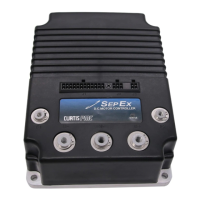
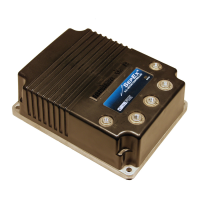
The Curtis 1268-5411 is a SepEx (Separately Excited) controller designed for use in generic golf carts, operating on a 36V/48V battery pack. This document provides essential pre-installation checks, troubleshooting sequences, and technical support information to ensure proper installation and operation, and to maintain warranty validity.

Function Description

The Curtis 1268-5411 controller manages the power delivery to the motor, controlling vehicle speed and direction. It integrates various safety and operational features, including:

  • Motor Control: Regulates current to the motor armature and field windings (F1, F2, A1, A2) to achieve desired speed and torque.
  • Direction Control: Processes inputs from Forward (J1-10) and Reverse (J1-11) switches to change the motor's direction.
  • Throttle Input: Interprets signals from the pedal switch (J1-8) and ITS (Inductive Throttle Sensor) assembly (J1-13, J1-15) to control acceleration.
  • Main Solenoid Control: Activates the main solenoid (J1-17) to connect battery power to the controller and motor.
  • Safety Interlocks: Incorporates inputs from the Run/Tow switch, Key Switch (J1-1), Charger Interlock (J1-2), and Mode Switch (J1-20) to ensure safe operation.
  • Optional Features: Supports optional features like Walkaway Relay (J1-3, J1-9, J1-23), Brake Light Relay (J1-18), LED Driver (J1-22), and Backup Alarm (J1-19).
  • Speed Sensing: Utilizes a speed sensor (J2-4, J2-5, J2-6) to monitor wheel speed, crucial for performance and safety features.
  • Diagnostic Capabilities: Features a built-in Status LED that flashes 2-digit fault codes to assist in troubleshooting.

Important Technical Specifications

  • Battery Voltage: 36V/48V.
  • Motor Type: SepEx (Separately Excited) motor.
  • Throttle Type: ITS (Inductive Throttle Sensor) compatible.
  • Motor Winding Resistance (Disconnected):
    • A1 to A2: Approximately 0.2Ω to 2Ω.
    • F1 to F2: Approximately 0.8Ω to 3Ω.
    • A1 to F1: OPEN.
    • F1 to motor case: Greater than 5MΩ.
  • Main Solenoid Coil Resistance (Disconnected): 100Ω to 250Ω (depending on solenoid type).
  • ITS Supply Voltage (J1-13 with Key Switch on): 14V to 15V.
  • ITS Signal Voltage (J1-15 with Key Switch on, Pedal up): Approximately 0.8V (+/- 0.3V).
  • ITS Signal Voltage (J1-15 with Key Switch on, Pedal fully depressed): Approximately 2.0V (+/- 0.3V).
  • Speed Sensor Supply Voltage (J2-6): 14V to 15V.
  • Speed Sensor Signal (J2-5): Toggles between 0V and approximately 5V when the drive wheel is slowly turned.
  • LED Status Codes: 2-digit codes flashed by the Status LED on top of the controller indicate specific faults (e.g., 3,2 for welded main contactor).

Usage Features

  • Pre-installation Checks: A crucial set of steps must be performed before installing the controller to validate the motor, main solenoid, and cart wire harness. Failure to complete these checks will void the warranty.
    • Motor Winding Checks: Measure resistance between motor terminals (A1, A2, F1, F2) and to the motor case to ensure proper winding integrity.
    • Main Solenoid Checks: Verify solenoid coil resistance and operation by applying battery voltage to the small terminals. Ensure any pre-charge resistor is removed if present, as this controller has an internal resistor.
    • Cart Wire Harness Checks: Inspect connectors for corrosion, loose, broken, burnt, or missing pins.
  • Troubleshooting Sequence: A detailed, step-by-step troubleshooting guide is provided to diagnose faults. This sequence requires a voltmeter and involves "back probing" pins from the wire side of the connector with the controller attached and the Run/Tow switch in the RUN position.
    • Voltage Measurements: Specific voltage readings are expected at various pins (J1-1, J1-2, J1-4, J1-8, J1-10, J1-11, J1-13, J1-15, J1-17, J1-19, J2-4, J2-5, J2-6) under different conditions (Key Switch On/Off, Pedal Up/Down, F/R Switch in Forward/Reverse/Neutral, Mode Switch Open/Closed).
    • Fault Isolation: The sequence is designed to isolate faults in wiring, switches, sensors, and relays. Users are instructed not to proceed to the next step until a fault is corrected.
  • Optional Feature Checks: Specific checks are outlined for optional features like Walkaway Relay, Brake Light Relay, Mode Switch, LED Driver, and Backup Alarm, to verify their functionality if present.
  • Safety Precaution: Always lift the drive wheels off the ground when troubleshooting to prevent accidental movement.

Maintenance Features

  • Diagnostic LED: The built-in Status LED provides immediate visual feedback on controller faults, flashing a 2-digit code that corresponds to specific issues listed in the "Troubleshooting Chart."
  • Troubleshooting Chart: A comprehensive chart links LED codes and programmer LCD displays to explanations and possible causes, aiding in quick fault identification (e.g., HW Failsafe, Throttle Fault, Speed Sensor Fault, Motor Stall, Low Battery Voltage, Overvoltage, Thermal Cutback, Main Driver On/Off, Main Welded, Precharge Fault, Field Missing, Aux Driver Off, Current Sense Fault, Driver Overcurrent, M- Shorted, Aux Relay DNC, Welded Aux Relay, Key Switch SRO, Main Coil Open, Aux Driver On, Circuit Brkr Open, Main Dropout).
  • Solenoid Replacement Recommendation: It is recommended to replace the solenoid at the time of controller replacement, as FSIP stocks popular replacement White Rodgers solenoids.
  • Importance of Motor Resistance Checks: Emphasizes that many cart issues are caused by burnt/damaged brushes (found during armature resistance check) or a shorted armature/field, which can damage the controller.
  • Technical Support Resources: Flight Systems Industrial Products offers various support options:
    • Troubleshooting Manuals / Codes (online)
    • Live Tech Support Chat
    • Technical Support Forum
    • Frequently Asked Questions (FAQ)
    • Phone Support (1-800-333-1194, Option 4)

Curtis 1268-5411 Specifications

General IconGeneral
BrandCurtis
Model1268-5411
CategoryController
LanguageEnglish

Related product manuals