6 | Application guidelines
Installer reference guide
44
ERGA04~08EAV3(A) + EHVH04+08SU18+23EA6V
Daikin Altherma 3 R F
4P629090-1 – 2020.08
NOTICE
▪ Make sure the auxiliary contact has enough differential or time delay to prevent
frequent changeover between indoor unit and auxiliary boiler.
▪ If the auxiliary contact is an outdoor temperature thermostat, install the
thermostat in the shadow so that it is NOT influenced or turned ON/OFF by direct
sunlight.
▪ Frequent changeover may cause corrosion of the auxiliary boiler. Contact the
manufacturer of the auxiliary boiler for more information.
6.4 Setting up the domestic hot water tank
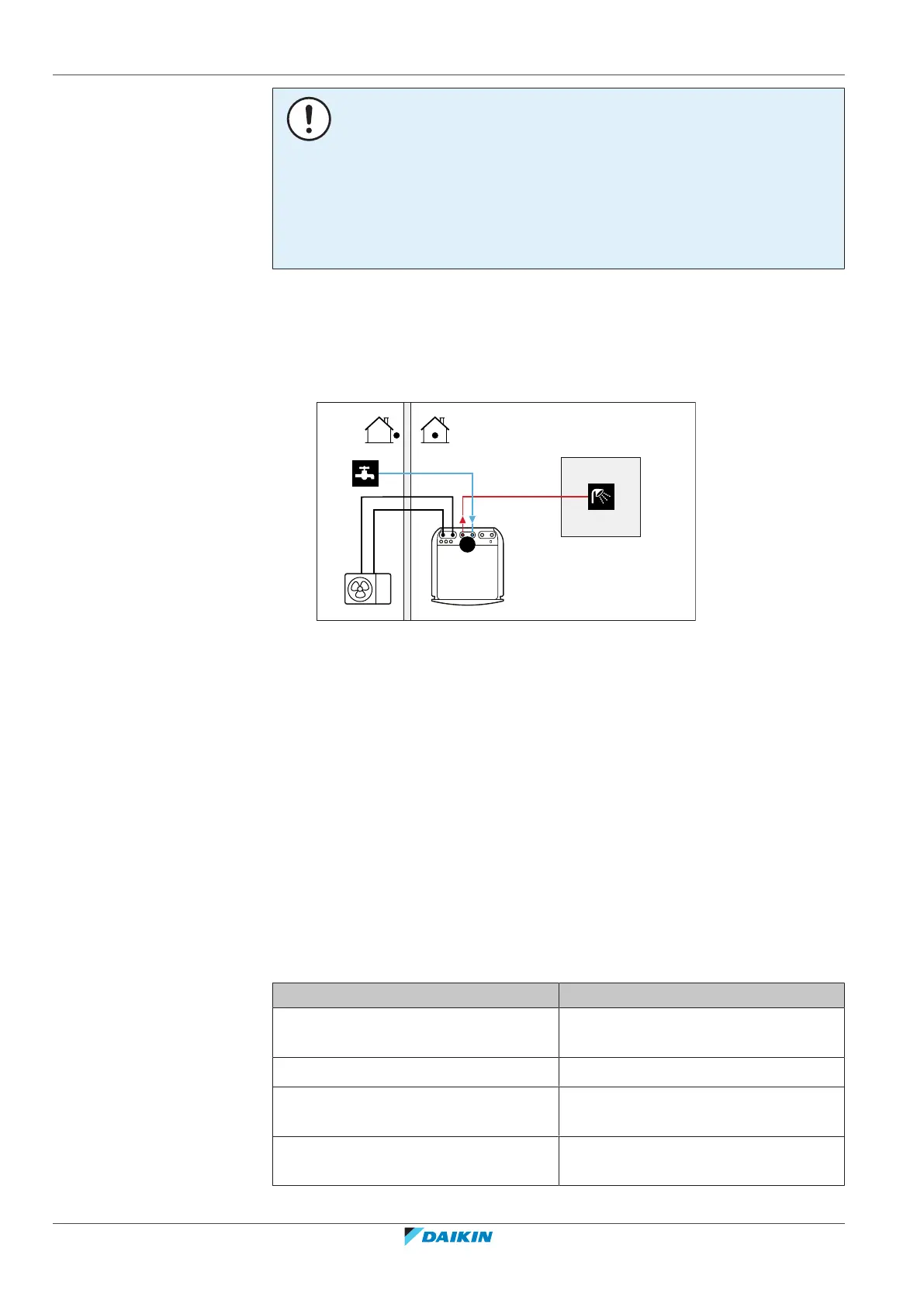
6.4.1 System layout – Integrated DHW tank
A Domestic hot water
a Cold water IN
b Hot water OUT
6.4.2 Selecting the volume and desired temperature for the DHW tank
People experience water as hot when its temperature is 40°C. Therefore, the DHW
consumption is always expressed as equivalent hot water volume at 40°C.
However, you can set the DHW tank temperature at a higher temperature
(example: 53°C), which is then mixed with cold water (example: 15°C).
Selecting the volume and desired temperature for the DHW tank consists of:
1 Determining the DHW consumption (equivalent hot water volume at 40°C).
2 Determining the volume and desired temperature for the DHW tank.
Determining the DHW consumption
Answer the following questions and calculate the DHW consumption (equivalent
hot water volume at 40°C) using typical water volumes:
Question Typical water volume
How many showers are needed per
day?
1shower = 10min×10l/min = 100l
How many baths are needed per day? 1bath = 150l
How much water is needed at the
kitchen sink per day?
1sink = 2min×5l/min = 10l
Are there any other domestic hot water
needs?
—



 To Next Page