7 | Unit installation
Installer reference guide
72
ERLA11~16DAV3+W1 + EBVH16SU23DJ
Daikin Altherma 3 R F
4P655196-1 – 2021.09
PATTERN 1
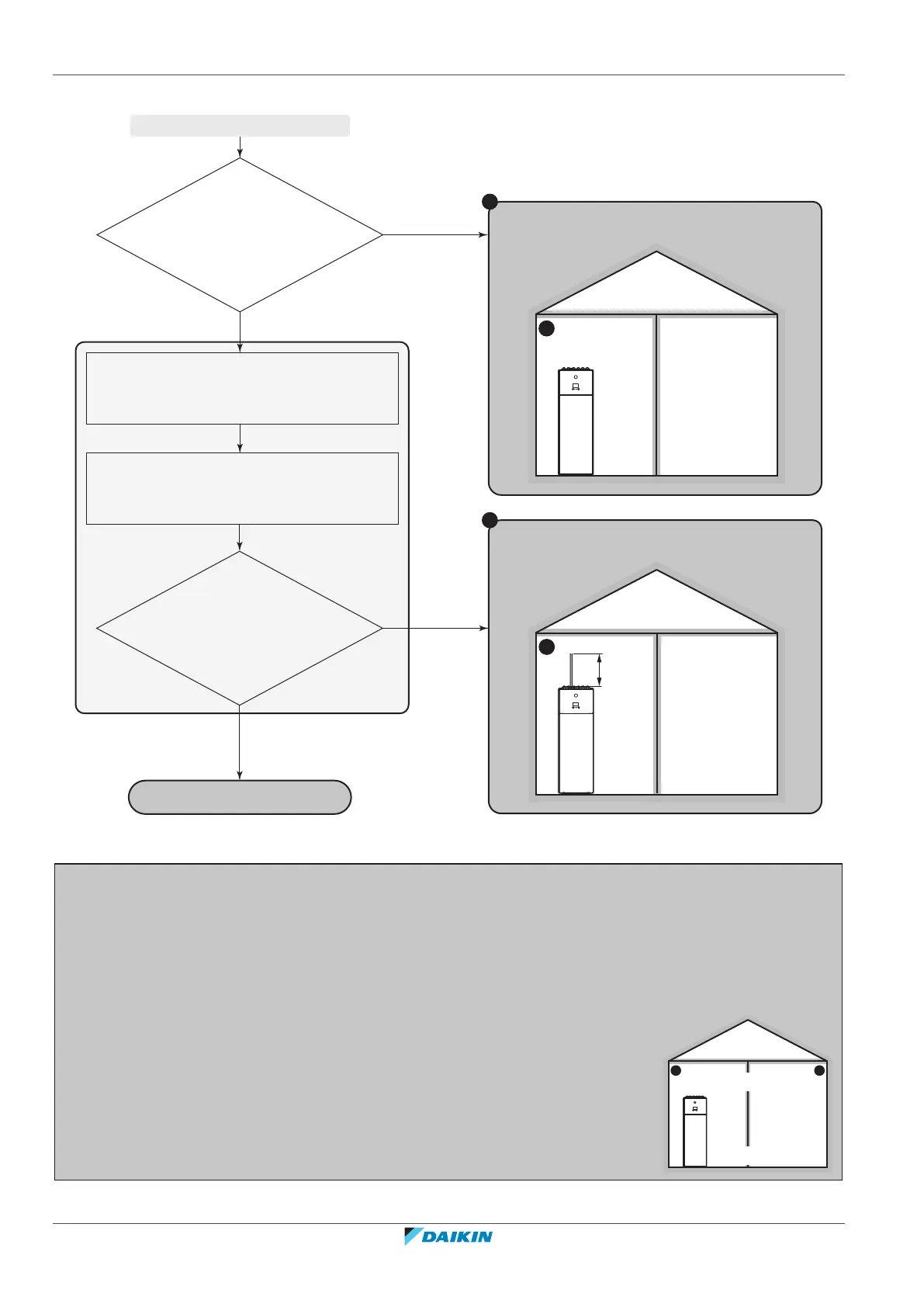
You can install the unit in room A. You do not need a chimney.
See table 2: Look up the minimum release height (H0) for the
given floor area (A
roomA
) and the given refrigerant charge.
No
Calculate ΔH0: difference between the minimum release height
required (H0) and the release height without chimney.
No
Yes
Yes
Go to PATTERN 2
H0, ΔH0
1a
A
You can install the unit in room A if you install a chimney.
Chimney height = ΔH0
1b
ΔH0
A
See table 3:
For ΔH0: Can the maximum
chimney length be respected, and is the
chimney practically feasible?
See table 1:
Is the floor area of room A
(A
roomA
) large enough for the given
refrigerant charge and the given release height
without chimney?
START PATTERN 1
PATTERN 2
A B
A
nv
(≥A
nv-min
)
Min. 50%
of A
nv-min
PATTERN 2: Conditions ventilation openings
If you want to take advantage of the floor area of the adjacent room, you must provide 2 openings (one at the bottom, one at the top) between the rooms to
ensure natural ventilation. The openings must comply with the following conditions:
▪ Bottom opening (A
nv
):
▪ Must be a permanent opening that cannot be closed.
▪ Must be completely located between 0 and 300 mm from the floor.
▪ Must be ≥A
nv-min
(minimum bottom opening area).
▪ ≥50% of the required opening area A
nv-min
must be ≤200 mm from the floor.
▪ The bottom of the opening must be ≤100 mm from the floor.
▪ If the opening starts from the floor, the height of the opening must be ≥20 mm.
▪ Top opening:
▪ Must be a permanent opening that cannot be closed.
▪ Must be ≥50% of A
nv-min
(minimum bottom opening area).
▪ Must be ≥1.5 m from the floor.



 To Next Page