The Danfoss KPP Pulse Pickup (PPU) is a speed sensor designed for rugged outdoor, mobile, or heavy industrial applications where contact with a rotating shaft is not possible. It is custom-designed for use with Sauer-Danfoss pumps and motors.
Function Description:
The KPP PPU operates by accepting a supply voltage and, in response to the speed of a permanently magnetized speed ring on a motor's cylinder block or shaft, outputs a digital pulse signal. The sensor's output changes its high/low state as the north and south poles of the speed ring pass its face. This digital output makes the KPP ideal for low-speed measurements, including zero speed.
Direction-sensing PPUs (KPPA13X models) utilize two Hall sensors mounted side-by-side. With proper orientation, the pulse train output from one sensor leads the other by 90°. A logic circuit decodes these two signals to provide a direction indication at the speed output (high or low, depending on direction). For quadrature directional signals, the logic is bypassed, and the direction signal is phase-shifted by a nominal 90° from signal A. Non-directional PPUs (KPPX12X models) output a high voltage when a north segment is above the Hall switch and a low voltage when a south segment is above it, creating a digital (on-off-on-off) pulse train that a controller interprets as speed. The KPPXN8Nnn models divide the standard signal output by two.
Important Technical Specifications:
Electrical Data:
- Supply Voltage (two ranges):
- Regulated 4.5 to 8.5 Vdc
- Battery 7 to 32 Vdc
- Maximum Operating Current: 20 mA at 1 Hz and 5 Vdc supply.
- Required Current: 12 mA at 5 Vdc (no load).
- Output Voltage (high state): Supply voltage minus 0.5 Vdc minimum (no load).
- Output Voltage (low state): 0.5 Vdc, maximum (no load).
- Maximum Frequency: 15 kHz.
- Load: 15 kΩ to both ground and supply.
- Peak Transient Voltage:
- 80 Vdc for 2 milliseconds (4.5 to 8.5 Vdc models).
- 300 Vdc for 2 milliseconds (7 to 32 Vdc models).
- 200 Vdc for 100 milliseconds (7 to 32 Vdc models).
- Peak Reverse Voltage:
- -15 Vdc continuous (4.5 to 8.5 Vdc models).
- -32 Vdc continuous (7 to 32 Vdc models).
Environmental Data:
- Operating and Storage Temperature: -40° to 110° C [-40° to 230° F].
Mechanical Configuration (Housing):
- Flat end (typical for Sauer-Danfoss Series 90 pump and motor, M46 pump and motor, Series 42 pump).
- Conical end (typical for Sauer-Danfoss Series 51 and 51-1 MV cartridge type motor).
- Conical end, fixed position.
- Flat end, fixed position.
Electrical Connectors:
- Amp Mate-n-Lok
- Delphi/Packard Weather-Pack (3 pin and 4 pin)
- Delphi/Packard Metri-Pack (3 pin and 4 pin)
- Integral Turck Eurofast (no leadwires)
- Deutsch DT04 (3 pin and 4 pin)
Usage Features:
- Choice of Directional or Non-directional Devices: Users can select KPP models based on whether they need to sense speed only or both speed and direction.
- Connector Options: Available with Delphi/Packard Weather-Pack®, Turck Eurofast®, or Deutsch® connectors for flexible integration.
- Rugged Housing: Designed to withstand extreme environments, making it suitable for demanding applications.
- Pre-mounted Option: Can be ordered pre-mounted in Sauer-Danfoss pumps and motors for convenience.
- Controller Compatibility: Compatible with both digital and analog controllers.
- Zero Speed Measurement: Capable of measuring zero speed, which is crucial for certain control applications.
- Supply Voltage Considerations:
- Most KPP models cannot be powered directly from a battery due to voltage transients (spikes above 15 Vdc) that can cause permanent damage in 12 or 24 Vdc systems. A separate voltage regulator is typically required.
- Microcontroller applications can use their 5 Vdc regulated power supply for 4.5 to 8.5 Vdc rated KPPs, or a regulated 15 Vdc maximum.
- For speed-only sensing directly from a battery, a 7 to 32 Vdc rated KPP model should be specified. Directional sensing requires a regulated supply voltage.
- 4-wire KPP Usage: When a 4-wire KPP is used for speed sensing only, connect to pins A, B, C, and fill the unused cavity (D) with a cavity plug (available in the 4-pin mating electrical connector kit, Sauer-Danfoss part number K03379).
- Speed Rings: Speed rings vary by cylinder block diameter and can be ordered from the pump manufacturer or a Sauer-Danfoss Global Service Partner. Specialized tooling may be required for retrofitting.
Maintenance Features:
- Installation Procedures: Detailed procedures are provided for both flat end and conical end models, including specific steps for non-directional and directional KPPs.
- Procedure A (Non-directional flat end): Turn in (CW) by hand until it gently touches the speed ring, then back out (CCW) 1/2 to 3/4 turn. Torque the lock nut to 13 N•m [10 lbf·ft] using a 1/2 inch wrench and an 11/16 inch hex wrench.
- Procedure B (Directional flat end): Turn in (CW) by hand until it gently touches the speed ring, then back out (CCW) 1/4 turn. Continue backing out until the flats are 22° either side of the pump or motor shaft centerline (20° to 30° acceptable). Do not back out more than 3/4 of a turn. Torque the lock nut to 13 N•m [10 lbf·ft]. Special KPP FLAT END models have application-specific installation ranges.
- Procedure C (Non-directional and Directional conical end): Turn in (CW) by hand until it gently touches the speed ring, then back out (CCW) 2 turns. Continue backing out until the KPP orientation notch is 180±15° to the motor shaft centerline. Torque the lock nut to 13 N•m [10 lbf·ft]. Special KPP CONE END models have application-specific installation ranges, backing out 1 turn until the orientation notch is 180° to the motor shaft centerline.
- Procedure D (Directional flat end for speed sensing only): Follow Procedure A.
- Procedure E (Fixed position conical and flat end): Insert PPU housing, align the hole in the mounting flange with the block housing. Torque M6x12 capscrew to 8 ± 1 N•m [5.9 ± 0.7 lbf·ft].
- System Wiring Guidelines:
- Protect wires from mechanical abuse using flexible metal or plastic conduits.
- Separate high-current wires (solenoids, lights, alternators, fuel pumps) from control wires.
- Run wires along or close to metal machine frame surfaces to minimize EMI/RFI radiation.
- Avoid sharp metal corners; use grommets when rounding corners.
- Avoid hot machine members or engine exhaust pipes.
- Provide strain relief for all wires.
- Avoid moving or vibrating components.
- Avoid long, unsupported wire spans.
- Use harness anchors that allow wires to float rather than rigid anchors.
- Troubleshooting Steps (requires a 1/2 inch open-end wrench with standard 22° offset and a Volt Ohm Meter (VOM)):
- Installation Check: Verify correct KPP installation according to the specific procedures.
- Speed Signal Check: Use a VOM across the ground and speed pins/terminals (DC Volt scale, low range). Slowly turn the pump or motor by hand or check output as the prime mover stops. Note for a voltage pulse (approximately 60 pulses per revolution). If no pulse is indicated, replace the KPP.
- Directional Signal Check: Use the same VOM setup as for the speed signal check. Slowly turn the motor and note a polarity change (±) on the VOM display as the motor direction changes.
Improvements Over Time:
Danfoss has continuously improved the KPP PPU to reduce environmental effects of moisture and corrosive liquids:
- D Revision (June 1996): Eliminated potting compound around lead wires; sealing now uses an O-ring. Internal cavity filled with silicone oil. Wires pass through a molded rubber piece compressed between two plates.
- E Revision (September 1996): Silicone oil replaced with a firm compound. External housing changed to a zinc chromate finish.
- F Revision (June 1999): Internal wire to circuit board joint modified. New seal and improved circuit board assembly.
- G Revision (February 2002): Housing machined from a solid block of aluminum-silicone-bronze.

 Need help?
 General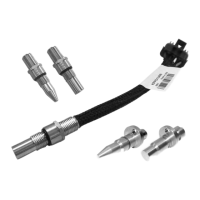

 To Next Page