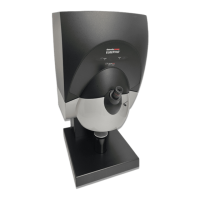
The Datacolor 200 is a state-of-the-art benchtop color measuring instrument designed for use in both laboratory and retail settings. It incorporates advanced CMOS integrated circuit technology for precise color measurement, specification, and evaluation.
Function Description
The primary function of the Datacolor 200 is to measure the reflectance of an object, providing accurate color data. It utilizes a dual-beam integrating sphere with a xenon flash lamp for illumination and an 8° viewing geometry, conforming to CIE publication No. 15.2 Colorimetry. The instrument can operate with specular component included (SCI) or excluded (SCE) measurements. Its proprietary SP2000 Spectral Analyzer features a dual-channel holographic grating and 256-photodiode linear arrays for both reference and sample channels, ensuring high-resolution spectral analysis.
Important Technical Specifications
- Instrument Type: Dual beam integrating sphere with xenon flash lamp.
- Measuring Geometry: Diffuse illumination, 8º viewing in conformance with CIE publication No. 15.2 Colorimetry.
- Illumination Source: Pulsed xenon, filtered to approximate D65.
- Spectral Analyzer: Proprietary SP 2000 analyzer with dual 256-diode array and high-resolution holographic grating.
- Wavelength Range: 400-700nm.
- Reporting Interval: 10nm.
- Wavelength Resolution: 2nm.
- Photometric Range: 0 to 200%.
- Photometric Resolution: 0.003%.
- Aperture Configuration:
- Large Area View: Illuminated 22mm, Viewed 18mm.
- Small Area View: Illuminated 9mm, Viewed 5mm.
- Ultra-Small Area View: Illuminated 6.5mm, Viewed 2.5mm.
- Power: 100-240 VAC, 50 to 60 Hz, 1 A.
- Performance – Repeatability*: 0.05 CIELAB Max on white ceramic.
- Performance – Reproducibility*: 0.2 CIELAB ΔE average of 12 BCRA tiles.
- Absolute Operating Environment: 5º to 40° C, 20-85% RH, non-condensing, Altitude up to 2,000 meters.
- Interface: USB v2.0 or (Optional) RS232 9600/19200 baud.
- Warranty: One Year.
- Dimensions with Drawer:
- Height: 8.5 inches (21.59 cm).
- Width: 6.7 inches (17.01 cm).
- Depth: 11.1 inches (28.23 cm).
- Weight: 12 lbs. (5.44 kg).
* Specification based on following environmental conditions: 20°C; 50% RH; 2 sigma.
Usage Features
The Datacolor 200 is designed for ease of use with its intuitive controls and indicators.
- Status Panel: The instrument features a status panel that displays current settings and calibration status. A red indicator signifies that calibration has elapsed, requiring recalibration for accurate measurements. A green indicator means the instrument is calibrated. An amber service indicator suggests an annual service check is recommended, while green indicates proper performance.
- Powering Up: The instrument requires a power cable and a USB instrument cable for connection to a computer. Users must ensure all cable connections are secure, plug the AC power cord into an outlet, and turn on the power switch located on the back of the instrument. The instrument performs an automatic reset upon power application. It is crucial to turn on the instrument before launching any Datacolor program to avoid error messages.
- Calibration Tiles: The Datacolor 200 comes with a black trap, white tile, and green tile, stored in a drawer at the base of the instrument. These tiles are essential for calibration. The black trap and white tile are used for routine calibration, while the green tile is used for a diagnostic test during calibration.
- Aperture Plates: The Datacolor 200 is a single-aperture instrument, but various aperture sizes are available to suit different applications. Users should consult a Datacolor representative to determine the correct aperture size for their specific needs.
- Instrument Calibration: Regular calibration is vital for accurate measurements. The instrument's calibration data is pre-stored and automatically detected by Datacolor software during the first calibration. A backup copy is provided on a memory stick. The calibration process involves measuring the black trap, white tile, and green tile as prompted by the software (e.g., Datacolor PAINT, Datacolor TOOLS). When the calibration status is red, the instrument will not operate until calibrated.
- Sample Presentation and Measurement: Proper sample positioning is critical for accurate measurements. The sample should rest between the sample holder and the front panel door, completely covering the aperture opening. To position a sample, grasp the sample holder, pull it forward, place the sample at the port, and return the holder to the upright position. Users must avoid allowing the sample arm to spring back.
- Sample Viewing Port: For small samples, a viewing port allows users to verify that the correct area of the sample is being measured. By pulling down a tab above the aperture plate, users can inspect the area covered by the sample on the backside of the door and adjust placement as needed to ensure the sample completely covers the port opening.
Maintenance Features
Maintaining the Datacolor 200 and its calibration tiles is crucial for ensuring consistent performance and accuracy over its lifespan.
- Sphere Cleaning: The integrating sphere should be visually inspected frequently for dust, sample particles, fibers, or excessive yellowing, especially when measuring loose materials. If loose materials are found, Datacolor Service should be contacted for instructions on removal, as there are no user-serviceable parts for this equipment.
- Tile Handling: Calibration tiles must be handled with extreme care to prevent dropping or scratching their glazed surfaces. Always grasp tiles by their edges.
- Tile Cleaning: Calibration tiles should be cleaned before each use with a soft, lint-free cloth. For oils, fingerprints, or other deposits, a detergent solution (1 part detergent, 250 parts water) free of optical brighteners, fluorescent materials, or photoactive dyes can be used. Apply a few drops to a lint-free cloth, gently wipe the tile surface, and then rinse with a clean, moistened cloth. Abrasive cleansers, razor blades, or metal objects should never be used, nor should tiles be immersed in water, as this can damage the surface. Tiles with scratches, chips, abrasions, or cracks must be replaced as they will affect calibration accuracy.
- Tile Storage: To maintain accuracy, calibration tiles should be stored in an environment that simulates the temperature of the samples to be measured, as large temperature variations can affect calibration. Prolonged exposure to sunlight or other UV radiation sources can cause color changes in the tiles, so they should always be stored in a protective case or container away from direct sunlight and environmental contaminants.
- Black Trap Cleaning: The black trap should be kept dust-free. Dust accumulation can be removed by blowing it out with compressed air, ensuring the compressed air is free of moisture.

 Need help?
 General

 To Next Page