PSX-AR Manual Rev: P Software Rev: N
14
g. When a train enters the block and covers the photocell, track power will turn off and
the LED will change from flashing to steady indicating a train is now in the block.
h. Further, the PSX-AR has stored the last photocell calibration values, so you can shut
down the layout with a train in the staging, and the PSX-AR will remember to show
block occupied the next time you power on.
i. As in the basic photocell control, send an accessory ON command to the first PSX-
AR accessory address and the block power will turn on. The occupied LED will remain
on until the end of the train clears the photocell while the train is leaving the block.
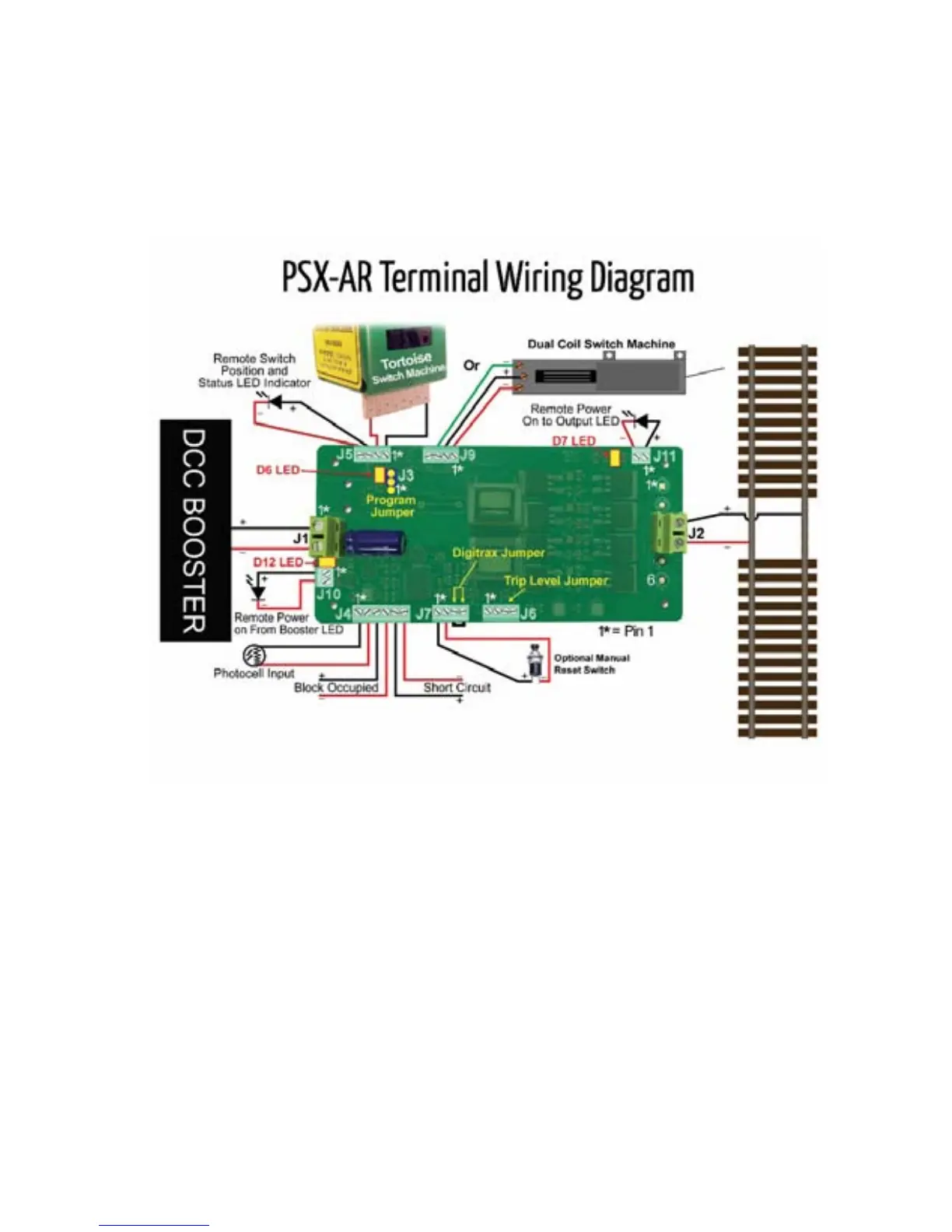
4. The third PSX-AR accessory address [Default address 2044, 999 for Digitrax] is used to
control the switch connected to either J5 (Tortoise) or J9 (snap coil). Sending an
accessory command to this address will operate the switch points. It is important to get
the switch position and the PSX-AR output phase correctly synchronized, otherwise the
PSX-AR will throw the points under your train as it enters the reverse loop. Send an
accessory Clear command to the PSX-AR. If the points move to the Throw position, then
reverse either J5-1 and J5-2 (for Tortoise) or J9-1 and J9-3 (snap coil). With the points in
the Clear position, enter the reverse loop through the Clear direction to the closest gap
at the end of the reverse loop. The DCC voltage in the reverse loop and the adjoining
“normal” track should be in phase. If you have a meter, measure the voltage across the
insulating gap between “normal” and reverse loop sections on the SAME rail. If you read
close to zero volts, the two sections are in phase. If you do not have a meter, you can
use a 14 volt grain-of-wheat engine headlight bulb or similar incandescent lamp. Again,
connect it across the gap on the SAME rail. If the lamp remains off, the two sections are
in phase. If you read a voltage roughly equal to the DCC track voltage or if the lamp
illuminates, then the sections are out of phase. In this case, exchange the J2-3 and J2-4
output wires. You should now have the two sections in phase and are set to run a train
through the reverse loop.


 To Next Page