PSX-AR Manual Rev: P Software Rev: N
7
Another thing you want to keep in mind while designing power districts is how each district is
used. In a yard area, for example, there is a higher risk of derailments occurring with their
associated shorts. You might want to isolate this area into a separate district so that a short
in the yard will not stop mainline operations.
D. PSX-AR Wiring
Wire to the PSX-AR should be heavy enough to carry the current efficiently. The size of
wire depends on your scale. Too much resistance in the wire or rails can result in faulty
short sensing, voltage drop and poor performance. At a minimum, we recommend the
following stranded gauge wires to prevent potential problems:
• N Scale 18 AWG bus, 22 AWG rail feeders
• HO Scale 14 AWG bus, 20 AWG rail feeders
• O Scale 12 AWG bus, 16 AWG rail feeders
We recommend using stranded pair wire such as speaker or lamp cord wire for bus wiring.
If you’re using two individual stranded wires, make sure to twist the wire 4 to 6 times every
foot. You can make your own twisted pair wire by placing two ends of the wire in a drill bit,
chuck the drill tight, and then turn on while you or something else holds the other end.
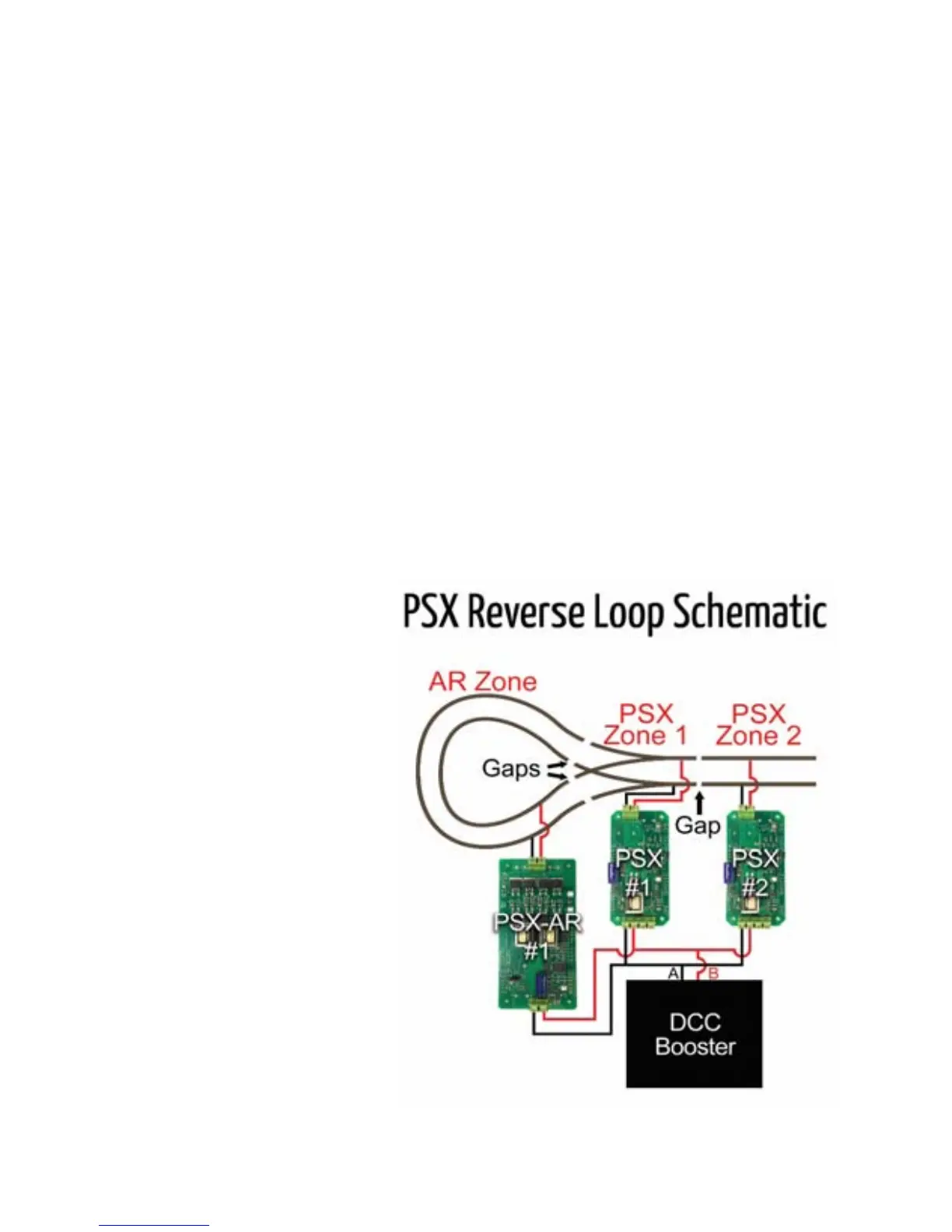
E. PSX-AR Reverse Section Examples
Reverse Section Notes
1) Make sure isolating rail gaps
are offset by 0.75” [21mm] and
the AR Zone is longer than
your longest train
2) If your train is longer than your
reverse block and has metal
wheels:
a) You may need to cut
additional gaps in the
REVERSE SECTION.
b) Simply cut another set of
gaps at BOTH ENDS of
the reverse sections inside
of the original gaps.
c) The distance between new
gaps and original gaps
should be longer than the
wheelbase of any metal
truck.


 To Next Page