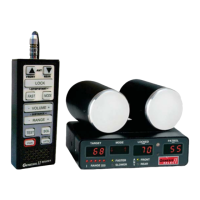
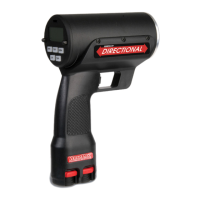
GHD
™
& Scout
™
User’s Manual
GHD
™
& Scout
™
User’s Manual
28
25/Aug/2010
7.2.5 Multi-Beam Cancellation
The GHD and the SCOUT are immune from multi-path cancellation.
7.2.6 Radio Frequency Interference (RFI)
The GHD and SCOUT radars contain an RFI detection circuit that
detects excess radio frequency energy. When stray radio frequency
energy reaches an excessive level, the system displays an RFI
message and stops processing and displaying speeds. The system
resumes normal operation when the RFI condition no longer exists.
At that time, any locked speeds will display again.
7.2.7 Scanning
The GHD and SCOUT are designed to be used while attached
to a solid mount or hand-held in a steady position. Moving or
“scanning” the antenna past stationary objects can cause the
system to detect motion. Obtaining a speed reading from scanning
will not happen when you properly use the radar.
7.2.8 Vehicle Ignition Interference
The GHD and SCOUT have been designed to operate from the
vehicle’s cigarette lighter receptacle (or from the 6 internal AA
Nickel-Metal-Hydride batteries located in the base of the handle in
the case of the SCOUT). When connected to the cigarette lighter
receptacle it should be noted that some vehicles exhibit excessive
alternator noise at the lighter receptacle. In these rare cases, the
radar can exhibit erratic readings, especially when the vehicle’s
electrical system is operated under heavy load. Wiring an accessory
outlet directly to the battery minimizes the eect. If you are
operating o of the gun’s internal batteries then vehicle ignition
interference will not be a factor.
If you suspect your vehicle’s electrical system, contact Decatur
Electronics’ Customer Service Department for more information.
8. Testing the Device
8.1 O perator-Requested Self Test
Pressing the TEST button initiates a comprehensive system self
test, which checks the numeric displays and runs a target speed
simulation. The self test checks:
DISPLAY TEST: Allows the operator to verify that the digit segments
and status LED lights are working correctly and that none of the
pixels in the number segments are burned out.
CIRCUITRY TEST: The system checks the internal circuitry. If the unit
passes all internal checks, the message PASS will be displayed. If an
error should occur then FAIL will appear in the display window.
SPEED SIMULATION TEST: The radar veries speed accuracy using
synthesized Doppler frequencies corresponding to a series of four
simulated speeds: 25, 50, 75, and 100 km/h.
• Section 8.1 must be completed by the ocer prior to
enforcement and at the conclusion of the ocer's tour
of duty (if any enforcement action was taken).
8.2 Mini-Test
The tSt option is set to automatically perform a “mini” self test every
10 minutes.
25/Aug/2010
29



 To Next Page