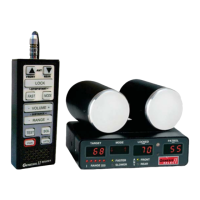
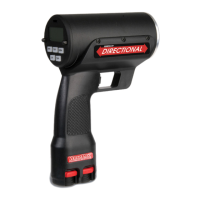
The Decatur Electronics SI-3™ System Interface 3 is a highly advanced directional radar unit designed for measuring and exporting speed data. It offers dependable service and incorporates high performance and long-range capabilities. The SI-3™ is suitable for a wide range of applications, including Radar Speed Trailers, traffic speed data collection, and other uses where speed monitoring is desired.
Function Description:
The SI-3™ operates by transmitting a beam of microwave energy (radio waves) at an approaching or departing target. When this beam strikes a target, a small amount of the beam is reflected back to the antenna. The reflected signal frequency shifts by an amount proportional to the speed of the target. The radar device then determines the target speed from the difference in frequency between the reflected and transmitted signal.
The device can be configured to display speeds in MPH, KPH, MPS, or FPS. It supports various target reporting options (All, Approach, Recede) and target selection (Fast, Strong). The SI-3™ also features adjustable cosine horizontal and vertical angles, hold time, update rate, and sensitivity settings. It supports different serial protocols for data transmission and includes start/stop output buttons and a radar on/off button for operational control.
Important Technical Specifications:
- Power: Operates off of conventional +12 VDC (+10.8 to +16.5 VDC) from the serial cable.
- Antenna Parameters (K-Band):
- Nominal transmission frequency: 24.150 GHz
- Nominal horizontal beamwidth: 12°
- Polarization: Linear (Vertical)
- RF Power (peak): 120.4 dBuV/m @ 3m
- Antenna Gain: Integral w/ 14 dBi max.
- Environment:
- Ambient operating temperatures: -22°F to +158°F (-30°C to +70°C)
- Maximum humidity: 100% relative humidity (Unit is weather proof, not water proof)
- Speed Range Parameters:
- Speed Display Ranges (mph option): Minimum 5, Maximum 150
- Speed Display Ranges (km/h option): Minimum 8, Maximum 241
- Power Consumption: +10.8VDC to +24VDC
- Baud Rate: Configurable to 1200, 2400, 4800, 9600 (default), 19200, 38400, 57600, or 115200 bits per second. The SI-3™ always uses 8 bits, no parity, and one stop bit for its serial port configuration.
- Serial Protocol: Supports various protocols, including a custom protocol for data transmission.
- FCC Compliance: The SI-3™ is FCC Part 15 compliant.
Usage Features:
- Configuration: The SI-3™ is configured using a dedicated "SI-3™ Config" program on a PC, connected via a programming cable (S769-127-0) and a 12V power supply. The configuration program allows users to set various parameters such as baud rate, measurement units, target report type, speed lock, hold time, update rate, sensitivity, and serial protocol.
- Serial Communication: The device connects to a computer's serial port (or a USB-to-Serial adapter) for configuration and data output.
- Mounting: Utilizes a single mounting point designed for quick, easy installation, typically with a ¼ x 20 bolt.
- Target Reporting: Can report all targets, approaching targets, or receding targets.
- Speed Lock: Can be configured to use a hold time or continuous update for speed display.
- Sensitivity: Adjustable from 0 to 9, allowing users to optimize the radar's range for different applications. Higher sensitivity increases range but may require careful adjustment to avoid spurious readings.
- Cosine Effect Compensation: Features adjustable cosine horizontal and vertical angles to compensate for the angle between the antenna and the target, ensuring more accurate speed readings.
- Radar Monitor Program: An optional Radar Monitor program is available to display speed information on a computer and record data to a text file for analysis.
Maintenance Features:
- Self-Test/Tuning Fork Test: The SI-3™ can be tested for signal processing accuracy using a tuning fork (S900-34). This test should be performed within a one-minute window after the unit is powered on. The tuning fork is tapped on a non-metallic surface and then placed about 3 inches in front of the antenna. The displayed speed should match the speed stamped on the fork within ±1 unit.
- Care and Cleaning: Avoid spilling food, beverages, or other liquids on the radar. Clean the radar device with a soft, clean cloth and cleaning solutions free of harsh chemicals.
- Storage: Store the device in its original packaging when not in use or during transport.
- Troubleshooting: The manual provides guidance on checking connections and communication status using the "Connect" and "OK" buttons in the configuration program. For issues like poor range or incorrect speed display, users are advised to verify antenna obstructions, increase sensitivity, or contact Decatur Electronics Customer Service.
- Warranty: The SI-3™ comes with a one-year radar warranty covering defects in workmanship and materials. Opening the unit automatically voids any warranty. Damage from excessive moisture, dropping, abuse, or unauthorized service is not covered.
- Service Return Procedure: If service is required, customers should contact Decatur Electronics Customer Service to obtain a problem diagnosis and an RMA number. Shipping costs for warranty repairs are typically covered by the customer for the initial shipment.
- Factory Defaults: The device can be reset to factory default settings using the configuration program. This will reset all configurable items and save them to flash memory.
The manual details several potential sources of interference that can affect radar performance:
- Angular Interference (Cosine Effect): Occurs when the angle between the antenna and the target increases, causing the displayed speed to decrease. Ideal operation is at 0 degrees.
- Fan Interference: Blower fan motors can cause spurious speed readings.
- Electromagnetic Interference (EMI): Operating electric motors (e.g., power seats, windshield wipers) can produce EMI, leading to spurious target speeds.
- Feedback Interference: Radar beam directed at computer screens, streetlights, or other electronic devices can display spurious speeds.
- Multi-Path Beam Cancellation: Occurs when the radar loses track of a target because the target reflects two or more signals, interfering with each other. The SI-3™ is designed to be immune to this.
- Radio Frequency Interference (RFI): Inadvertently processes radio energy from 2-way radios, airport radar, microwave transmission towers, CB radio transmitters, and AM/FM transmission towers.
- Scanning: Moving or "scanning" the antenna past stationary objects can cause the system to detect motion.
- Environmental Factors: Wind, rain, and snow can reduce the range (distance) at which a target can be detected, but generally do not affect accuracy.
Understanding and mitigating these interference sources is crucial for optimizing the SI-3™'s performance.

 Need help?
 General

 To Next Page