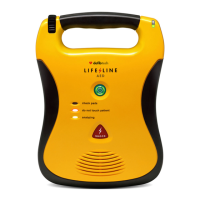
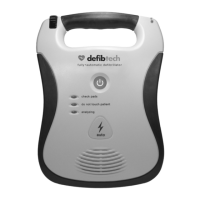
1
DAC-510E-EN-BF
1 Introduction to the DDU-100 Series AED
This User Manual provides information to guide trained operators in the use and maintenance of the
Defibtech DDU-100 series Semi-Automatic External Defibrillator (“AED”) and its accessories. This
chapter includes an overview of the AED, a discussion of when it should and should not be used, and
information on required operator training.
1.1 Overview
The DDU-100 AED is a Semi-Automatic External Defibrillator (“AED”) that is designed to be easy to
use, portable and battery powered. It has only two user controls: the ON/OFF and SHOCK buttons.
Voice prompts and visual indicators provide a simple interface for the operator. The DDU-100 AED is
capable of recording event information including ECG, audio data (optional), and SHOCK/NO-SHOCK
recommendations.
When connected to a patient who is unconscious and not breathing, the DDU-100 AED performs the
following tasks:
• Promptstheoperatortotakenecessaryactionstoenableanalysis.
• Automaticallyanalyzesthepatient’sECG.
• Determineswhetherashockablerhythmispresent.
• ChargesthedebrillationcapacitorandarmstheSHOCKbuttoniftheAED
detects a shockable rhythm.
• PromptstheoperatortopresstheSHOCKbuttonwhenthedeviceisreadyandashockis
recommended.
• DeliversashockoncethedevicehasdeterminedashockisrequiredandtheSHOCKbuttonhas
been pressed.
• Repeatstheprocessifadditionalshocksarerequired.
The Defibtech DDU-100 AED will NOT shock a patient automatically; it will only advise the operator.
The SHOCK button is enabled only when a shockable rhythm is detected and the device is charged
and ready to shock. Charging occurs automatically when the device detects a shockable rhythm. The
operator must press the SHOCK button to initiate defibrillation.
The DDU-100 AED uses two self-adhesive defibrillation/monitoring pads to monitor ECG signals and,
if necessary, to deliver defibrillation energy to the patient. These pads (also known as electrodes) are
provided in a single-use, disposable package.
The DDU-100 AED determines proper pad-to-patient contact by monitoring the impedance between
thetwopads(impedancevarieswiththeelectricalresistanceofthepatient’sbody).Visualandaudio
prompts inform the operator of possible problems with patient contact. Voice prompts and visual


 To Next Page