EasyManua.ls Logo

Delta 2000 Series - Electrical Connections; Changing Speeds

Delta 2000 Series
8 pages
Print Icon
To Next Page IconTo Next Page
To Previous Page IconTo Previous Page
Loading...
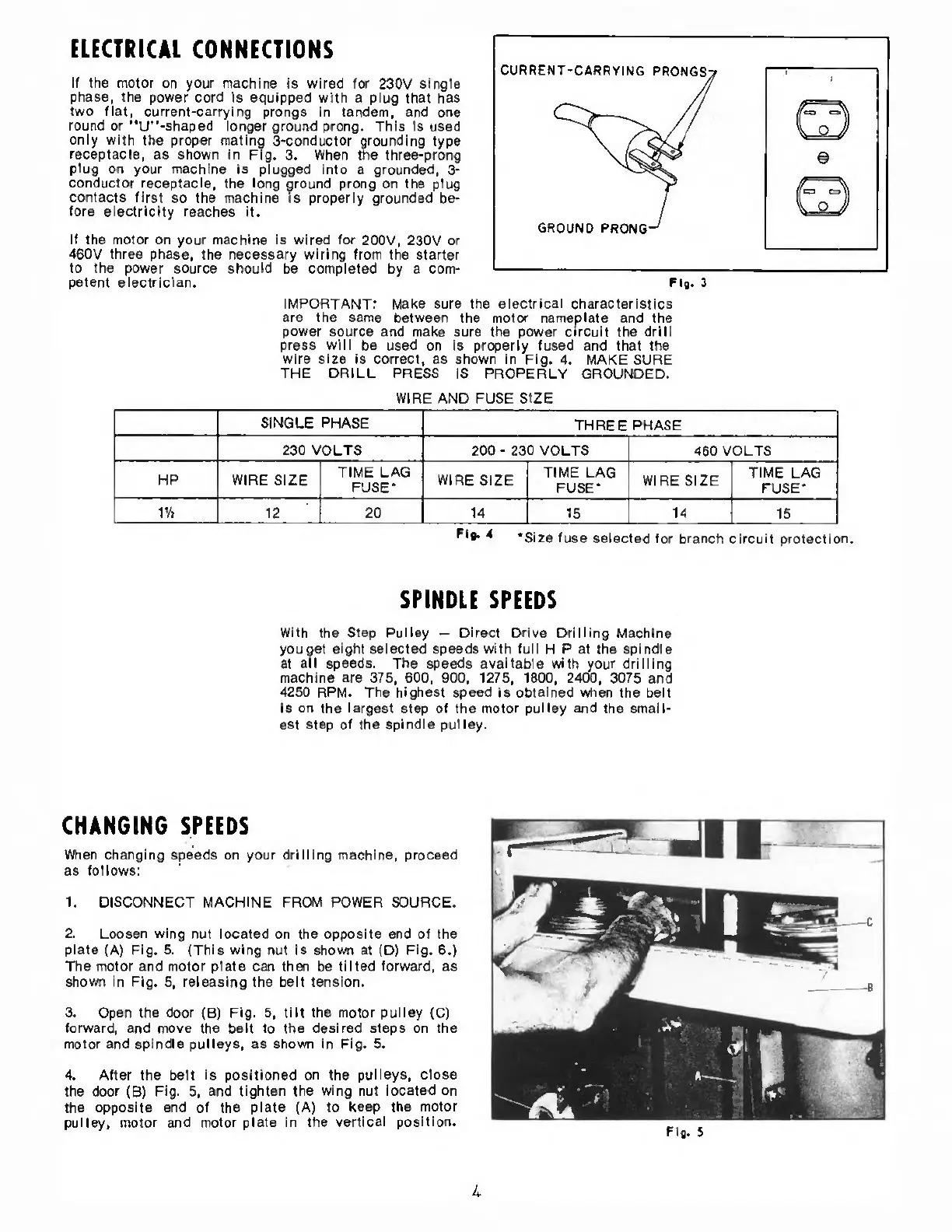
ELECTRICAL
CONNECTIONS
If
the
motor
on
your
machine
is
wired
for
230V
single
phase,
the
power
cord
is
equipped
with
a
plug
that
has
two
flat,
current-carrying
prongs
in
tandem,
and
one
round
or
"U"-shaped
longer
ground
prong.
This
is
used
only
with
the
proper
mating
3-conductor
grounding
type
receptacle,
as
shown
in
Fig.
3.
When
the
three-prong
plug
on
your
machine
is
plugged
into
a
grounded,
3-
conductor
receptacle,
the
long
ground
prong
on
the
plug
contacts
first
so
the
machine
is
properly
grounded
be¬
fore
electricity
reaches
it.
If
the
motor
on
your
machine
is
wired
for
200V,
230V
or
460V
three
phase,
the
necessary
wiring
from
the
starter
to
the
power
source
should
be
completed
by
a
com¬
petent
electrician.
IMPORTANT:
Make
sure
the
electrical
characteristics
are
the
same
between
the
motor
nameplate
and
the
power
source
and
make
sure
the
power
circuit
the
drill
press
will
be
used
on
is
properly
fused
and
that
the
wire
size
is
correct,
as
shown
in
Fig.
4.
MAKE
SURE
THE
DRILL
PRESS
IS
PROPERLY
GROUNDED.
WIRE
AND
FUSE
SIZE
SINGLE
PHASE
THREE
PHASE
230
VOLTS
200
-
230
VOLTS
460
VOLTS
HP
WIRE
SIZE
TIME
LAG
FUSE*
WIRE
SIZE
TIME
LAG
FUSE*
WIRE
SIZE
TIME
LAG
FUSE*
1%
12
20
14
15
14
15
Fl
®*
4
‘Size
fuse
selected
for
branch
circuit
protection.
Flo.
3
SPINDLE
SPEEDS
With
the
Step
Pulley
-
Direct
Drive
Drilling
Machine
you
get
eight
selected
speeds
with
full
H
P
at
the
spindle
at
all
speeds.
The
speeds
available
with
your
drilling
machine
are
375,
600,
900,
1275,
1800,
2400,
3075
and
4250
RPM.
The
highest
speed
is
obtained
when
the
belt
is
on
the
largest
step
of
the
motor
pulley
and
the
small¬
est
step
of
the
spindle
pulley.
CHANGING
SPEEDS
When
changing
speeds
on
your
drilling
machine,
proceed
as
follows:
1.
DISCONNECT
MACHINE
FROM
POWER
SOURCE.
2.
Loosen
wing
nut
located
on
the
opposite
end
of
the
plate
(A)
Fig.
5.
(This
wing
nut
is
shown
at
(D)
Fig.
6.)
The
motor
and
motor
plate
can
then
be
tilted
forward,
as
shown
in
Fig.
5,
releasing
the
belt
tension.
3.
Open
the
door
(B)
Fig.
5,
tilt
the
motor
pulley
(C)
forward,
and
move
the
belt
to
the
desired
steps
on
the
motor
and
spindle
pulleys,
as
shown
in
Fig.
5.
4.
After
the
belt
is
positioned
on
the
pulleys,
close
the
door
(B)
Fig.
5,
and
tighten
the
wing
nut
located
on
the
opposite
end
of
the
plate
(A)
to
keep
the
motor
pulley,
motor
and
motor
plate
in
the
vertical
position.
-II
Fig.
5
4

Related product manuals