Need help?
Do you have a question about the Delta 22-785 and is the answer not in the manual?
Explains the critical importance and procedure for grounding the machine.
Instructions on how to turn the planer on and off using the controls.
Procedure for securing the machine in the off position to prevent unauthorized use.
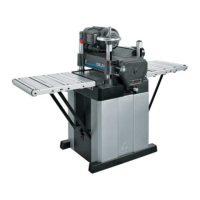
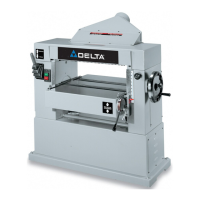
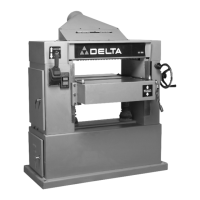
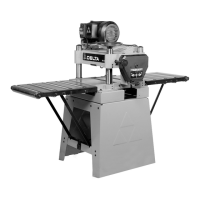
The Delta 15" Planer, available in Models 22-785 and 22-785X, is a woodworking machine designed for planing stock to a desired thickness and achieving smooth finishes. It is intended for use in a workshop environment and requires careful attention to safety guidelines and proper operation.
The planer operates by feeding a workpiece through a cutterhead equipped with sharp knives, which remove material to achieve a uniform thickness. The machine features an adjustable feed rate, allowing users to select between two speeds for optimal planing under various conditions. A slower feed rate generally provides more cuts per inch, resulting in a finer and smoother finish, particularly for wide or hard stock. Conversely, a faster feed rate is suitable for general planing. The feed speed can be adjusted using a shifter knob, which also includes a neutral position to stop the feeding mechanism.
The depth of cut is controlled by raising or lowering the head assembly, which houses the cutterhead and feed rollers. This adjustment is made using a handwheel, and the head assembly can be locked in position to maintain a consistent depth during operation. A limiter is incorporated to prevent excessive depth of cut, especially for wider stock.
Anti-kickback fingers are positioned at the infeed end of the planer. These fingers operate by gravity and are designed to prevent the workpiece from being forcefully ejected back towards the operator during the planing process. They require occasional inspection to ensure they are free of gum and pitch and move independently.
The machine also includes infeed and outfeed rollers, which are crucial for feeding the stock smoothly through the planer. These rollers are under spring tension, which needs to be sufficient to feed the stock without slipping but not so tight as to damage the board. The tension can be adjusted using screws located on both sides of the machine.
Two table rollers are provided to aid in feeding the stock by reducing friction. These rollers can be adjusted for height relative to the table surface. For rough stock, they are typically set slightly higher, while for finish stock, they are set lower or level with the table. Proper adjustment of these eccentric screws is important to prevent the stock from leading to one side.
The planer is equipped with a dust chute to direct wood chips and dust away from the work area, which should be connected to a dust collection system for effective dust removal.
Before operating the planer, users must read and understand all warnings and operating instructions. Safety glasses and hearing protection are mandatory, and proper apparel, free of loose clothing or jewelry, should be worn. The work area must be clean, well-lit, and clear of obstructions. Children and visitors should be kept away from the machine.
The planer is started by pushing a "START" button and stopped by pushing a "STOP" button. An important safety feature is the ability to lock the switch in the "OFF" position using a padlock to prevent unauthorized use.
When planing, it is recommended to true up one face of the board on a jointer first to ensure a flat surface. Then, the board can be planed to thickness, alternating sides with thin cuts to maintain flatness and prevent warping. For long stock, table extensions should be used to provide adequate support. Engaging the cutterhead lock before planing, planing with the grain, and keeping the planer table clean are also recommended practices for best results. To ensure even wear of the knives, it is advisable to feed wood through different spots on the table whenever possible.
The machine requires a 240-volt, 60 Hz alternating current electrical supply and must be properly grounded to protect the operator from electric shock. A 3-wire extension cord with a 3-prong grounding type plug and matching receptacle should be used, and the cord gauge must be appropriate for the length and current draw to prevent power loss and overheating.
Regular maintenance is essential for the planer's optimal performance and longevity. This includes keeping the machine clean by periodically blowing out air passages with dry compressed air and cleaning plastic parts with a soft damp cloth. Solvents should not be used on plastic parts.
The knives, being very sharp, require careful handling during inspection, adjustment, or replacement. The knife setting gauge is used to ensure proper knife height and parallelism with the cutterhead. The locking screws must be securely tightened after any knife adjustment or replacement.
The height of the chipbreaker, infeed roller, and outfeed roller must be checked and adjusted periodically to ensure they are parallel to the knives and set at the correct distance from the cutting circle. This adjustment involves using a homemade gauge block and a feeler gauge.
Belt tension for the cutterhead drive system needs to be checked and adjusted as required. This involves removing a guard cover, placing a spacer between the motor plate and head casting, loosening screws, and prying the motor plate until the correct belt tension is achieved.
Lubrication is a critical maintenance task. The gear box oil should be changed annually using extreme pressure gear oil. The four raising screws should be lubricated with common grease as needed. Chains and sprockets should be cleaned and lubricated with light machine oil periodically.
To protect cast iron tables from rust, a cleaning and protection regimen involving WD-40, degreaser, and TopCote® Aerosol is recommended.
In case of a failure to start, users should check the cord plug connection and inspect for blown fuses or open circuit breakers. For parts, service, warranty, or other assistance, users can contact Delta Machinery's customer service or visit their website for a list of service centers.
 General
| Model | 22-785 |
|---|---|
| Type | Planer |
| Motor Power | 15 Amp |
| Planing Width | 13 inches |
| Planing Thickness | 6 inches |
| No Load Speed | 10, 000 RPM |
| Feed Rate | 26 feet per minute |
| Maximum Cutting Depth | 1/8 inch |
| Cutterhead Speed | 10, 000 RPM |
| Number of Knives | 2 |
| Voltage | 120V |
| Blade Type | HSS |
| Blade Length | 13 inches |
| Dust Port Size | 4 in |

 To Next Page