Need help?
Do you have a question about the Delta DC-580 20" PLANER 22-450 and is the answer not in the manual?
Details warnings about chemicals and health risks from construction activities.
Understand machine operation, limitations, and hazards for accident prevention.
Always use certified safety glasses and hearing protection compliant with standards.
Avoid loose clothing, jewelry, and secure long hair to prevent entanglement in moving parts.
Operate in well-lit, dry areas; keep work area clean to prevent accidents.
Keep tools sharp and clean for safe and optimal performance; follow maintenance instructions.
Inspect for damaged or misaligned parts before use; repair or replace as needed.
Cluttered areas increase accident risk; maintain an organized workspace.
Ensure unauthorized persons, especially children, are kept away from the shop area.
Ensure switch is OFF before plugging in; move switch to OFF during power failure.
Verify all guards are in place, secured, and functioning correctly.
Remove all tools and wrenches before starting the machine to prevent projectile hazards.
Do not force a machine or attachment for jobs it was not designed for to prevent damage or injury.
Use only accessories recommended by the manufacturer to ensure safety and proper operation.
Use heavy-gauge, good condition extension cords sized correctly for the tool's power draw.
Clamp or vise workpieces for stability; loss of control can cause injury.
Feed stock against cutter rotation direction to prevent kickback.
Avoid forcing the workpiece into the machine to prevent damage or injury.
Avoid overreaching to prevent loss of balance and falling into the machine.
Do not stand on the machine to prevent injury from tipping or accidental contact.
Turn power OFF and wait for complete stop before leaving the machine unattended.
Disconnect from power source before installing/removing accessories or making adjustments.
Secure machines with padlocks or master switches to prevent unauthorized use by children.
Operate alertly, free from fatigue or influence of drugs/alcohol/medication.
Use ventilation, dust collection, and proper respiratory protection when operating.
Do not operate until fully assembled and installed according to instructions.
Seek advice from qualified persons if unfamiliar with machine operation.
Adhere to all wiring codes and recommended electrical connections for safety.
Maintain sharp, clean knives to prevent kickback and ensure efficient operation.
Never turn on machine with objects on the table to prevent flying debris injury.
Never turn on machine with workpiece contacting cutterhead to prevent kickback.
Mount machine securely to prevent sliding, walking, or tipping over.
Ensure knives are securely fastened in the cutterhead before powering on.
Securely lock speed settings before planing to prevent kickback from speed changes.
Maintain proper hand positions and avoid awkward stances to prevent slips.
Keep hands, fingers, and arms away from cutterhead and rollers to prevent severe cuts.
Never reach into the cutterhead area while the machine is running.
Avoid standing in the path of the workpiece to prevent injury from kickback.
Allow cutterhead to reach full speed before feeding workpiece to prevent kickback.
Plane bowed stock with concave side down and with grain to prevent kickback.
Do not feed warped, knotted, or debris-embedded workpieces to prevent kickback.
Do not feed short, thin, or narrow workpieces to prevent hands being drawn in.
Never feed a workpiece into the outfeed end of the machine.
Remove shavings only when the power is OFF to prevent serious injury.
Properly support long or wide workpieces to maintain control and prevent injury.
Never perform layout, assembly, or set-up work while the machine is running.
Turn machine OFF and disconnect from power source before cleaning or maintenance.
Refer to Power Tool Institute, National Safety Council, ANSI, and OSHA for more safety info.
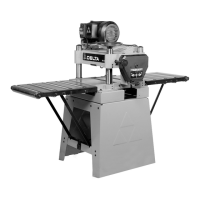
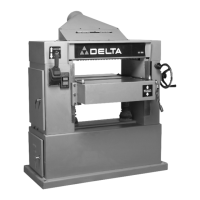
Overview of the Delta Industrial Model 22-450/22-451 20" Planer features.
Overview of the main controls and adjustment mechanisms on the planer.
Instructions on how to safely turn the planer on and off using the power switch.
Procedure for securing the power switch in the OFF position to prevent unauthorized use.
Guide to adjusting the table height using the handwheel and lock knob.
The DC-580 20" Planer, available as Model 22-450 (Three Phase) and Model 22-451 (Single Phase), is a robust woodworking machine designed for surfacing lumber to a uniform thickness and achieving smooth finishes. This industrial planer is equipped with features that enhance both its performance and user convenience.
The primary function of the DC-580 Planer is to remove material from the surface of wood stock, creating a flat and smooth finish with precise thickness. It achieves this through a cutterhead equipped with three sharp knives that rotate at high speed. The machine incorporates a feed roller system that automatically draws the workpiece through the planer, ensuring consistent material removal.
The planer's design includes a sectional serrated infeed roll and a polyurethane outfeed roller. The sectional serrated infeed roll helps to grip and feed the workpiece effectively, even if the stock has slight variations in thickness. The polyurethane outfeed roller, positioned after the cutterhead, continues to feed the stock out of the machine once the planing operation is complete, ensuring a smooth exit and preventing marring of the planed surface. Sectional chipbreakers are also integrated into the design; these rise as stock is fed through, breaking or curling wood chips to facilitate efficient dust collection and prevent tear-out.
A dust hood with a 5" opening is provided for connecting the planer to a dust collector or a central dust collection system, which is crucial for maintaining a clean work environment and protecting the operator from airborne dust. The machine also comes with a knife-setting gauge and wrench, essential tools for accurate and safe knife maintenance.
The planer features a Low Voltage Magnetic Motor Control System and automatic reset overload protection, which are important safety and operational components. The LVC magnetic starter helps prevent accidental restarts after a power interruption, while the overload protection safeguards the motor from damage due to excessive load.
Operating the DC-580 Planer involves several key controls and adjustments that allow for precise and safe woodworking. The power switch, located on the front of the planer, includes "START" and "STOP" buttons for easy control. An important safety feature is the ability to lock the switch in the "OFF" position using a padlock, preventing unauthorized use.
The table height is adjustable via a handwheel and a lock knob. Rotating the handwheel clockwise raises the table, while counterclockwise rotation lowers it. This allows the operator to set the desired thickness of the workpiece. An English/Metric table height scale provides clear indications of the current setting. For optimal results, it is recommended to always make table height adjustments from the bottom to the up position.
The planer offers two feed roller speeds: 20 and 30 feet per minute (FPM). A faster feed rate (30 FPM) is generally used for rough planing operations, while a slower feed rate (20 FPM) provides more cuts per inch of stock, resulting in a finer and smoother finish. The feed rollers are engaged by simultaneously pushing a button and pulling down a handle, and disengaged by moving the handle to the raised position. Changing feed roller speeds involves repositioning the drive belt on different steps of the motor and gearbox pulleys, a process clearly outlined by a feed rate adjustment chart located on the back of a side panel.
Table rollers, which reduce friction between the stock and the table, can also be adjusted. For rough stock, they should be set slightly higher than the table surface, and for finish stock, they should be set lower or level. This adjustment is made by loosening a locking lever and moving a control lever.
Anti-kickback fingers are provided on the infeed end of the planer. These gravity-operated fingers prevent the workpiece from being thrown back towards the operator during planing, significantly enhancing safety.
The machine also includes a pressure bar, located behind the cutterhead, which presses the stock downward onto the table. This bar must be parallel to the knives and tangent to the table, and set slightly below the cutting circle to ensure proper stock hold-down and consistent planing.
Regular maintenance is crucial for the longevity and optimal performance of the DC-580 Planer. This includes checking, resetting, and replacing the cutterhead knives, adjusting drive belt tension, and adjusting feed roller belt tension.
Knife maintenance involves carefully positioning a knife setting gauge on the cutterhead to ensure the knives are correctly aligned and set at the proper height. If adjustments are needed, locking screws are loosened to allow the lifter springs to raise the knife into contact with the gauge, after which the screws are tightened. When replacing knives, extreme care must be taken due to their sharpness; wearing gloves is recommended. The knife slots, locking bars, and screws should be thoroughly cleaned, and any worn or stripped screws replaced.
Drive belt tension should be checked periodically. Proper tension is indicated by approximately 1/4" deflection with light finger pressure midway between pulleys. Adjustment involves loosening and tightening adjustment nuts to move the motor plate up or down. Similarly, feed roller belt tension is checked for approximately 1/2" deflection and adjusted by loosening a jam nut and turning an adjustment hex nut.
The machine's work surfaces, particularly the cast iron table and extension tables, should be lubricated weekly with household floor paste wax to reduce friction and prevent rust. For rust protection, a specific cleaning and polishing procedure using Scotch-Brite™ Blending Hand Pad, WD-40®, degreaser, and TopCote® Aerosol is recommended.
The feed rollers require lubrication every 50 to 100 hours of use, or as needed, by adding a few drops of 10W Machine oil into designated oil cups.
Periodically, all air passages should be blown out with dry compressed air to keep the machine clean. Plastic parts should be cleaned with a soft damp cloth, avoiding solvents that could cause damage.
In the event of unwanted table movement, the table gibs can be checked and adjusted to maintain a precise gap, ensuring stable planing operations. The table height scale pointer can also be adjusted to accurately reflect the true thickness of the planed stock.
For optimal knife wear, it is advised to feed wood through different spots on the table rather than consistently using the same area. This helps to distribute wear evenly across the knives.
 General
| Model | 22-450 |
|---|---|
| Cutting Width | 20 inches |
| Maximum Material Thickness | 6 inches |
| Cutterhead Speed | 5000 RPM |
| Number of Knives | 3 |
| Type | Planer |
| Feed Rate | 20 FPM |
| Motor | Induction |
| Maximum Cutting Depth | 3/32 inches |

 To Next Page