7.1 20 95-8242
NOTE
Be sure that the detector is correctly aimed at the
potential hazard and that no obstructions interfere
with its line of vision. In addition, UV absorbing
gases should not exist between the detector and
the potential hazard.
CHECKOUT PROCEDURE
CAUTION
When testing the system, be sure to secure all
output devices to prevent unwanted activation
of this equipment, and remember to place these
same devices back into service when the checkout
is complete.
MANUAL
o
i
CHECK
1. Place the keylock switch in the TEST position.
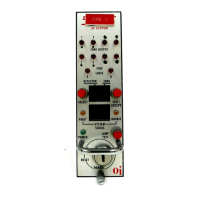
— TheFAULTandINHIBITLEDsturnon
— Upper right display indicates the zone selected.
Upper left display identifies the detector of the
displayed zone.
— Lower display indicates a “1.” (If any other number
appears, refer to the “Troubleshooting” section of
this manual.)
2. Push and hold the TEST/ACCEPT button.
— AZONEOUTPUTLEDashestoindicatethezone
of the detector being tested.
— Upper left display goes blank.
— Lower display changes to “6” to indicate that the fire
threshold has been exceeded due to the radiation
received from the UV source in the detector. (See
Table 1 for System Status Codes.)
3. Release the TEST/ACCEPT button.
— TheZONEOUTPUTLEDremainsonsteady.
— The upper left display again shows the detector
being checked. The lower display changes back
to a “1.”
4. Push the SELECT button. The controller sequences to
the next lower numbered zone.
NOTE
The o
i
test will check the detectors connected to
the No. 2 position of each zone rst. The upper
display will indicate 2-8, 2-7, etc., and then cycle
to 1-8, 1-7, etc., until all (switch selected) detectors
are checked.
5. Repeat the test until all detectors have been
checked.
6. Return the system to the normal operating mode after
the test is complete.
NOTE
The Automatic o
i
system continuously monitors
the operation of the R7404 but does not monitor
external relays or equipment that may be operated
from the re signal output, the alarm signal output,
or the fault signal output. It is important that the
system be manually checked using the NORMAL
mode checkout procedure on a regular basis. The
whole system (including external equipment) should
be checked periodically using a UV Test Lamp to
simulate a re.
DETECTOR COUNT TEST
1. Place the keylock switch in the TEST position.
— The SYSTEM STATUS display shows the number
“1.”
— The upper displays show the detector and zone
that are electrically positioned for test. If the
desired detector and zone are not displayed, press
the SELECT button until the appropriate numerals
appear on the upper display.
2. Press and release the SELECT and TEST/ACCEPT
buttons at exactly the same time.
— SYSTEM STATUS display changes to an “8.”
— Upper display does not change.
3. Press and hold the TEST/ACCEPT button.
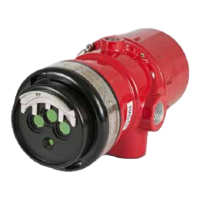
— The UV source tube in the detector under test turns
on.
— The upper displays indicate the discharge rate
ofthe UV sensor under test. Ifthe FIRELOGIC
LEDs turn on, multiply the displayed count by 10.
If the count rate does not fall within the 50 to 300
range, clean the detector viewing window and the
o
i
reflector ring, then test again. If cleaning does
not solve the problem, replace the o
i
reflector ring.
Make sure that the slot is positioned at the bottom
of the detector and away from the source tube.
NOTE
During normal operation, tube modules should be
replaced only if a “2” fault occurs and cannot be
remedied following the above procedure.
4. Release the TEST/ACCEPT button. The upper displays
now indicate the quiescent state of the detector tube.
The count should be between 0 and 5. If higher, place
an obstruction (cardboard or similar material) over the
detector window. If the count rate returns to the 0 to 5
range, the detector has been responding to external




 To Next Page