7.1 5 95-8242
Digital Displays
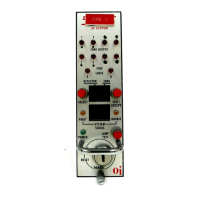
The upper digital display on the R7404 panel identifies
both the detector and zone involved in any “System
Status”occurrence.Forexample,withthekeylockswitch
in the TEST position, and a “1” digit showing on the lower
display, the upper display shows which detector and zone
is electrically positioned for a manual o
i
test.
Voting Logic
The R7404 permits two groups of four zones each to “vote”
separately, or eight zones to “vote” together. This means
that the controller can be programmed to require more
thanonedetectortobeactuatedbeforetheFireLogicA
and/or B outputs are energized. The Det-Tronics “voting”
principle allows combinations of detectors to fulfill voting
requirements, and represents the best balance between
reliability of fire detection and freedom from false actuation
due to individual detector malfunction.
Fault Identication
The automatic fault identification feature of the R7404
operates much the same as on other Det-Tronics
equipment, but has expanded capability. The lower
display on the controller panel identifies the probable
source or type of fault using a numerical code. A summary
of the R7404 system status code is shown in Table 1.
System Reset
The reset function is incorporated in a rotary keylock
switch, which has three positions: (1) NORMAL, (2) RESET
and (3) TEST. The switch sequence is such that a return
to NORMAL from the TEST position can be achieved
only by passing through the RESET mode (Figure 2).
The reset function may also be performed by an optional
external reset switch. Whenever the keylock switch is
placed in the RESET or TEST position, the FAULT and
INHIBITLEDswillturnon,andallZone,FireLogic,and
Alarm outputs will be disabled.
Programming Switches
The circuit board on the left side of the R7404 Controller
contains switches for selection of:
1. Detectors connected to the controller
2. System sensitivity
3. Time delay
4. Firelogicandlatching/non-latchingoptions.
See “Switch Setting Procedure” in the “Installation” section
for a detailed description.
SPECIFICATIONS
SPECTRAL SENSITIVITY RANGE—
The detector is solar blind and responds to UV radiation
over the range of 185 to 245 nanometers (1850 to 2450
angstroms).
SYSTEM SENSITIVITY—
Sensitivity for the standard R7404 Controller is field
adjustable over a range of 8 through 120 counts per
second (cps) in increments of 8 cps (24 cps setting is
factory recommended). The maximum response distance
isachievedatan8cpssensitivitysetting.Forapplications
involving high background radiation potential, the system
can be desensitized by increasing the count rate required
to actuate it. The 120 cps setting results in the minimum
response distance.
INPUT VOLTAGE—
The R7404 can operate from any voltage in the range of
18 to 38 volts dc.
TEMPERATURE RATING—
Operating:
Standarddetector: –40°Fto+167°F(–40°Cto+75°C).
Controller: –40°Fto+158°F(–40°Cto+70°C).
Detectors with higher temperature ratings are available.
Storage:
Detector and controller:
–67°Fto+167°F(–55°Cto+75°C).
HUMIDITY—
0 to 95% RH, non-condensing.
0 — Keylock switch in RESET position, or external
Inhibit/Reset is activated.
1 — Keylock switch in TEST position.
2 — Reduced detector sensitivity (
o
i
fault) or faulty
wiring.
3 — Spurious UV detection or over sensitive detector.
4 — Low +290 vdc
(+290 volt detector supply wire may be shorted).
5 — High +290 vdc
(voltage regulation failure in the 290 volt supply).
6 — Fire.
7 — Not used.
8 — Controller in count test mode.
Table 1—System Status Codes




 To Next Page