20- ENG
D26805
Belt – Replacement and Adjustment
Serious injury or damage may occur if parts of the body or
loose items get caught in moving parts. Never operate the
unit with the belt guard removed. the belt guard should be removed only
when the air compressor is turned off the spark plug wire is disconnected.
Belt Guard – Removal
1. Disconnect the spark plug wire on the engine and release all air tank
pressure.
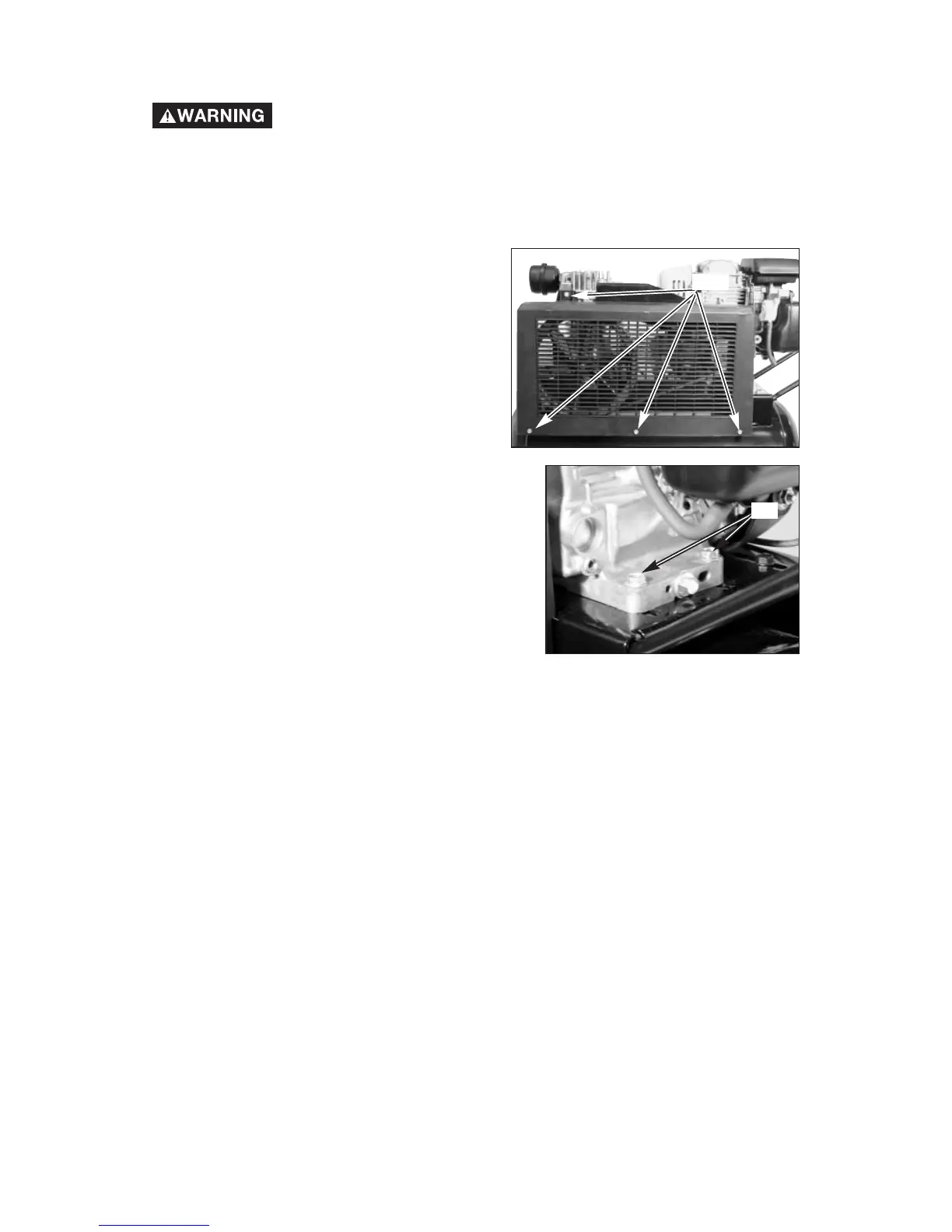
2. (Refer to figure) Remove the four screws
(A) from the belt guard. The belt guard
can now be removed.
Belt – Replacement
1. Disconnect the spark plug wire on the
engine and release all air tank pressure.
2. Remove the belt guard as previously
described.
3. Mark engine position on saddle.
4. Loosen stiffener bracket screws on engine.
5. (Refer to Figure) Being careful not to remove
the stiffener plate under the saddle, loosen
the six engine mounting bolts (C).
6. Slide engine toward pump to remove
tension from the belt, and then remove the
old belt.
7. Install the new belt over the pulleys.
NOTE: The belt must be centered over the
grooves on the engine pulley and flywheel.
8. Slide the engine back into its regular position. Line the engine up with the
mark made earlier on saddle.
Belt Tension - Adjustment
1. Hold belt tension and securely tighten two engine mounting bolts.
2. Measure correct belt tension. Proper tension is achieved when a three (3)
pound weight or equivalent finger pressure applied midway between the
motor pulley and compressor flywheel causes a 1/4" deflection of the belt
as shown.
3. When proper belt tension is achieved,
tighten the remaining engine mounting
bolts.
4. Tighten stiffener bracket screws.
NOTE: Once the engine pulley has been
moved from its factory set location, the
grooves of the flywheel and pulley must
be aligned to within 1/16" to prevent
excessive belt wear. Verify the alignment
by performing the following Pulley and
Flywheel - Alignment.
5. Replace belt guard.
A
C


 To Next Page