EasyManua.ls Logo

DeVilbiss DeVO/MC44-90 - Manifold Check Valves; Molecular Sieve Bed Assemblies

DeVilbiss DeVO/MC44-90
43 pages
Print Icon
To Next Page IconTo Next Page
To Previous Page IconTo Previous Page
Loading...
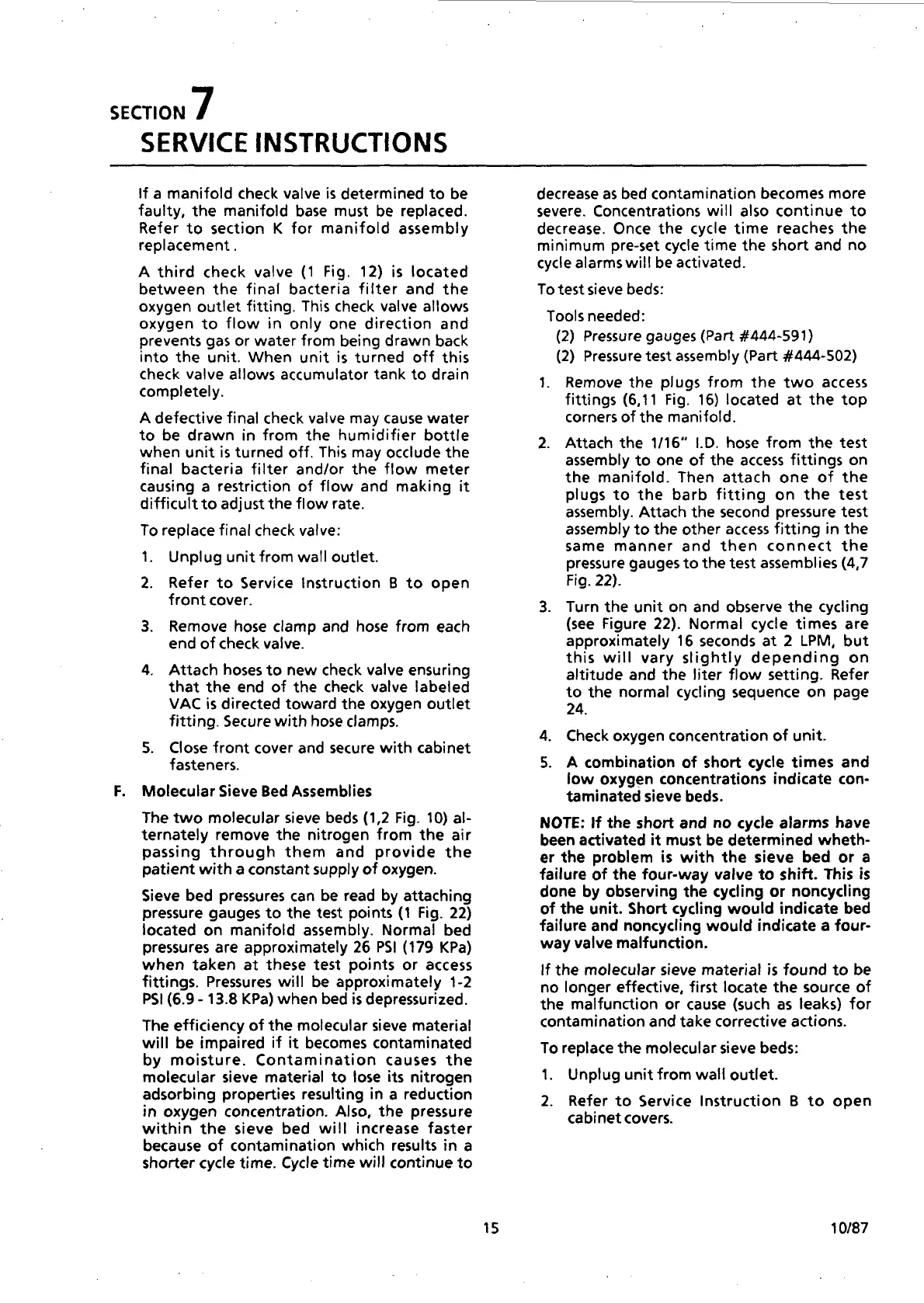
SECTION
7
SERVICE
INSTRUCTIONS
If
a
manifold
check
valve
is
determined
to
be
faulty,
the
manifold
base
must
be
replaced.
Refer
to
section
K
for
manifold
assembly
replacement.
A
third
check
valve
(1
Fig.
12)
is
located
between
the
final
bacteria
filter
and
the
oxygen
outlet
fitting.
This
check
valve
allows
oxygen
to
flow
in
only
one
direction
and
prevents
gas
or
water
from
being
drawn
back
into
the
unit.
When
unit
is
turned
off
this
check
valve
allows
accumulator
tank
to
drain
completely.
A
defective
final
check
valve
may
cause
water
to
be
drawn
in
from
the
humidifier
bottle
when
unit
is
turned
off.
This
may
occlude
the
final
bacteria
filter
and/or
the
flow
meter
causing
a
restriction
of
flow
and
making
it
difficult
to
adjust
the
flow
rate.
To
replace
final
check
valve:
1.
Unplug
unit
from
wall
outlet.
2.
Refer
to
Service
Instruction
B
to
open
front
cover.
3.
Remove
hose
clamp
and
hose
from
each
end
of
check
valve.
4.
Attach
hoses
to
new
check
valve
ensuring
that
the
end
of
the
check
valve
labeled
VAC
is
directed
toward
the
oxygen
outlet
fitting.
Secure
with
hose
clamps.
5.
Close
front
cover
and
secure
with
cabinet
fasteners.
Molecular
Sieve
Bed
Assemblies
The
two
molecular
sieve
beds
(1,2
Fig.
10)
al-
ternately
remove
the
nitrogen
from
the
air
passing
through
them
and
provide
the
patient
with
a
constant
supply
of
oxygen.
Sieve
bed
pressures
can
be
read
by
attaching
pressure
gauges
to
the
test
points
(1
Fig.
22)
located
on
manifold
assembly.
Normal
bed
pressures
are
approximately
26
PSI
(179
KPa)
when
taken
at
these
test
points
or
access
fittings.
Pressures
will
be
approximately
1-2
PSI
(6.9
-
13.8
KPa)
when
bed
is
depressurized.
The
efficiency
of
the
molecular
sieve
material
will
be
impaired
if
it
becomes
contaminated
by
moisture.
Contamination
causes
the
molecular
sieve
materia!
to
lose
its
nitrogen
adsorbing
properties
resulting
in
a
reduction
in
oxygen
concentration.
Also,
the
pressure
within
the
sieve
bed
will
increase
faster
because
of
contamination
which
results
in
a
shorter
cycle
time.
Cycle
time
will
continue
to
15
decrease
as
bed
contamination
becomes
more
severe.
Concentrations
will
also
continue
to
decrease.
Once
the
cycle
time
reaches
the
minimum
pre-set
cycle
time
the
short
and
no
cycle
alarms
will
be
activated.
To
test
sieve
beds:
Tools
needed:
(2)
Pressure
gauges
(Part
#444-591)
(2)
Pressure
test
assembly
(Part
#444-502)
1.
Remove
the
plugs
from
the
two
access
fittings
(6,11
Fig.
16)
located
at
the
top
corners
of
the
manifold.
2.
Attach
the
1/16”
1.D.
hose
from
the
test
assembly
to
one
of
the
access
fittings
on
the
manifold.
Then
attach
one
of
the
plugs
to
the
barb
fitting
on
the
test
assembly.
Attach
the
second
pressure
test
assembly
to
the
other
access
fitting
in
the
same
manner
and
then
connect
the
pressure
gauges
to
the
test
assemblies
(4,7
Fig.
22).
3.
Turn
the
unit
on
and
observe
the
cycling
(see
Figure
22).
Normal
cycle
times
are
approximately
16
seconds
at
2
LPM,
but
this
will
vary
slightly
depending
on
altitude
and
the
liter
flow
setting.
Refer
to
the
normal
cycling
sequence
on
page
24.
4.
Check
oxygen
concentration
of
unit.
A
combination
of
short
cycle
times
and
low
oxygen
concentrations
indicate
con-
taminated
sieve
beds.
NOTE:
If
the
short
and
no
cycle
alarms
have
been
activated
it
must
be
determined
wheth-
er
the
problem
is
with
the
sieve
bed
or
a
failure
of
the
four-way
valve
to
shift.
This
is
done
by
observing
the
cycling
or
noncycling
of
the
unit.
Short
cycling
would
indicate
bed
failure
and
noncycling
would
indicate
a
four-
way
valve
malfunction.
If
the
molecular
sieve
material
is
found
to
be
no
longer
effective,
first
locate
the
source
of
the
malfunction
or
cause
(such
as
leaks)
for
contamination
and
take
corrective
actions.
To
replace
the
molecular
sieve
beds:
1.
Unplug
unit
from
wall
outlet.
2.
Refer
to
Service
Instruction
B
to
open
cabinet
covers.
10/87

Related product manuals