EasyManua.ls Logo

DeWalt 140 - Page 3

DeWalt 140
8 pages
Print Icon
To Next Page IconTo Next Page
To Previous Page IconTo Previous Page
Loading...
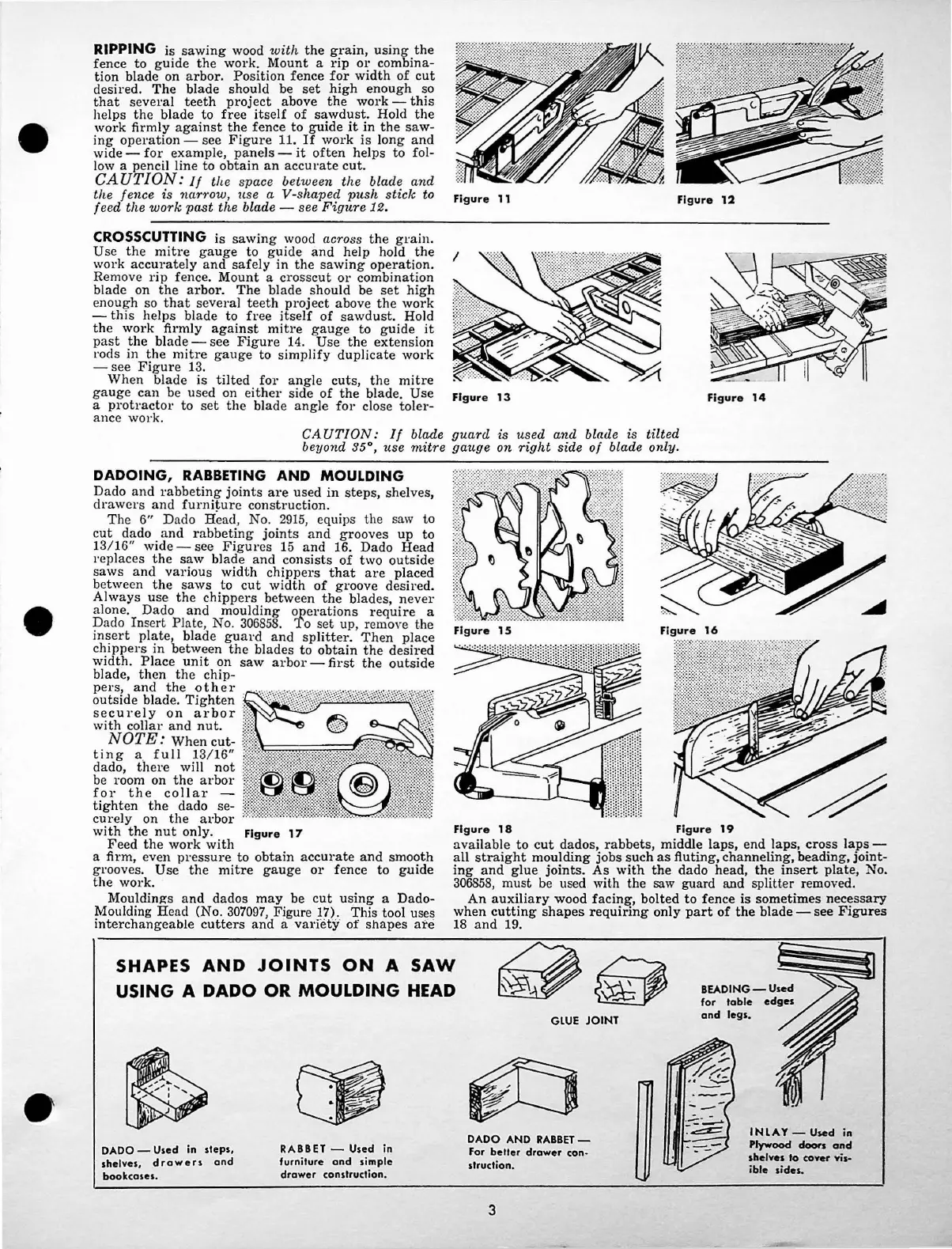
RIPPING is
sawing
wood
with
the
grain,
using
the
fence
to
guide
the
work.
Mount
a
rip
or
combina-
tion
blade
on
arbor.
Position
fence
for
width
of
cut
desired.
The
blade
should
be
set
high
enough
so
that
several
teeth
project
above
the
work
-
this
helps
the
blade
to
free
itself
of
sawdust.
Hold
the
work
firmly
against
the
fence
to
guide
it
in
the
saw-
ing
operation
- see
Figure
11.
If
work
is
long
and
wide -
for
example,
panels
-
it
often
helps to fol-
low a pencil line
to
obtain
an
accurate
cut.
CAUTION:
If
the
space be
tween
the
blade
and
lhe
fence
is
narrow,
use a V-shapecl
push
stick
to
feed
the
work
past
the
blade - see
Figure
lZ.
CROSSCUTTING
is
sawing
wood ac1·oss
the
grain.
Use
the
mitre
gauge
to
guide
and
help
hold
the
work
accurately
and
safely
in
the
sawing
operation.
Remove
rip
fence.
Mount
a
crosscut
or
combination
blade
on
the
arbor.
The
blade
should
be
set
high
enough
so
that
several
teeth
project
above
the
work
-
this
helps
blade
to
free
itself
of
sawdust.
Hold
the
work
firmly
against
mitre
gauge
to
guide
it
past
the
blade
-
see
Figure
14.
Use
the
extension
rods
in
the
mitre
gauge
to
simplify
duplicate
wo1·k
- see
Figure
13.
-
·=
·· .
-:::
,
/!.
'
:}
~
Figure
11
Figure
12
When
blade
is
tilted
for
angle
cuts,
the
mitre
gauge
can
be
used
on
either
side
of
the
blade.
Use
Figure
1
3
a
protractor
to
set
the
blade
angle
for
close
toler-
ance
work.
Figure
14
CAUTION:
If
blade
guard
is
used
and
blade is
tilted
beyond 35°,
use
mitre
gauge
on
right
side
of
blade only.
DADOING,
RABBETING
AND MOULDING
Dado
and
rabbeting
joints
are
used
in
steps,
shelves,
drawers
and
furniture
construction.
The
6"
Dado
Head, No.
2915
, equips the s
aw
io
cut
dado
and
rabbeting
joints
a
nd
grooves
up
to
13/ 16" wide - see
Figures
15
and
16.
Dado
Head
replaces
the
saw
blade
and
consists
of
two
outside
saws
and
various
width
chippers
that
are
placed
between
the
saws
to
cut
width
of
groove desired.
Always
use
the
chippers
between
the
blades
,
never
alone.
Dado
and
moulding
operations
require
a
Dado
In
se
rt
Plate
, No.
306858.
To
s
et
up, remove the
in~ert
pl~te,
blade
guard
and
splitter.
Then
place
chippers
m between
the
blades
to
obtain
the
desired
width
.
Place
unit
on
saw
arbor
-
first
the
outside
blade,
then
the
chip-
with
the
nut
only. Figure
17
Feed
the
work
with
a firm, even
pressure
to
obtain
accurate
and
smooth
grooves.
Use
the
mitre
gauge
or
fence
to
guide
the
work
.
Mouldings
and
dados
may
be
cut
using
a
Dado-
Moulding
Head
(No.
307097,
Figure 17). This tool uses
interchangeable
cutters
and
a
variety
of
shapes
ate
Figure
15
Figure
16
Figure
18
Figure
19
available
to
cut
dados,
rabbets,
middle
laps,
end
laps,
cross
laps
-
all
straight
moulding
jobs
such
as
fluting,
channeling,
beading,
joint-
ing
and
glue
joints.
As
with
the
dado
head,
the
insert
plate,
No.
306858,
must be used with
the
saw guard
Md
splitter removed.
An
auxiliary
wood
facing,
bolted
to
fence
is
sometimes
necessary
when
cutting
shapes
requiring
only
part
of
the
blade - see Figures
18
and
19.
SHAPES
AND
JOINTS
ON
A
SAW
USING A DADO
OR
MOULDING
HEAD
DADO
- Used in steps.
shelves,
drawers
and
baakcases
.
RABBET
- Used
in
furniture
and
simple
drawer
construction.
GLUE
JOINT
DADO
AND
RABBET
-
Far
heller
drawer
con-
slruction.
3
and
legs.
INLAY
- Used
in
Plywood doors
and
shelves
to
co,rer
Yis-
i
ble
sides.

Related product manuals