9
Press the up arrow to rotate the table in the positive direction, CCW. Press the down arrow to rotate
the table in the negative direction, CW. Note that while the table rotates CCW, the cutting wire
“rotates” CW relative to the table surface. Therefore, when programming an automatic cut
sequence, think of the cutting wire moving relative to the specimen.
A quick tap on either the up or down arrow key results in a single step. Press and hold one of these
keys and the table rotates continuously at a slow rate of speed. Release the key very briefly and
resume pressing it and the table accelerates and continues to rotate at a higher velocity as long as
the key is held down. Release the key and the table quickly decelerates to a stop.
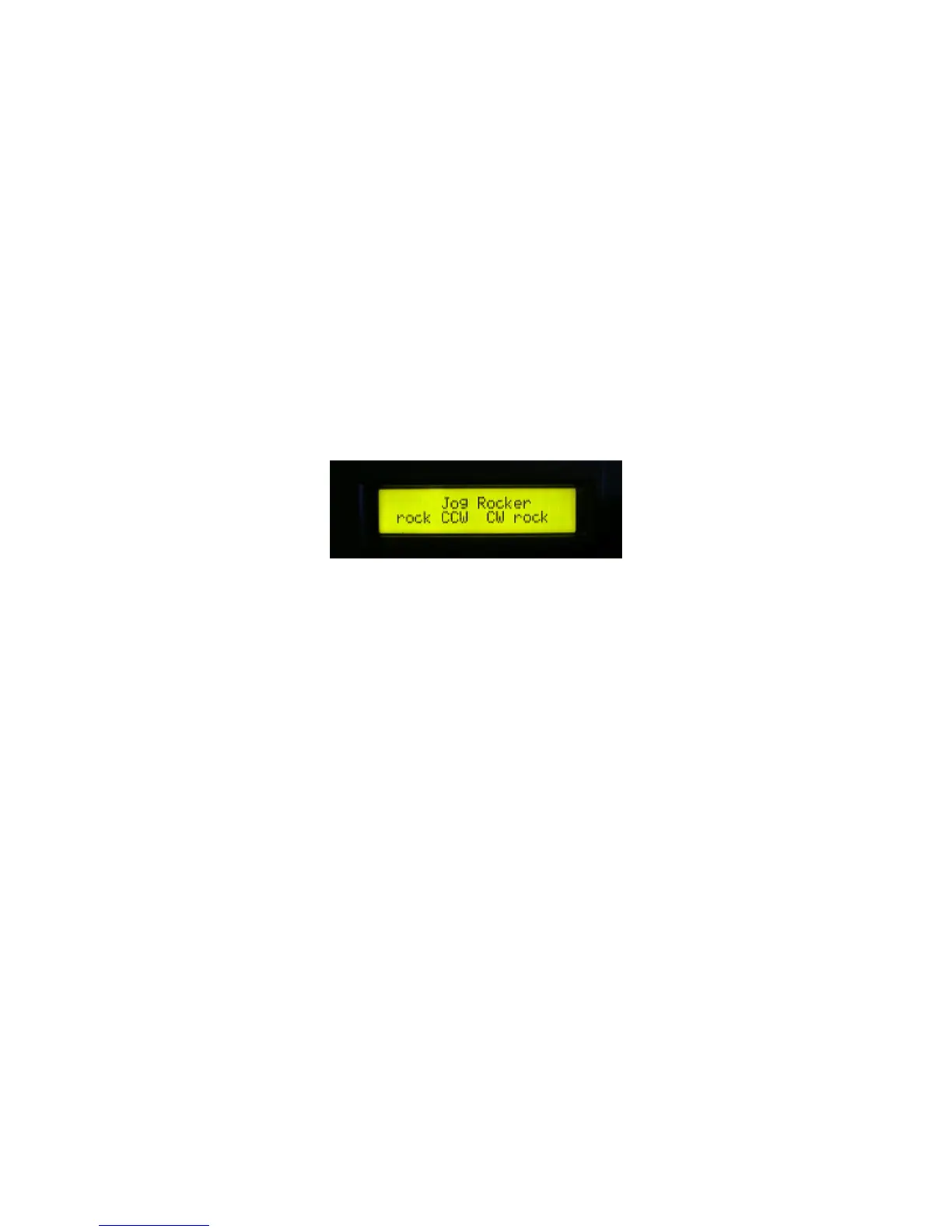
Jog the rocker clockwise or counter-clockwise (Models CT400 and CT800 only):
The display shows which key is allocated to which action. It does not indicate the actual rock
position. Here, the user needs to observe the position of the rocker and adjust the keys to position
the rocker in its start position.
Press the up arrow to move the rocker in a clockwise (CW) direction. Press the down arrow to
move the rocker in a counter-clockwise (CCW) direction.
A quick tap on either the up or down arrow key results in a single step. Press and hold one of these
keys and the rocker moves continuously at a slow rate of speed. The jog rocker action has only one
speed.
Position recommendation:
As noted above the absolute position on all axes is set to zero at power on. Since zero, or home, is
arbitrary and varies with each new part mounted for cutting, we recommend that you jog the wire
into position prior to making the first cut, then turn power off briefly. When power to the controller
is restored, the position values are now set to zero. This allows you to make all further movements
relative to this known position.
Should power to the controller be lost during a cut program, once again the position values will be
set to zero when power is restored. You can jog the saw back to the physical “home”, make note of
the position values, turn power off momentarily, then manually jog the saw to position values that
are compliments of the values recorded in the previous step. Now, the absolute position values are
restored to their “correct” values as they were prior to the power failure.
The stepper motors controlling the linear translation stages have a back shaft equipped with a



 To Next Page