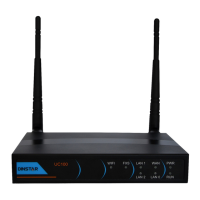
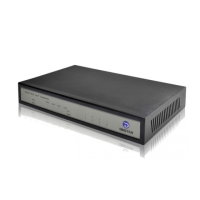
The Dinstar VoIP Gateway is a versatile communication device designed to bridge traditional telephony networks (PSTN) with modern IP-based communication systems. It facilitates seamless integration between analog phone lines and VoIP networks, enabling businesses to leverage the cost-effectiveness and flexibility of VoIP while retaining their existing PSTN infrastructure. This quick installation guide provides essential information for setting up and configuring various models of the Dinstar gateway, including the DAG1000-4O, DAG1000-8O, DAG2000-16O, DAG3000-32O, and DAG3000-128O, each offering different port configurations to suit diverse operational needs.
Function Description
The primary function of the Dinstar VoIP Gateway is to convert analog voice signals from PSTN lines into digital packets for transmission over an IP network, and vice versa. This allows traditional analog phones, fax machines, and PBX systems to communicate with VoIP endpoints and SIP servers. The gateway supports various FXO (Foreign Exchange Office) ports, which are used to connect to analog telephone lines from a telecom operator. Depending on the model, these FXO ports can be either RJ11 or RJ45. The gateway also features WAN and LAN ports for network connectivity, enabling it to integrate into existing network infrastructures.
The gateway acts as a crucial interface, allowing inbound calls from PSTN to be routed to SIP extensions and outbound calls from SIP extensions to be routed to PSTN lines. This capability is essential for businesses that want to migrate to VoIP gradually or maintain a hybrid communication environment. The device supports SIP (Session Initiation Protocol), a widely used signaling protocol for controlling multimedia communication sessions such as voice and video calls over IP networks.
Key functional aspects include:
- PSTN to VoIP Conversion: Converts analog voice signals from PSTN lines into digital data packets for transmission over an IP network.
- VoIP to PSTN Conversion: Converts digital voice packets from an IP network back into analog signals for transmission over PSTN lines.
- Call Routing: Intelligently routes calls between PSTN lines and SIP endpoints based on configured rules, including inbound and outbound routes.
- Port Grouping: Allows for the organization of PSTN lines into logical groups, which is particularly useful when dealing with lines from different telecom operators or for managing call distribution.
- Codec Support: Supports various audio codecs (e.g., G729, G723, G711U, G711A) to ensure compatibility with different VoIP systems and optimize bandwidth usage.
- SIP Trunking: Facilitates the creation of IP trunks to connect with peer SIP servers, enabling communication with other VoIP systems or service providers.
Usage Features
The Dinstar VoIP Gateway is designed for ease of use and flexible deployment, offering several features that enhance its operational utility.
Installation and Connectivity:
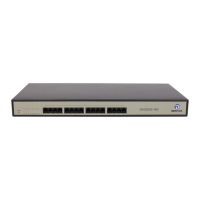
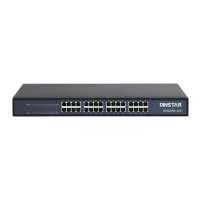
- Model-Specific Ports: Different models offer varying numbers of WAN, LAN, RJ11, and RJ45 ports, allowing users to select a gateway that matches their specific port requirements. For instance, models like DAG1000-4O and DAG1000-8O include WAN ports and multiple LAN ports, while DAG2000-16O and DAG3000-32O focus on a higher number of FXO ports with fewer LAN/WAN distinctions.
- Power Supply: The DAG1000 series uses a 12VDC power adapter, while the DAG2000 and DAG3000 series accept AC input voltage (100-240V), providing flexibility in power source options.
- Network Integration: The gateway connects to the network via LAN/WAN ports, allowing it to be integrated into existing network infrastructures alongside PCs, switches, and routers.
- PSTN Line Connection: FXO ports connect directly to PSTN lines from telecom operators, enabling the gateway to receive and make calls over traditional phone networks.
Configuration and Management:
- Web Management System: The gateway is managed through a user-friendly Web Management System, accessible via a web browser. This system allows for comprehensive configuration of all gateway parameters.
- IP Address Configuration: Users can modify the gateway's IP address to ensure it resides within the same network segment as the managing PC, facilitating initial access and ongoing management.
- Port Group Creation: PSTN lines can be logically grouped, which simplifies call routing and management, especially in environments with multiple lines or different telecom providers.
- Inbound and Outbound Route Configuration: The system allows for detailed configuration of call routing rules, specifying how calls from PSTN are directed to SIP endpoints (inbound) and how calls from SIP endpoints are directed to PSTN lines (outbound). This includes setting caller/callee prefixes and selecting specific port groups or IP trunks.
- Offhook Auto-Dial: This feature allows the gateway to automatically dial a predefined number when an offhook event occurs on an FXO port. This is often used for DID (Direct Inward Dialing) or to connect to an IVR (Interactive Voice Response) system or ring group on the SIP server.
- FXO Parameter Adjustment: Users can configure various FXO parameters, such as CID (Caller ID) detection (before or after ring), and the format of the "From" field for CID display. This ensures proper caller ID functionality and compatibility with different PSTN services.
- Codec Priority: The ability to configure the priority of preferred codecs allows users to optimize voice quality and bandwidth usage according to their network conditions and SIP server capabilities.
Indicators for Status Monitoring:
- PWR (Power Indicator): Shows whether the gateway is powered on or if there's a power supply issue.
- RUN (Running Indicator): Indicates the operational status of the gateway, including proper running, successful SIP registration (fast flashing), or improper running.
- FXO (FXO In-use Indicator): Shows whether an FXO port is currently occupied or idle/faulty.
- Link (Green) and Speed (Orange) Indicators for WAN/LAN/GE0/GE1: Provide visual feedback on network connectivity (flashing for proper connection, off for no connection) and link speed (on for 100Mbps/1000Mbps, off for 10Mbps/100Mbps). These indicators are crucial for quick troubleshooting of network issues.
Maintenance Features
The Dinstar VoIP Gateway incorporates several features to facilitate maintenance, troubleshooting, and ensure reliable operation.
Troubleshooting and Diagnostics:
- Indicator Lights: The comprehensive set of LED indicators (PWR, RUN, FXO, Link, Speed) provides immediate visual cues for diagnosing common issues related to power, operational status, FXO port activity, and network connectivity. This allows administrators to quickly identify the source of a problem without needing to access the web interface.
- PSTN Line Testing: In cases where caller ID is not displayed, users can consult their telecom operator or connect a standard telephone to the PSTN line to verify CID functionality independently of the gateway.
- IP Address Query: If the gateway's IP address is forgotten, it can be queried by dialing a specific sequence (*158#) from a connected PSTN line, providing a recovery mechanism for network access.
Configuration Management and Recovery:
- Factory Default Reset: The gateway offers multiple ways to restore factory default settings:
- RST Button: A physical RST button can be pressed for 7 seconds to initiate a reset.
- PSTN Dialing: A specific dialing sequence (166000000#) from a connected PSTN line can trigger a factory reset.
- Web Interface: The Web Management System includes a "Factory Reset" option under "Tools," allowing for a software-initiated reset. These options provide flexibility in restoring the gateway to its initial state for troubleshooting or redeployment.
- Impedance Auto Test: To ensure optimal compatibility with various PSTN lines, the gateway features an "Impedance Auto Test." This function automatically detects and sets the best impedance value for FXO lines, which is crucial for clear voice quality and reliable call connections. After the test, the impedance value can be saved.
Operational Reliability and Best Practices:
- Anti-jamming Recommendations: To minimize interference with PSTN lines, it is recommended to keep PSTN cables away from power cables. This attention to physical installation helps maintain signal integrity.
- Ventilation: Proper ventilation is emphasized to prevent overheating, which can impact device performance and longevity. Users are advised not to stack the gateway with other devices and to ensure adequate airflow.
- Temperature and Humidity Guidelines: For optimal performance and to prevent malfunctions, the gateway should be installed in an environment with appropriate temperature and humidity levels, typically an equipment room.
- Mechanical Load: The gateway should be placed steadily on a flat surface or in a cabinet to prevent physical damage, ensuring its long-term stability and operation.
- Network Bandwidth Assurance: Maintaining sufficient network bandwidth is crucial for the stable operation of the gateway, especially for voice quality and call reliability.
These maintenance features, combined with the robust design and comprehensive configuration options, ensure that the Dinstar VoIP Gateway can be effectively managed, troubleshooted, and maintained throughout its operational lifespan.

 Need help?
 General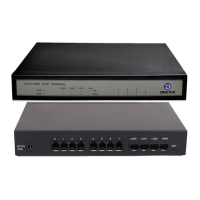



 To Next Page