
 Need help?
Do you have a question about the Dinstar DWG2000E and is the answer not in the manual?
Provides a functional overview of the DWG2000E/F/G VoIP Gateway for various user types.
Illustrates a network scenario integrating mobile and fixed networks with the gateway.
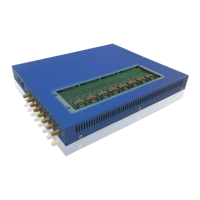
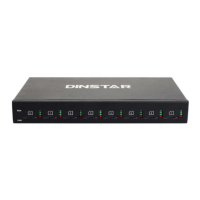
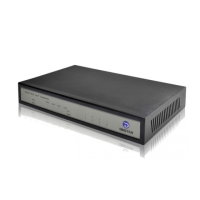
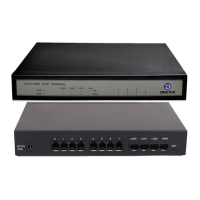
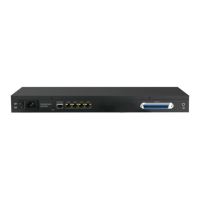
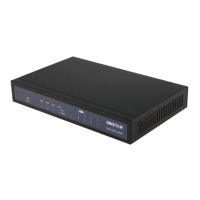
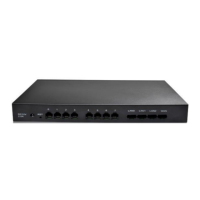
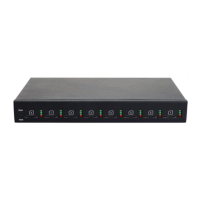
Details the visual aspects and front/rear views of the DWG2000E unit.
Highlights key functions and features of the gateway.
Lists supported communication protocols like SIP, STUN, PPPoE, HTTP, and DHCP.
Highlights key system functionalities such as Packet Loss Concealment (PLC).
Enlists various industrial standards met by the gateway, including EN, CE, and FCC.
Specifies hardware details like power supply, operating temperature, and humidity.
Provides essential installation prerequisites and precautions, including power and network connections.
Outlines the step-by-step process for installing SIM cards and antennas.
Details the physical insertion of a SIM card into the device.
Guides on correctly installing the antennas for optimal performance.
Explains how to connect the gateway to the network using Ethernet cables.
Introduces the Interactive Voice Response system for basic system settings via dial numbers.
Covers fundamental operations like checking IP address and restoring factory settings.
Describes the use of the console port for maintenance via RS232.
Details how to access and use the gateway's web interface.
Guides on accessing the web interface using a browser and the default IP address.
Explains the structure of the web configuration interface and how to navigate it.
Details how to view system status, network, license, and version information.
Provides specific system status, network, and version details.
Shows details about the GSM/CDMA module status, signal strength, and carrier information.
Displays SIP registration status and port information with the Softswitch or SIP Server.
Provides an overview of various statistics collected by the gateway.
Provides statistics on TCP and UDP packet transmission and reception.
Shows RTP statistics including payload type, packet loss, and jitter.
Records incoming and outgoing call statistics for SIP channels.
Logs call details for IP to GSM connections, including call failure reasons.
Provides Call Detail Record (CDR) reporting for call analysis, including source, destination, and duration.
Records BCCH history to aid in SIM card registration status analysis.
Configures network settings for the gateway.
Configures IP address, subnet mask, default gateway, and DNS server settings.
Manages ARP entries to map IP addresses to MAC addresses for network device identification.
Configures VPN parameters for secure remote access, including server and account details.
Manages various mobile-related settings and features.
Sets fundamental mobile parameters like dial tone gain, select band, and remote API settings.
Manages mobile channel states, call limitations, gain settings, and module resets.
Allows management of SIM card PIN for security and unlocking.
Configures the SMS center number if it cannot be auto-detected by the module.
Enables sending SMS messages and configuring encoding and destination.
Manages Unstructured Supplementary Service Data (USSD) requests and replies for mobile services.
Allows selection of the GSM/CDMA carrier, either automatically or manually.
Configures Broadcast Control Channel (BCCH) settings for signal strength and frequency detection.
Configures call forwarding rules for unconditional, busy, or unreachable scenarios.
Enables or disables call waiting functionality for mobile channels.
Selects the SIM card installation mode: Local, SIM Box, or SIM Bank.
Configures connection to the Dinstar Cloud server for centralized management and SIM Bank integration.
Sets up rules for directing calls based on number manipulation.
Sets global routing parameters that affect number manipulation for IP-to-Tel and Tel-to-IP calls.
Configures rules for routing calls from IP to Tel, specifying source, destination, and prefixes.
Configures rules for routing calls from Tel to IP, defining source, destination, and prefixes.
Defines rules for manipulating numbers during call routing.
Defines rules for changing called numbers in IP-to-Tel calls, including stripping and adding digits.
Defines rules for changing caller numbers in Tel-to-IP calls, including stripping and adding digits.
Defines rules for changing called numbers in Tel-to-IP calls, including stripping and adding digits.
Configures operational rules for call handling.
Configures operations for IP-to-Tel calls, such as allowing, forbidding, or authenticating calls.
Configures operations for Tel-to-IP calls, including call back, auto call, and authentication.
Manages port groups, allowing selection of multiple ports for specific operations.
Manages port groups, allowing selection of multiple ports for specific operations.
Configures connections to remote Softswitch or SIP servers.
Configures remote IP trunks for connecting to Softswitch or SIP servers.
Organizes IPs into groups for referenced routing and number manipulation.
Manages system-wide settings and parameters.
Configures voice call parameters like call progress tone, codecs, and silence suppression.
Adjusts various settings like private service, call acceptance, and anonymous call rejection.
Configures SIP server addresses, ports, and outbound proxy settings.
Sets registration intervals and DNS query types for SIP server communication.
Maps GSM cause codes to SIP response codes for better interoperability.
Configures parameters for individual ports.
Configures individual port settings, including SIP User ID, authentication, and gain.
Defines digit map syntax for custom call routing and number manipulation.
Provides access to various diagnostic and management tools.
Guides on updating the device firmware, including version checking and package preparation.
Configures syslog for network device data logging and error reporting.
Manages file logs stored locally for system diagnostics and downloads them.
Configures management parameters like NTP, Web Port, and Telnet Port.
Allows downloading the current device configuration for backup purposes.
Enables restoring a previously backed-up configuration to the device.
Allows uploading custom voice prompts for incoming PSTN calls.
Performs a ping test to check network reachability and measure round-trip time.
Executes a traceroute to diagnose network paths and transit delays.
Captures network traffic for diagnostic purposes, supporting PCM, Syslog, RTP, and DSP data.
Conducts voice loopback tests (DSP TDM and DSP IP) to diagnose audio paths.
Allows modification of web and telnet login credentials for security.
Resets all device parameters to their factory default settings.
Restarts the gateway device to apply changes or resolve issues.
Covers logging into the gateway via Telnet and understanding basic command-line interface (CLI) usage.
Introduces commands available in the privileged ROS# mode for advanced system management.
Lists key commands available in ROS# mode, accessible via a help prompt.
Details common ROS# commands for showing IP address, time, version, and SIP configuration.
Describes commands used within the configuration mode for managing network and system settings.
Provides an overview of commands available in config mode through a help prompt.
Lists essential Config mode commands for setting time, saving configurations, and enabling debug modes.
Guides on tracing SIP logs by enabling debug messages and using telnet commands.
Explains how to trace ECC logs to analyze call details and module behavior.
Details methods for tracing module-specific logs for troubleshooting.
Recommends physical separation distances between antennas to minimize interference.
Suggests using metal baffles between antennas to block radiation coupling and improve isolation.
Explains how orthogonal polarization of antennas can enhance isolation.
Discusses using antenna radiation patterns and placement to improve isolation.
Provides troubleshooting steps for network connectivity issues when the gateway is physically connected.
Offers solutions for SIM card registration failures, checking network and configuration.
Addresses issues with incorrect caller ID display during outgoing calls.
Provides steps to diagnose and resolve sudden call interruptions.
Offers solutions for poor voice quality, including network checks and tunnel configuration.
 General
| SMS | Yes |
|---|---|
| Weight | 0.5 kg |
| Protocols Supported | SIP |
| Power Supply | AC 100-240V, 50/60Hz |
| Voice Codecs | G.723.1 |
| Frequency | 850/900/1800/1900 MHz |
| Network Interface | Ethernet |
| Operating Temperature | 0°C to 45°C |
| Storage Temperature | -20°C to 70°C |
| Humidity | 10% to 90% non-condensing |



 To Next Page