
 Need help?
Do you have a question about the Dinstar DAG2000-24S and is the answer not in the manual?
Introduction and welcome message for the DAG2000-24/32S VoIP Gateway.
Provides information on the manual's content and purpose.
Specifies the target readers for this manual.
Lists document versions and firmware versions.
General overview of the DAG2000-24/32S VoIP gateway and its features.
Illustrates the typical use cases and network setup for the gateway.
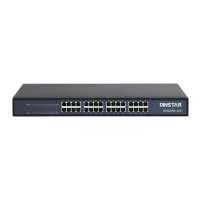
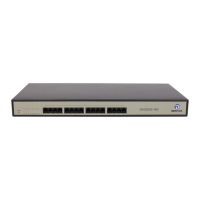
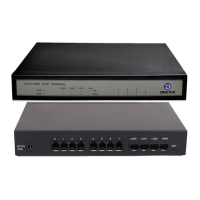
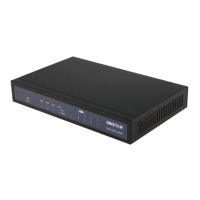
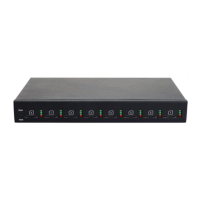
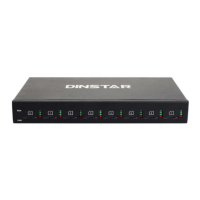
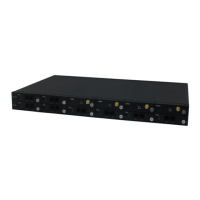
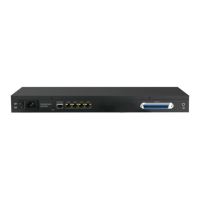
Details the physical appearance and layout of the gateway.
Front and back view of the DAG2000-24S model.
Front and back view of the DAG2000-32S model.
Identifies and describes the ports and connectors on the gateway.
Lists the key features and functionalities of the gateway.
Lists the primary features like cost-effectiveness, fax over IP, codecs, and compatibility.
Details the telephone ports, Ethernet interfaces, and console port.
Describes codecs, silence suppression, CNG, and VAD.
Lists the key features and functionalities of the gateway.
Covers FXS connector, dial modes, caller ID, and cable length.
Lists supported VoIP protocols, RTP, SIP features, and NAT.
Lists the key features and functionalities of the gateway.
Encompasses features like Hunting Group, Web ACL, Digitmap, and routing rules.
Covers call waiting, forwarding, transfer, and conference features.
Details power supply, consumption, temperature, and compliance.
Lists maintenance protocols and methods like SNMP, TR069, and provisioning.
Important considerations before installing the gateway, including ports, jamming, power, and ventilation.
Step-by-step guide for connecting power, telephone lines, and network cables.
Explains network connection modes, specifically bridge mode.
Provides a visual diagram of network setup in bridge mode.
Steps to prepare for accessing the web interface, including network setup and IP checks.
Instructions on how to access and log into the device's web interface.
Describes two methods for dialing numbers or extension numbers.
Explains how to use the call holding feature to switch between calls.
Details how call waiting works and how to manage incoming calls.
Covers methods for transferring calls.
Explains how to transfer a call without notifying the recipient.
Covers methods for transferring calls.
Describes transferring a call after confirming with the recipient.
Explains call switching using the flash hook during a conversation.
Lists feature codes for querying information and controlling functions.
Details fax transmission modes and protocols.
Lists supported fax modes: T.38 and Pass-Through.
Explains the T.38 and Pass-through fax transmission methods.
Describes how the RST button restores factory default settings.
Instructions for querying IP addresses and resetting the device.
Overview of the web management system's navigation structure.
Displays system information, registration, traffic, and call records.
Displays system information, registration, traffic, and call records.
Shows device ID, MAC, IP, version, and system uptime.
Displays system information, registration, traffic, and call records.
Displays the registration status of FXS ports and port groups.
Shows statistics for sending/receiving TCP and UDP packets.
Displays system information, registration, traffic, and call records.
Provides real-time RTP session information like port, IP, and packet details.
Details Call Detail Records, including export and filtering options.
Displays system information, registration, traffic, and call records.
Displays statistics on records, responses, and errors.
Guides users through device configuration step-by-step.
Covers network settings including IP, VLAN, and DHCP.
Configuration of IP address, subnet mask, and gateway in bridge mode.
Covers network settings including IP, VLAN, and DHCP.
Setup for dividing the network into data, voice, and management VLANs.
Covers network settings including IP, VLAN, and DHCP.
Configuration of DHCP options for IP address and network information.
Covers network settings including IP, VLAN, and DHCP.
Setting Quality of Service priority for IP messages.
Covers network settings including IP, VLAN, and DHCP.
Configuration of Address Resolution Protocol for MAC address resolution.
Configuration of SIP server settings for call establishment.
Configuration of IP-related parameters for SIP server and codecs.
Configuration of line-related parameters for FXS ports.
Configuration of SIP accounts for FXS port registration.
Access to advanced configuration settings for FXS ports and other parameters.
Access to advanced configuration settings for FXS ports and other parameters.
Configures FXS parameters like call progress tone and gain control.
Access to advanced configuration settings for FXS ports and other parameters.
Settings for FXS ports including polarity, hook flash, and CID.
Access to advanced configuration settings for FXS ports and other parameters.
Configures RTP, DTMF, and preferred vocoder settings.
Access to advanced configuration settings for FXS ports and other parameters.
Settings for dialing timeouts, digitmap, and MWI.
Access to advanced configuration settings for FXS ports and other parameters.
Advanced SIP settings including early media and session timers.
Access to advanced configuration settings for FXS ports and other parameters.
Configuration of NAT traversal and STUN settings.
Setup for speed dial numbers for easy access.
Access to advanced configuration settings for FXS ports and other parameters.
Lists feature codes for querying information and controlling functions.
Access to advanced configuration settings for FXS ports and other parameters.
Settings for NTP, time zone, and reboot schedules.
Manages call routing rules and IP trunk configurations.
Groups FXS ports for unified SIP account registration.
Manages call routing rules and IP trunk configurations.
Configuration for peer-to-peer VoIP calls via IP trunk.
Manages call routing rules and IP trunk configurations.
Determines if calls are routed before or after manipulation.
Manages call routing rules and IP trunk configurations.
Routes calls from IP network to FXS ports or port groups.
Manages call routing rules and IP trunk configurations.
Routes calls from FXS ports to IP trunks or SIP servers.
Manages call routing rules and IP trunk configurations.
Routes calls between different IP trunks.
Rules for changing called or caller numbers during a call.
Manipulates the called number for IP to Tel calls.
Rules for changing called or caller numbers during a call.
Manipulates the caller number for Tel to IP/Tel calls.
Rules for changing called or caller numbers during a call.
Manipulates the called number for Tel to IP/Tel calls.
Manages device settings via TR069, SNMP, Syslog, Provision, Cloud, User, Remote, and Action URL.
Configuration for the TR069 protocol for auto-configuration.
Manages device settings via TR069, SNMP, Syslog, Provision, Cloud, User, Remote, and Action URL.
Setup for Simple Network Management Protocol for monitoring.
Manages device settings via TR069, SNMP, Syslog, Provision, Cloud, User, Remote, and Action URL.
Configuration for system message logging.
Automatic device firmware upgrade settings.
Registration and management via a cloud server.
Manages user accounts and groups for device access.
Configuration for remote technical support access.
Manages device settings via TR069, SNMP, Syslog, Provision, Cloud, User, Remote, and Action URL.
Configures URLs for reporting device statuses to VoIP servers.
Manages security settings including ACLs, passwords, and encryption.
Configures IP address access control for the web interface.
Manages security settings including ACLs, passwords, and encryption.
Configures IP address access control for the Telnet interface.
Modifies web and telnet login usernames and passwords.
Manages security settings including ACLs, passwords, and encryption.
Enables SIP and RTP encryption for VOS softswitch.
Utilities for firmware upload, data backup/restore, and testing.
Uploads new firmware versions to the device.
Utilities for firmware upload, data backup/restore, and testing.
Downloads configuration, status, and message data.
Utilities for firmware upload, data backup/restore, and testing.
Restores configuration data from a local file.
Tests network connectivity and calculates response time.
Utilities for firmware upload, data backup/restore, and testing.
Tracks network routes from one IP address to another.
Diagnoses the physical function of FXS ports using GR909 standard.
Utilities for firmware upload, data backup/restore, and testing.
Captures data packages for maintenance and analysis.
Utilities for firmware upload, data backup/restore, and testing.
Resets device configurations to factory default settings.
Restarts the device to apply configuration changes.
 General
| Model | DAG2000-24S |
|---|---|
| Number of FXS Ports | 24 |
| Protocol | SIP |
| Fax over IP | T.38 |
| Weight | 3.5 kg |
| Type | Gateway |
| Ports | 24 FXS |
| Voice Codecs | G.711, G.723, G.729 |
| Power Supply | AC 100-240V |
| Dimensions | 440mm x 44mm |
| Operating Temperature | 0°C to 45°C |
| Humidity | 10% to 90% non-condensing |



 To Next Page