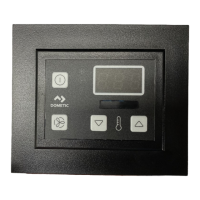
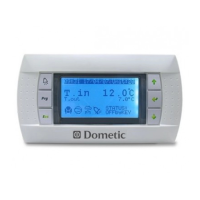
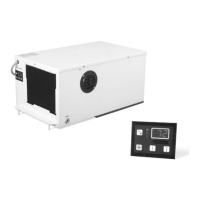
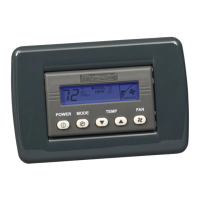
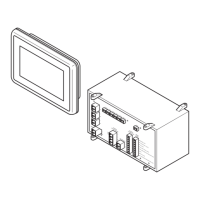
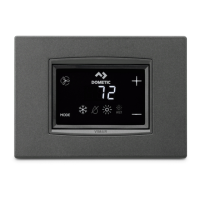
Passport I/O Control Operations Manual Important Programming Notes To Installer and End User
L-2231 ENGLISH 3
IMPORTANT PROGRAMMING NOTES TO INSTALLER AND END USER
1. If your air conditioning unit is Cool Only (if it does not have a reversing valve), then you MUST program Cool Only
Mode into parameter P-1 (factory default is Automatic Mode). DO NOT program Automatic Mode for a Cool Only unit.
If Automatic Mode is selected and the thermostat calls for heat, the compressor will run. Since there is no reversing
valve, the air conditioning unit will supply cool air when heating is desired. Cool Only units do not heat. See “P-1:
Operating Mode” on page 7 for more information on how to set the proper operating mode.
2. If your air conditioning unit has a Shaded-Pole (SP) fan motor instead of a Split-Capacitor (SC) High-Velocity (HV) fan
motor, you MUST program “SP” into parameter P-16 before operating the equipment. The SP units are recognizable
by an overhanging blower motor. (The SC motor of an HV unit is inside the blower, and the unit has “VTD” or “HV” in
the model number.) Only reprogram this parameter if you do NOT have an HV blower.
3. When powering on the control, press and immediately release the Power button so you do not unintentionally enter
Program Mode. You will enter Program Mode if the Power button is pressed and held for more than 5 seconds. If you
enter Program Mode unintentionally, any subsequent presses of the Up or Down buttons will change the P-1
parameter setting since it is the first parameter shown after entering this mode. This will change the operating mode to
Cool Only, Heat Only, or Automatic, which could result in improper system operation. Always use care when in
Program Mode. For further information, refer to “Using Program Mode” on page 6.
NORMAL HEATING OR COOLING CYCLE
In Automatic Mode, heating and cooling are supplied as required. If cooling is required, the system will start a cooling cycle
when the cabin temperature exceeds the set point by 2°F (1.1°C) and will continue to cool until the temperature equals the set
point. The cabin temperature must drop below the set point by at least 4°F (2.2°C) in order for the system to switch from cooling
to heating. Similarly, if heating is required, the system will start a heating cycle when the cabin temperature is below the set
point by 2°F (1.1°C) and will continue to heat until the temperature equals the set point. The cabin temperature must exceed the
set point by at least 4°F (2.2°C) in order for the system to switch from heating to cooling.
If you select Cool Mode, only cooling is supplied. If you select Heat Mode, only heating is supplied. The cabin temperature in
either mode is maintained within 2°F (1.1°C) of set point by default. When the heating or cooling set point is satisfied, the
compressor cycles off and the fan returns to low speed. The fan speed remains constant if Manual Fan Speed is selected.
For more programming information on this feature, see “P-1: Operating Mode” on page 7.
REVERSING VALVE OPERATION
The position of the reversing valve determines if the system is in Cool Mode or Heat Mode.
In addition, the reversing valve is programmed to toggle in these situations:
• When the system is running and heating or cooling is required, the reversing valve toggles to the opposite mode to
reduce the starting surge of the compressor.
• When a cooling or heating cycle is called for and if the system has been off for less than 75 seconds.
• When a cycle is interrupted from the display panel by pressing the Power button or changing the set point.
Unnecessary valve toggling is limited to reduce reversing-valve noise. You can totally eliminate valve toggling by programming
the minimum compressor staging delay to 75 seconds or greater (see “P-4: Compressor Staging Time Delay” on page 8 for
more information).
Power-On Reset, which occurs when the system is powered up, always initiates a valve toggle.
INSTALLING THE DISPLAY PANEL
CHOOSING THE LOCATION
Before mounting the control panel, consider the location. The display panel’s built-in air sensor provides excellent room-air
temperature sensing when properly located and installed. For air sensor location see item 6 in Figure 1, page 2.
Mount the display panel on an inside wall, slightly higher than mid-height of the cabin, in a location with freely circulating air
where it can best sense average temperature. Its distance from the air conditioner must be within the 15’ (4.5m) length of the
display cable (custom lengths available).
Do not mount the display in direct sunlight, near any heat-producing appliances or in a bulkhead where temperatures radiating
from behind the panel may affect performance. Do not mount the display in the supply-air stream. Do not mount the display


 To Next Page
 Loading...