DE08TS Diesel Engines Maintenance
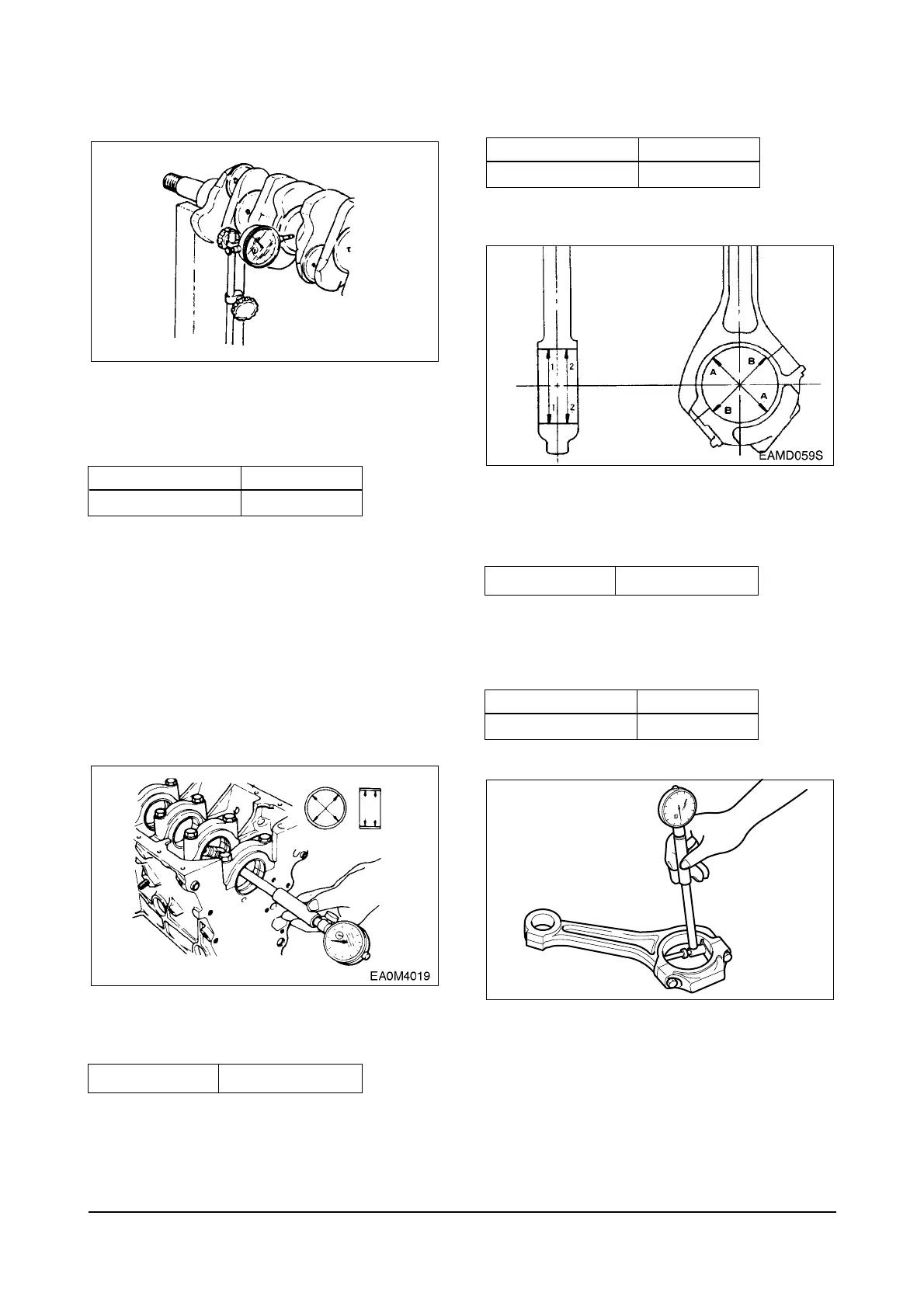
c. Crankshaft run-out
• Support the crankshaft on V blocks.
• Turn the crankshaft with a dial indicator placed on
the surface plate and take the amount of crankshaft
run-out.
2. Crankshaft bearing and connecting rod
a. Visual check
Visually check the crankshaft bearing and con-
necting rod bearing for scores, uneven wear or
damage.
b. Oil clearance between crankshaft and bearing
(Method 1 : dial gauge)
• Main bearing clearance
Install the main bearing in the cylinder block, tighten
the bearing cap to specified torque, then measure
the inside diameter.
Compare the two values obtained through measure-
ment of main bearing inside diameter with the out-
side diameters of crankshaft journals to determine
the oil clearance.
<Main bearing oil clearance>
• Connecting rod bearing clearance
Install the connecting rod bearing in the connecting
rod bearing cap, tighten the connecting rod cap bolts
to the specified torque, then measure the inside
diameter.
Compare the two values obtained through measure-
ment of connecting rod bearing inside diameter with
the outside diameters of crankshaft pins to determine
the oil clearance.
• If the clearance deviates from the specified range,
have the crankshaft journals and pins ground and
install undersize bearings.
c. Oil clearance between crankshaft and bear-
ing (Method 2 : plastic gauge)
• Assemble the crankshaft on the cylinder block and
put plastic gauge on the journal and pin of crank-
45
Standard Limit
0.05 mm 0.1 mm
Torque 30 kg
•
m
Standard Limit
0.052 ~ 0.122 mm 0.25 mm
Standard Limit
0.034 ~ 0.098 mm 0.25 mm
Torque 18 kg
•
m



 To Next Page