6 Dräger Polytron 8200/8310
Description
2.2 Functional description
2.2.1 Principle of operation of the DrägerSensor DD, LC
The DrägerSensor is a transducer for measuring the partial
pressure of flammable gases and vapors in ambient air.
It operates on the heat of combustion principle.
The ambient air to be monitored diffuses through the flame
arrestor in the sensor. The mixture of flammable gases and
vapors is burned catalytically on the heated measuring element
(pellistor). The oxygen required for combustion is taken from
the monitored ambient air (must be greater than 12 vol.%).
The measuring element receives additional warming from the
heat arising from the combustion. This warming causes
a change in the resistance of the measuring element which is
proportional to the concentration of the mixture of flamable
gases and vapors in the air being monitored.
In addition to the catalytically activated measuring element, the
sensor also has a compensating element. Both elements are
part of a Wheatstone bridge circuit. Consequently, environmental
influences such as changes in temperature or humidity are
almost completely compensated for.
The DrägerSensor LC includes additional processing and
amplification of the measuring signal. As a result, the sensor is
suitable for the measuring range 0 - 10 %LEL.
2.2.2 Principle of operation of the DrägerSensor IR
The DrägerSensor IR infrared gas sensor is a gas transmitter
for determining the concentration of gases and vapors in
ambient air. The measuring principle is based on the
concentration-dependent absorption of infrared radiation in the
measured gases.
The ambient air to be monitored diffuses through a sintered
body into the pressure-tight housing of a measurement
cuvette. The broadband light produced by the emitter passes
through the gas in the cuvette, is reflected from the cuvette
walls and is focused on the entrance window of a dual-element
detector. One channel of the detector measures the gas-
dependent light transmission of the cuvette (measuring
channel) and the other is used as the reference. The gas
concentration in the cuvette can be determined from the ratio
of the measured signal to the reference signal. The cuvette is
heated to prevent condensation of atmospheric humidity.
The calculation of the concentration is performed by internal
electronics and software. For the output signal, the gas sensor
emulates the half bridge of a catalytic bead sensor.
2.2.3 Contaminating gases for the DrägerSensor DD, LC
It may be necessary to check the calibration if the sensor has
been exposed for a long time to a high concentration of
flammable gases or vapors or the above-mentioned
contaminating substances.
2.3 Intended use
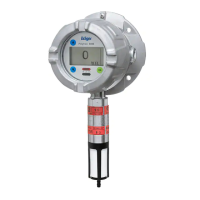
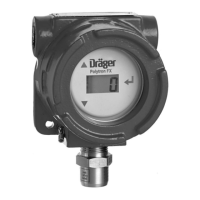
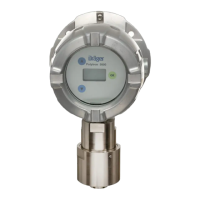
The Dräger Polytron 8200/8310 is an explosion proof device for
continuous monitoring of the concentration of gases and vapors
containing hydrocarbons. The housing for the device consists
of robust, non-corroding stainless steel or aluminum and is
suitable for indoor or outdoor applications. The unit can be
connected to a Dräger monitoring system or a programmable
logic controller (PLC) by means of a sealed conduit or an
appropriately approved cable gland. With the optionally
integrated relay module, the device can be operated without a
central controller (with additional local alarm signalling). The
device is designed for fixed installation and is approved for use
in potentially explosive atmospheres, see chapter 2.5 on
page 7.
2.3.1 Dräger Polytron 8200 with DrägerSensor
® 1
Ex DD
Catalytic bead sensor for monitoring flammable gases and
vapors containing hydrocarbons
{ Detection range: 0 to 100 % LEL
2
2.3.2 Dräger Polytron 8200 with DrägerSensor Ex LC
Catalytic bead sensor for monitoring flammable gases and
vapors containing hydrocarbons
{ Detection range: 0 to 10 % LEL
2)
NOTICE
Certain substances in the atmosphere to be measured
can impair the sensitivity of the sensors.
a) Polymerizing substances such as acrylonitrile,
butadiene and styrene
b) Corrosive compunds such as halogenated
hydrocarbons (which release halogens such as
bromine, chlorine or fluorine on oxidation) and halogen
hydracids, as well as gaseous acidic compounds such
as sulfur dioxide and oxides of nitrogen.
c) Catalyst poisons such as sulfur and phosphorus
compounds, silicon compounds (particularly silicones)
and organometallic vapors. The sensors used work with
measuring elements (pellistors) that are poison-resistant
(PR) and thus have a longer life than conventional
sensors when catalyst poisons are present.
WARNING
Not tested in oxygen enriched atmospheres
(>21% O
2
). High off-scale readings may indicate an
explosive concentration.
1 DrägerSensor
®
is a registered trademark of Dräger.
2 Lower Explosion Limit, depending on substance and the locally
applicable regulations.
i
i
!



 To Next Page