1
1. Introduction:
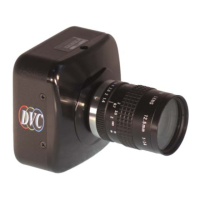
DVC Company, a San Diego, California based manufacturer of cost-effective, rugged video
cameras, thanks you for purchasing from the “DigitEyes" series of digital and analog video
cameras.
This series of cameras is based on the premise that to-day's high-end image processing
applications DEMAND cameras that are designed for the maximum accuracy and repeatability
that can be achieved with to-day's CCDs. DVC's moderately priced cameras occupy a niche
BETWEEN the low-end "security and surveillance" cameras which are inexpensive but
inaccurate, and the expensive, non real-time, high resolution cameras that might be "overkill" for
many applications.
The 30 frames/sec video data is provided as 10 or 8 bit parallel, differential RS-422 data which is
"plug-and-play" compatible with industry-standard image processors and a simultaneous RS-170
composite video signal (Signal-to-Noise ratio ≥62 dB @ 0.5 lux, 100 IRE ). The digital data,
pixel clock, enable line, enable frame and field index signals are accessible via DB-37
connector. Manual (or remote) external gain / offset or Automatic Gain Control (AGC) functions
that can provide nearly 30 dB of gain are available with the RS-170 output to "tune" the dynamic
range of the camera to the application. This provides an optimum match between the dynamic
range & sensitivity of the camera and the requirements of the application - in some cases,
optimum imagery is obtained under low-light conditions in real time (30 frames per second)
without an external image intensifier !
The TC-245 CCD imager has a 755(H) X 484(V) interlaced image format and has on-chip
correlated clamp sample & hold circuitry that minimizes noise. The CCD has a full well of
>80,000 electrons and a noise floor of <30 electrons (at 25°C). It has no "dead" pixels or
"blemishes" that are found in low-end security and surveillance CCD cameras.
The CCD is physically mounted in a cavity within a high-precision opto-mechanical plate to
eliminate the stability problems that are caused by using imprecisely aligned cameras in high-
end applications. On-camera digitization using the CCD pixel clock eliminates pixel jitter,
improves repeatability and brings sub-pixel accuracy to image processing applications.
The DVC-0A (analog only RS-170 model) is upgradeable to the DVC-08 or DVC-10 models
which are 8 or 10 bit digital RS-422 cameras with simultaneous RS-170 output. The camera can,
literally, "grow" with your application ! Shuttering, Pulse driven integration, cooling to -25°C,
genlock (for multiple camera synchronization, removal of the sensor faceplate for UV
applications are options that are available upon request. All DVC cameras come with a standard
2 year warranty and use industry-standard C-mount lenses.
In today's state-of-the-art digital video applications, the parallel 8 or 10 bit digital data can be
serialized and transmitted via fiber optic cable or over other channels. This is achievable without
any degradation of the signal quality over long distances.
This manual applies to all three of the DigitEyes cameras. Since the Analog Video Output is
common to all three cameras, any reference to the Analog Video Output applies equally to all
three cameras. References to the Digital Video Output applies only to the DVC-08 and DVC-10
cameras.



 To Next Page