
 Need help?
Do you have a question about the Dyson AB10 and is the answer not in the manual?
Paper towels cause blockages, overflow, waste, and maintenance issues.
Warm air dryers are slow; jet dryers lack airflow and HEPA filters; drain tanks are unhygienic.
Hands are dried at the sink in 12 seconds, eliminating separate drying areas.
Sensor-activated water and air flow controlled by intelligent infrared sensors.
Small, powerful 1600W motor using digital pulse technology for speed.
Captures 99.9% of bacteria and virus-sized particles from air for hygienic drying.
High-speed air jets from narrow apertures scrape water efficiently.
Air exits laser-cut apertures at 690 km/h through 0.8 mm width.
Robotic precision welding for high-quality stainless steel tubes.
Auto-calibrating infrared sensors activate water/air when hands are present.
Spins at 90,000 rpm, drawing 35 litres of air per second through HEPA filter.
Includes easily replaceable motor unit and removable end cap for service.
Optional aerator reduces water flow; sensor-controlled valve starts water.
Spring-mounted motor reduces sound and vibration.
Eliminates water spillage on washroom floors, improving safety and cleanliness.
Significantly lower running costs compared to paper towels and other dryers.
Provides a more hygienic hand drying experience.
Offers a more environmentally sustainable drying solution.
Delivers the fastest over-sink hand drying.
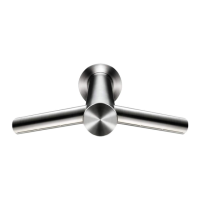
Integrates drying into the tap, freeing up washroom space.
Product is covered by a comprehensive five-year warranty.
Conventional drying methods cause water to drip on the floor, creating hazards.
Airblade Tap keeps water within the sink, preventing floor spillage.
Paper towels and slow dryers incur high costs for restocking and energy.
Dyson Airblade Tap offers up to 97% less cost than paper towels.
Achieves hygienic drying in just 12 seconds.
Features Dyson digital motor V4, HEPA filter, no drain tank, and touch-free operation.
Damp hands spread up to 1,000 times more bacteria than dry hands.
Significant environmental footprint from paper towel production and disposal.
Produces up to 74% less CO2 than other dryers and 71% less than paper towels.
Lower impact across carbon emissions and energy consumption compared to alternatives.
Many dryers are slower than claimed, leading to damp hands and bacteria spread.
Airblade Tap dries hands quickly and hygienically in 12 seconds.
Separate washing and drying areas require significant wall and floor space.
Combines washing and drying, freeing space for extra cubicles or smaller washrooms.
Dryers are engineered for durability and guaranteed against defects for 5 years.
Provides repair support and self-service spare parts to minimize downtime.
Validates environmental impact measurement and reduction efforts.
Confirms suitability for food preparation environments due to hygiene standards.
Confirms compliance with NSF Protocol P335 for hygienic hand drying.
Details component assessment, transport, energy, and recyclability for carbon footprint.
Only hand dryers globally certified for use in food and beverage industries.
Defines criteria for hygienic hand dryers, met by Dyson Airblade.
Mandates HEPA filtration for hygienic air used in drying.
Unheated air prevents bacterial growth and maintains skin oils.
Hands must be dried to 0.1g moisture in under 15 seconds.
Dryer must start and stop without contact for optimal hygiene.
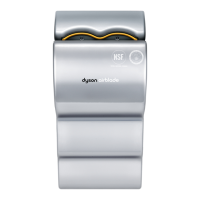
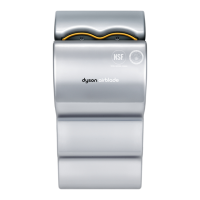
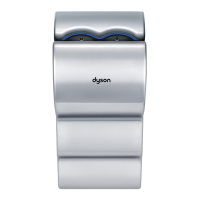
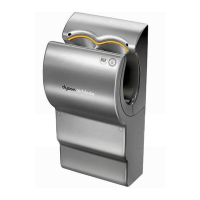
Dimensions and specifications for the AB09 model.
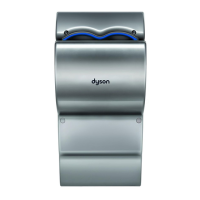
Dimensions and specifications for the AB10 model.
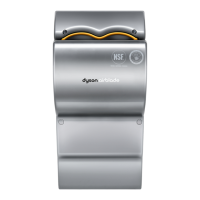
Dimensions and specifications for the AB11 model.
Requires an indoor, dry environment below 2000 metres altitude.
Details voltage, wattage, and necessary disconnection means.
Specifies pressure, pipe size, temperature control, and isolation valve needs.
Provides guidance for motor bucket installation for different models.
A range of sink styles have been tested and approved for use.
Illustrations of recessed, pedestal, wall-mounted, and under-counter sinks.
Recommends porcelain/metal sinks; advises against highly polished surfaces.
Specifies distances for tap stem, centres, and sensor placement for optimal use.
Guides placement to avoid accidental sensor activation by users reaching for soap.
Advises on sink base profiles and wall transitions to reduce water dispersion.
Specifies minimum clearance for servicing and installation below the sink.
Recommends open aperture plug holes; avoid grills/perforated types.
Details clearance and mounting rules for AB09/AB10 motor buckets.
Explains installing the AB11 unit behind a stud wall with an enclosure.
Required for hot and cold feeds to ensure consistent water temperature output.
Required for cold-only feeds to provide controlled water temperature.
Lists all parts provided in the Dyson Airblade Tap box.
Lists necessary tools and additional items for installation.
Guidance on selecting the optimal position for the motor unit.
Steps for safely connecting the mains power supply to the unit.
Procedure for connecting hot/cold or cold-only water feeds.
Steps to secure the cover and motor assembly in place.
Instructions for installing studwork and metal enclosure for AB11.
Steps for fitting plasterboard around the installed unit.
Procedure for installing the main Dyson Airblade Tap hand dryer unit.
Installing the base of the motor bucket within the metal enclosure.
Final wiring steps for the unit's electrical supply.
Connecting water feeds and temperature control systems.
Wipe sensors with a soft cloth and cleaner; use cleaning cap to prevent activation.
Clean all tap surfaces, sink, mirror, and counter tops thoroughly.
Regularly clean air inlets and ensure sink plug hole is free from blockages.
Provides instructional messages for washroom walls and cubicle doors.
Includes stickers with user instructions for the hand dryer arms.




 To Next Page


 General