EasyManua.ls Logo

ebm-papst 422 J/2M - User Manual

ebm-papst 422 J/2M
6 pages
Print Icon
To Next Page IconTo Next Page
Loading...
page 1 of 6
Operating manual
422 J/2M
Product type, manufacturing date (calendar week/year of construction)
and if required, conformity mark can be found on the nameplate on the
product.
Please provide us with the contents of the nameplate when making
enquiries about the product.
ebm-papst St.Georgen GmbH & Co. KG
Hermann-Papst-Straße 1
D - 78112 St.Georgen
Phone: +49 (0) 7724 / 81-0
Fax: +49 (0) 7724 / 81-1309
info2@de.ebmpapst.com
www.ebmpapst.com
As per: 08.10.2019
Version: 1 3
Article number: 9291908022
Original operating manual
INDEX
1 SAFETY REGULATIONS AND INFORMATION 1
2 INTENDED USE 3
3 TECHNICAL DATA 3
4 CONNECTION AND COMMISSIONING 4
5 FAULTS, POSSIBLE CAUSES AND REMEDIES 5
6 COMPLIANCE 5
1 SAFETY REGULATIONS AND INFORMATION
Read the operating manual carefully before commencing work at the
product. Pay attention to the following warnings to avoid risk to
persons or malfunctioning.
This operating manual is an integral part of the product.
In the event of resale or change of ownership the operating manual
must accompany the product. This operating manual may be copied
and provided as information on potential risks and their avoidance.
Hazard classification of warning notices
The following risk ratings are used in this operating manual to denote
potential risk situations and important safety instructions:
DANGER
This is a potentially dangerous situation
and warns of an impending health risk
or risk of fatal injury if this warning is
not observed. Observe this warning.
WARNING
The dangerous situation can occur and
can result in major or fatal injuries if the
warning is not observed. Work with
extreme care.
CAUTION
The dangerous situation can occur and
can result in minor injuries or damage
to property if the warning is not
observed.
NOTE
A potentially dangerous situation can
occur and results in damage to
property if not avoided.
Qualification of personnel
Only skilled electricians are permitted to install the product, to carry out
the test run and to work at the electrical unit.
Only instructed and authorized skilled personnel are permitted to
transport, unpack, operate and service the product.
Basic safety regulations
Safety risks related to the product must be reassessed after installing
in the final device.
The operating manual was developed in accordance with European
market requirements and may need adapting to the market
requirements of the country in question.
When working at the product, observe the following:
Do not make any changes to the product.
WARNING
Impermissible high load
Stop the product immediately after
impermissible loading (e.g. impact,
heat, overvoltage).
Question and Answer IconNeed help?

Do you have a question about the ebm-papst 422 J/2M and is the answer not in the manual?

Summary

Safety Regulations and Information

Hazard Classification of Warning Notices

Explains DANGER, WARNING, CAUTION, NOTE symbols for risk assessment.

Qualification of Personnel

Defines requirements for skilled and authorized personnel working with the product.

Basic Safety Regulations

Outlines fundamental safety rules, including prohibitions on product modification.

Electrical Safety Precautions

Safety advice for electrical connections, emphasizing regular checks and cable integrity.

Safety and Protective Functions

Addresses risks from missing safety devices, faulty equipment, and EMC interactions.

Moving Parts Safety

Warnings about self-starting products and rotating impellers, detailing injury risks.

Airflow Danger Zone

Caution regarding airborne parts and the danger zone around the product's airflow.

Hot Surface Warning

Warning about hot motor housing and burn risks, recommending protective measures.

Transport and Storage Guidelines

Guidelines for safe product transport and storage conditions, including shelf life.

Cleaning and Disposal Procedures

Procedures for careful cleaning and instructions for product disposal according to regulations.

Intended Use

Product Purpose and Requirements

Defines the product's purpose as a built-in air conveying device and requirements for its use.

Prohibited and Dangerous Uses

Lists dangerous applications such as conveying abrasive air or operating in explosive atmospheres.

Technical Data

Technical Description and Specifications

Details product specifications like voltage, speed, mass, protection class, and dimensions.

Ambient Conditions and Vibration

Specifies permitted ambient temperatures and vibration/shock load guidelines.

Connection and Commissioning

Mechanical Connection Procedures

Safety advice for mounting, handling, and using protective equipment during mechanical installation.

Voltage Control and Electrical Wiring

Instructions for speed control, electrical wiring, and ensuring compliance with installation regulations.

Connection Checks and Pre-Operation

Guidance on verifying connections, operating with low voltage, and pre-operation checks.

Faults, Possible Causes and Remedies

Fault Diagnosis and Remedial Actions

Lists common faults like motor not rotating, causes, and suggested remedial actions.

Technical Safety Inspection Schedule

Details required technical safety checks, their frequency, and methods.

Compliance Information

Overview

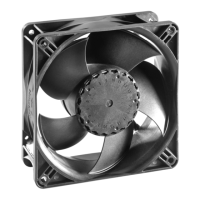
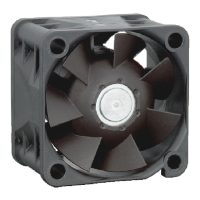
This document describes the ebm-papst 422 J/2M device, an axial fan designed for conveying air. It serves as a built-in component, intended for integration into larger systems.

Function Description

The 422 J/2M is primarily designed for air conveyance, operating with an airflow direction that exhausts air over its struts. The impeller rotates counterclockwise when viewed from the rotor side. The motor automatically restarts after a mains failure or when a blockage is eliminated, provided voltage is applied. This self-starting capability necessitates caution during operation and maintenance. The device is a built-in component and lacks an integrated power disconnecting switch, requiring external means for power isolation during work.

Important Technical Specifications

  • Nominal Voltage: 12 V
  • Current Consumption: 200 mA
  • Power Consumption: 2.4 W
  • Speed: 11,400 1/min
  • Max. Free-Air Flow: 24.0 m³/h
  • Mass: 0.045 kg
  • Protection Class: III
  • Airflow Direction: Air outlet over struts
  • Rotating Direction (looking at rotor): Counterclockwise
  • Max. Torque (mounting): 40 Ncm (wire outlet corner), 60 Ncm (remaining corners)
  • Screw Size: ISO 4762 - M3 degreased, without an additional brace and without washer
  • Permitted Ambient Temperature (Transport and Storage): -40 °C to 80 °C
  • Permitted Ambient Temperature (Operation): -20 °C to 70 °C
  • Pollution Degree: 1 (according to DIN EN 60664-1), indicating no pollution or only dry, non-conductive pollution with no negative impact.
  • Dimensions: Approximately 40 x 40 x 28 mm (length x width x height), with mounting holes for M3 screws.

Usage Features

The product is intended for use in sheltered rooms with controlled temperature and humidity, avoiding direct exposure to water. It must be operated with all protective equipment in place and should not be put into operation before being fully installed in the customer's application. The operating manual must be observed at all times.

Prohibited uses include:

  • Conveyance of air containing abrasive particles, highly corrosive effects, or high dust loads (e.g., sawdust).
  • Conveyance of inflammable gases/particles.
  • Contact with materials that can damage the product (e.g., acids, caustic solutions, solvents).
  • Exposure to radiation that can damage components (e.g., strong UV rays or thermal radiation).
  • Operation during external vibration.
  • Operation close to inflammable materials or components.
  • Operation in an explosive atmosphere.
  • Use as a safety component or for safety-relevant functions without specific validation from ebm-papst.
  • Operation in medical devices with life-sustaining or life-saving functions without specific validation from ebm-papst.
  • Operation in non-stationary systems (e.g., railway vehicles, aircraft, spacecraft) without specific validation from ebm-papst.
  • Operation with fully or partially dismantled or manipulated protective equipment.
  • Operation under conditions other than those specified in the technical data.

An in-situ assessment is required for heating behavior, protection against contact, electrical shocks, impact of foreign objects or water, and usage at altitudes higher than 2000 meters. Speed control via the supply voltage is only permitted within the stipulated supply voltage range; PWM-based speed control is not permitted. Only cables designed for the current and ambient conditions specified on the nameplate should be used, ensuring adequate mechanical protection.

Maintenance Features

Regular maintenance is crucial for the longevity and safe operation of the device.

Safety Inspections:

  • Protection against accidental contact/protective clothing: Visual inspection, minimum 1/2 yearly.
  • Product for damage: Visual inspection, minimum 1/2 yearly.
  • Fixation of product: Visual inspection, minimum 1/2 yearly.
  • Fixation of wires: Visual inspection, minimum 1/2 yearly.
  • Insulation of wires: Visual inspection, minimum 1/2 yearly.
  • Impeller for wear/sediments/corrosion: Visual inspection, minimum 1/2 yearly.

Cleaning: The product should be cleaned carefully with a moist cloth, without applying pressure to the rotor. Avoid cleaning agents containing acids, caustic solutions, or solvents, as these can damage the product.

Storage: The device should be stored in its original packaging in a dry place, protected from weather and vibration, and in a clean environment. It should be protected from environmental effects and dirt until final installation. To ensure trouble-free operation and the longest possible service life, the device should not be stored for more than one year. Even devices intended for outdoor use should be stored as described prior to commissioning.

Extended Non-Operation:

  • If the device is not operated for a lengthy period in a dry environment, it should be started up and operated at full speed for one hour at least every four months.
  • If the device is not operated for a lengthy period in a damp environment (e.g., outdoors), it should be started up and operated at full speed for at least three hours once a month to move the bearings and allow any condensate that may have ingressed to evaporate.

In case of faults, the product should be replaced rather than repaired. If damage is visible, the product should not be started. The product bears the CE and EAC marks, indicating compliance with relevant European directives.
ebm-papst 422 J/2M Specifications

General IconGeneral
Brandebm-papst
Model422 J/2M
CategoryFan
LanguageEnglish

Related product manuals