
 Need help?
Do you have a question about the ebm-papst K3G630-FA38-03 and is the answer not in the manual?
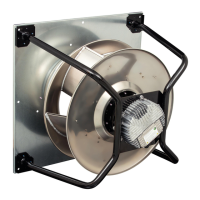
This document outlines the operating instructions for a built-in device designed for conveying air. It emphasizes safety, proper usage, and maintenance to ensure optimal performance and longevity.
The device is intended for use in stationary systems within specific environmental conditions, including an ambient air pressure between 800 mbar and 1050 mbar, and within a permitted ambient temperature range. It is designed to operate with all protective devices in place and in accordance with these operating instructions. The device is suitable for power systems with grounded neutral (TN/TT power systems), phase conductor grounding, or IT power systems, and must adhere to network quality characteristics as per EN 50160.
The device functions as an air conveyor, integrating an EMC filter for compliance with electromagnetic compatibility limits. This filter may cause reactive currents to be measured in the supply line even when the motor is at a standstill and the line voltage is switched on. The device features a motor with ball bearings and includes an alarm display with an LED for operational status. It supports external 15-50 VDC input for parameterization and incorporates an alarm relay. An integrated PI controller allows for configurable inputs/outputs (I/O) and supports MODBUS V6.3 communication via an RS-485 MODBUS-RTU interface. It also includes a soft start function and a voltage output of 3.3-24 VDC, with a maximum power of 800 mW. The control interface is designed with SELV potential, safely disconnected from the mains. Thermal overload protection for both electronics and the motor, along with line undervoltage and phase failure detection, are integrated safety features.
The device's integrated protective functions automatically switch off the motor in the event of specific faults. These include rotor position detection errors, a blocked rotor, line undervoltage (when the line voltage is outside the permitted nominal range), and phase failure. In cases of rotor blockage or line undervoltage, the motor will automatically restart once the condition is resolved. For phase failure, if all phases are correctly supplied again, the motor will automatically restart after a delay of 10-40 seconds.
The device is designed for mechanical connection with the shaft horizontal or the rotor on the bottom, and support struts installed vertically. It is crucial to handle the device carefully during transport and installation to prevent damage to the bearings, frame, or impeller. The fan should not be subjected to force or excessive vibration from the installation. If connected to air ducts, the connection should be isolated from vibration using compensators or similar elements. Stress-free attachment to the substructure is essential. The device must not be handled by the inlet nozzle during transport and installation to avoid impeller damage.
Electrical connection requires careful attention to cable selection and routing. Only cables meeting specified installation regulations for voltage, current, insulation material, and capacity should be used. The protective earth must have a cross-section equal to or greater than that of the phase conductor. Cables should be routed to prevent contact with rotating parts. When connecting multiple devices in parallel, ensure the arrangement conforms to IEC 61000-3-12 regarding short-circuit power at the connection point. For residual current devices, only AC/DC-sensitive types (type B or B+) are permissible, and a trip threshold of 300 mA with delayed tripping is recommended to avoid nuisance tripping from charging currents.
The terminal box connection involves specific stripping lengths for supply, control, and relay lines. Wire-end ferrules with or without insulating collars, conforming to DIN 46228 standards, are required. For flexible control and relay cables from a cross-section of 1.0 mm², a trapezoid crimp is necessary for correct installation. Cable routing should prevent moisture penetration into the terminal box, ideally by forming a U-shaped loop or using a drip edge.
The device should only be switched on after proper installation, ensuring all safety mechanisms are in place and electrical hookup is correct. Before switching on, check for external damage and functional protective devices. Ensure no combustible or flammable materials are near the fan and clear air flow paths of any foreign matter.
Regular maintenance is crucial for the device's long service life. This includes checking the electrical equipment at regular intervals, replacing loose connections and defective cables immediately. The device is a built-in component and requires adequate safeguarding by the owner, operating only with a fixed protective device and guard grill.
For storage, the device should be kept in a dry, vibration-free, clean environment, preferably in its original packaging. It is recommended not to store the device for longer than one year to ensure trouble-free operation and maximum service life. Even devices intended for outdoor use should be stored as described prior to commissioning.
The device's status is indicated by an LED on the electronics housing, displaying various colors and flash codes. Green signifies no warning or fault, orange indicates a warning (no user intervention required), and red indicates an error. Multiple simultaneous errors are displayed in succession, with errors taking precedence over warnings.
Cleaning the fan regularly is essential to prevent soiling and ensure proper operation. The frequency of cleaning should be adapted to the degree of soiling. Cleaning should only be performed when the device is not in motion, and the power supply should be switched off via the control input to prevent accidental start-up. Dry cleaning, such as using compressed air, is the preferred method. Aggressive cleaning agents, high-pressure cleaners, acids, alkalis, solvents, or sharp-edged objects should not be used. All cleaning agents must be completely removed. If severe corrosion is visible on load-bearing or rotating parts, the device should be replaced immediately, as repair of these parts is not permitted. After cleaning, operate the fan for two hours at maximum speed to evaporate any ingested water. If vibrations persist after cleaning, the fan may need rebalancing.
The fan is equipped with maintenance-free ball bearings designed for a service life of 40,000 hours. If bearing replacement becomes necessary after this period, ebm-papst should be contacted. Maintenance intervals should be adapted to the actual level of dust exposure.
A safety inspection should include visual checks of the contact protection cover, device for damage to blades and housing, fastening of cables, insulation of cables for damage, impeller for wear/deposits/corrosion and damage, tightness of cable gland, and condensation drainage holes for clogging. Vibration testing based on ISO 14694 is recommended every 6 months, with a maximum permissible vibration severity of 3.5 mm/s.
For disposal, the product must be disassembled by qualified personnel into suitable components for recycling. Metallic materials (steel, copper, aluminum) are generally recyclable. Components should be separated into categories such as steel and iron, aluminum, non-ferrous metal (motor windings), plastics (with flame retardants), insulating materials, cables and wires, and electronic scrap (circuit boards). Ferrite magnets can be disposed of like normal iron and steel.
 General
| Manufacturer | ebm-papst |
|---|---|
| Model Number | K3G630-FA38-03 |
| Type | Axial Fan |
| Rated Voltage | 230 V |
| Frequency | 50/60 Hz |
| Impeller Material | Plastic |
| Voltage | 230 V |
| Protection class | IP54 |
| Phase | Single-phase |


 To Next Page