Need help?
Do you have a question about the Edwards SIGA-CC2A and is the answer not in the manual?
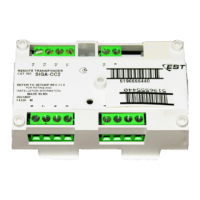
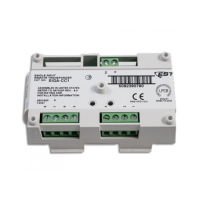
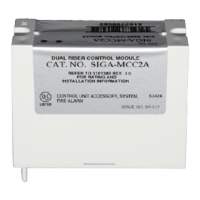
SIGA-CC2A and SIGA-MCC2A are intelligent analog addressable modules for connecting supervised signal or telephone circuits.
Provides visible indication of module status: Normal green LED flashes, Alarm/active red LED flashes.
Details personality codes for single input modules, including riser selection and telephone circuits.
Explains personality codes for dual input modules, covering signal power and audio evacuation.
Instructions for mounting SIGA-MCC2A (UIO) and SIGA-CC2A (2-gang box) modules.
Key safety warnings, including lack of riser supervision and no conventional detector support.
Lists compatible EDWARDS Signature Series control panels: EST3, EST3X, and iO Series.
Covers automatic self-diagnosis and requirements for scheduled maintenance.
Diagrams and notes for Class A/B and telephone/speaker circuit wiring for SIGA-CC2A.
Diagrams and notes for Class A/B and telephone/speaker circuit wiring for SIGA-MCC2A on UIO.
Details electrical, environmental, and synchronization specifications for the modules.
Lists catalog numbers, descriptions, and ship weights for modules and related equipment.
The EDWARDS SIGA-CC2A and SIGA-MCC2A Single/Dual Input Signal Modules are intelligent, analog addressable devices designed for use within the EDWARDS Signature Series system. These modules serve a critical role by connecting supervised Class A or Class B signal or telephone circuits to their respective power inputs, upon command from the loop controller. This functionality allows them to manage various life safety signals, ensuring timely and effective communication within a fire alarm system.
The primary function of these modules is to act as riser selectors, managing power inputs that can carry polarized 24 Vdc current for operating audible and visible signal appliances, or 25 and 70 VRMS for audio evacuation speakers and firefighter's telephones. This versatility makes them suitable for a wide range of applications within a comprehensive fire alarm and emergency communication system.
When configured for telephone circuits, the SIGA-CC2A/MCC2A modules are capable of generating their own ring-tone signal. This eliminates the need for a separate ring-tone circuit, simplifying system design and reducing installation complexity. This feature is particularly useful in firefighter's telephone systems, where clear and immediate communication is paramount.
The modules can be configured to operate in various "personality codes," which define their specific behavior. For instance, as single input modules, they can function as Class B or Class A riser selectors for signal power (24 VDC) or audio evacuation (25 or 70 VAC). In these configurations, the output circuit is continuously monitored for open or shorted wiring. If a fault is detected, the control panel prevents the activation of the audible or visible signal circuit, ensuring that the riser is not connected to a wiring fault.
For telephone applications, the modules can be set up as three-state or four-state riser selectors. In a three-state configuration (open, normal, active), when a telephone handset is plugged in or lifted, the module generates a ring-tone signal and sends a signal to the control panel indicating an off-hook condition. It then awaits a response from the system operator. Once the operator responds, the ring-tone signal is disabled. The four-state configuration (open, normal, active, trouble) offers similar functionality but with an added trouble state, allowing for more detailed status reporting. It's important to note that in the four-state configuration, only one telephone can be used with the CC2A at any given time.
The modules also support Class B and Class A auto synchronization output. In this mode, they provide synchronization of compatible fire alarm signals across multiple zones. The output wiring is monitored for opens and shorts, and if a short exists, the module inhibits the activation of the audible/visual signal circuit to prevent connection to the wiring fault. This ensures that synchronized signals are delivered reliably and safely.
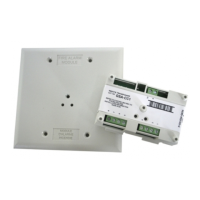
The SIGA-CC2A and SIGA-MCC2A modules offer flexible installation options to suit different project requirements. The SIGA-CC2A is designed for standard 2-gang mounting, fitting into North American 2-1/2 inch deep two-gang electrical boxes or 1-1/2 inch deep 4-inch square boxes with two-gang covers and SIGA-MP mounting plates. This makes it ideal for remote locations where a single module is needed. The SIGA-MCC2A, on the other hand, is a plug-in (UIO) version that mounts onto a UIO motherboard within a suitable EDWARDS enclosure. This option is particularly advantageous in installations where multiple modules are required, allowing for quick and efficient setup.
A key feature of these modules is their electronic addressing capability. Unlike devices that require manual setting of switches or dials, Signature modules are electronically addressed. The loop controller automatically assigns an address to each module during system configuration. Alternatively, a custom address can be assigned using a laptop computer. This simplifies the commissioning process, saving valuable time and reducing the potential for human error.
The modules also benefit from automatic device mapping. Signature modules transmit information to the loop controller about their circuit locations relative to other Signature devices on the wire loop. This intelligent mapping capability aids in system management and troubleshooting.
For enhanced safety and system integrity, the modules include ground fault detection by address. This feature allows the system to detect ground faults down to the individual device level, providing precise fault location and facilitating quicker resolution.
Diagnostic LEDs are integrated into the modules, providing visible status indications when the cover plate is removed. A green LED flashes to indicate normal operation, while a red LED flashes to signal an alarm or active state. These visual cues aid in quick status checks and initial troubleshooting.
The SIGA-CC2A and SIGA-MCC2A modules are designed with maintenance in mind, incorporating features that simplify upkeep and ensure system reliability. The module's automatic self-diagnosis capability is a significant advantage. It continuously monitors its own operation and identifies when it is defective, triggering a trouble message to the control panel. This proactive diagnostic approach helps in early detection of issues, preventing potential system failures.
The user-friendly maintenance program associated with the Signature Series system allows operators to view the current state of each module and access other pertinent messages. This detailed information aids in diagnosing problems and planning corrective actions. Furthermore, individual modules can be temporarily turned off (de-activated) from the control panel, which is useful during maintenance procedures or when isolating a specific part of the system without affecting overall operation.
Regular and selected scheduled maintenance is crucial for proper system operation. The design of these modules supports adherence to the requirements of the Authority Having Jurisdiction (AHJ), as well as current NFPA 72 and ULC CAN/ULC 536 standards. This ensures that the fire alarm system remains compliant and performs optimally over its lifespan.
The electronic addressing and automatic device mapping features, while primarily for installation, also contribute to easier maintenance. Without physical switches to check or set, troubleshooting addressing issues is streamlined. The system's ability to map device locations automatically means that technicians can quickly identify and locate specific modules for inspection or repair.
The diagnostic LEDs, as mentioned earlier, also play a role in maintenance by providing immediate visual feedback on the module's status, allowing technicians to quickly assess its operational state without needing specialized tools or extensive system interrogation.
 General
| Model | SIGA-CC2A |
|---|---|
| Category | Control Unit |
| Operating Voltage | 24 V DC |
| Maximum Alarm Current | 3.5mA |
| Dimensions | 2.1 in (53 mm) high; 6.2 in (157 mm) diameter |
| Operating Humidity Range | 10% to 93% RH, non-condensing |
| Humidity Range | 10% to 93% RH, non-condensing |
| Certifications | UL, ULC, FM |
| CO Sensor Range | Not Applicable |
| Heat Sensor Range | Not Applicable |
| Mounting | Standard 4-inch square or double gang electrical box |

 To Next Page