Straight Sewing
—
fig. 6
fiorfi
⋮
As
↿−∡∔
This generally presents
no
problems, provided
that
the length
of
the stitch is adapted
to
the material being
sewn:
Sheer materials: More
or
less short stitches. Medium and heavy
materials: Longer stitches.
Guide the
work
only,
without
holding
it
back.
Stitches
that
are
too
long
—
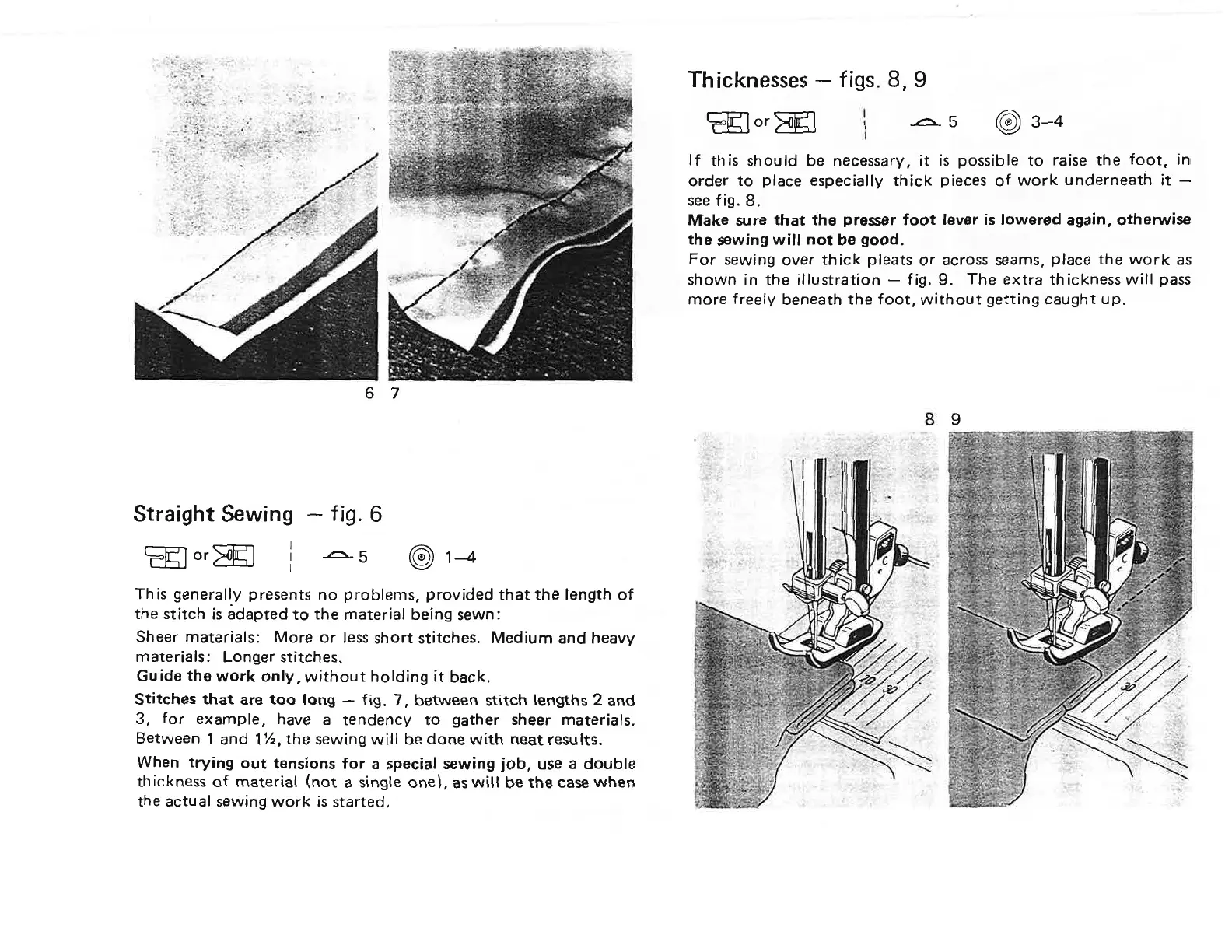
fig. 7, between stitch lengths 2 and
3,
for
example, have a tendency
to
gather sheer materials.
Between 1 and 1‘/2,
the
sewing
will
be done
with
neat
results.
When trying
out
tensions
for
a
special sewing job,
use
a double
thickness
of
material (not
a
single one),
as
will
be the
case
when
the actual sewing
work
is started.
ux. For Evaluation. https://www.qoppa.com/pdfstudio
Thicknesses
—
figs. 8, 9
%@
o
I:
.3
5
3-4
If
this
should be necessary, it is possible
to
raise the foot, in
order
to
place especially
thick
pieces
of
work
underneath
it
—
see fig. 8.
Make
sure
that
the
pre$er
foot
lever is lowered again, othewvise
the
sewing
will
not
be good.
For sewing
over
thick
pleats
or
across
seams, place the
work
as
shown in
the
illustration
—
fig. 9. The
extra
thickness
will
pass
more
freely beneath
the
foot,
without
getting caught
up.
PDF Studio - PDF Editor for Mac, Windows, Linux. For Evaluation. https://www.qoppa.com/pdfstudio



 To Next Page