Satin Stitch
—
figs. 33, 34
jg
⊽↕
A
1.5~5 ↴∕≀⇁↿⋌≖
Embroidery
or
darning thread.
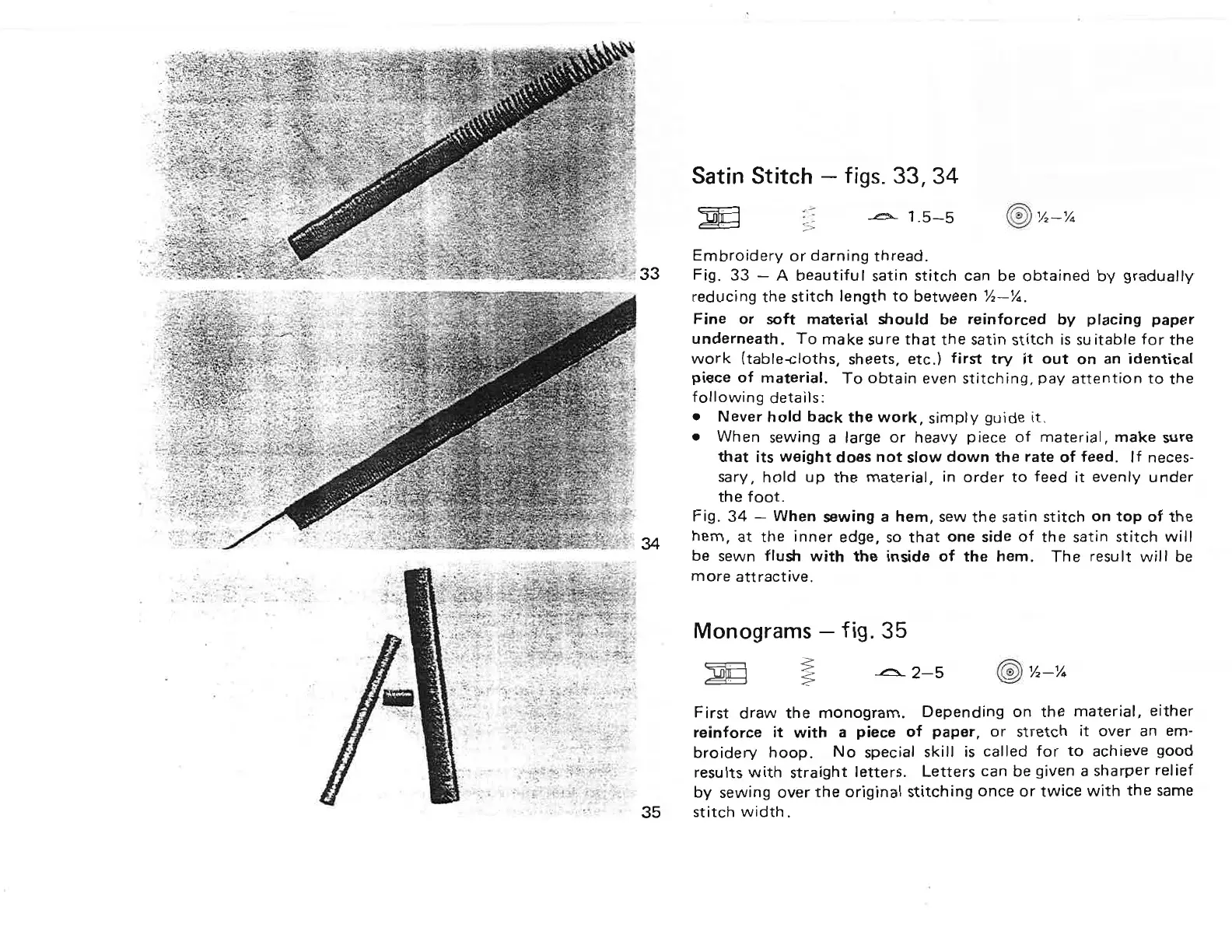
Fig. 33
—
A
beautiful satin
stitch
can
be obtained by gradually
reducing the stitch length
to
between ↿∕≃↽↿∠∙⋅⋅
Fine
or
soft material should be
reinforced
by placing
paper
underneath. To make
sure
that
the satin stitch is suitable
for
the
work
(tablecloths, sheets, etc.)
first
try
it
out
on
an
identical
piece
of
material.
To
obtain
even
stitching,
pay
attention
to
the
following
details:
∙
Never
hold
back
the
work, simply guide
it.
∙
When sewing a large
or
heavy piece
of
material, make
sure
that
its weight does
not
slow down the
rate
of
feed.
If
neces-
sary,
hold
up
the material, in
order
to
feed
it
evenly
under
the
foot.
Fig. 34
—
When sewing
a
hem,
sew
the satin
stitch
on
top
of
the
hem,
at
the inner edge,
so
that
one
side
of
the satin stitch
will
be
sewn
flush
with
the
inside
of
the
hem. The result
will
be
more
attractive.
∖↖∎∎
Monograms
—
fig. 35
y
≣
∆⊇∹↽⋡
First draw the
monogram.
Depending
on
the
material, either
reinforce
it
with
a piece
of
paper,
or
stretch
it
over
an
em-
broidery hoop. No special skill is called
for
to
achieve good
results
with
straight
letters.
Letters
can
be given
a
sharper relief
by sewing
over
the original stitching
once
or
twice
with
the
same
stitch
width.
PDF Studio - PDF Editor for Mac, Windows, Linux. For Evaluation. https://www.qoppa.com/pdfstudio



 To Next Page