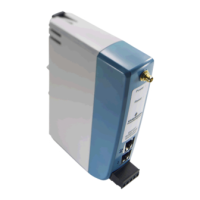
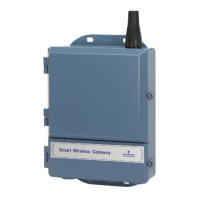
3.3 Power specifications
Table 3-1: Emerson 1410S Gateway Power
Gateway version Non-barrier Barrier
Input voltage 10.5 to 30V VDC 24 VDC
Power consumption 5 Watts 7.5 Watts
At start-up, the power supply must be capable of momentarily
sourcing at least twice the operating current. The Gateway may
draw significantly more current momentarily at start-up if not
limited by the power supply.
Power over Ethernet (PoE) Gateway supports IEEE 802.11 PoE as a Powered Device (PD) on
either port.
Input and output connections In: DC power (2-wire)
I/O: RS-485 (2-wire)
The Gateway is designed to be powered by 24 VDC (nominal) Class 2 supply and requires
350 mA of current per network.
The wiring should include an external power shut-off switch or circuit breaker positioned
near the Gateway.
The terminals on this connector can accommodate wires from 24 AWG to 12 AWG; 18
AWG wire is recommended. Tighten screws to 4.4 to 5.3 l bf-in (0.5 to 0.6 Nm).
In ambient temperatures greater than +60 °C, use wire rated for at least 5 °K above the
maximum ambient temperature.
Note
Using an uninterruptible power supply (UPS) is recommended to ensure availability during
power failure.
Table 3-2: Emerson 781S Smart Antenna Power
Emerson Smart Antenna
model version
781S 781SC
Input voltage
10.5 to 30V VDC
Power consumption
0.25 W 0.30 W
Radio protocol
IEC 62591 (WirelessHART
®
) IEC 62734 (ISA100)
EIRP (Max)
Meets all industrial environment requirements of EN61326.
Maximum deviation less than one percent span during EMC
disturbance.
Antenna options
Integrated omni-directional antenna
Input and output connections
In: DC power (2-wire)
I/O: RS-485 (2-wire)
Installing the Gateway Reference Manual
May 2020 00809-0600-4410
22 Emerson.com


 To Next Page
 Loading...