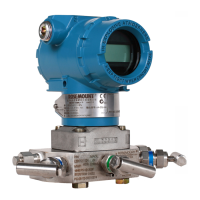
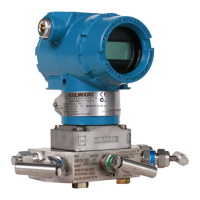
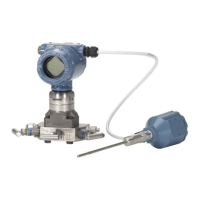
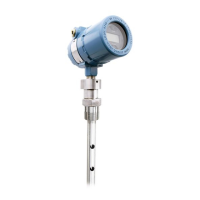
To wire the transmitter:
Procedure
1. Remove the housing cover on the field terminals side.
2. Connect the positive lead to the “+” terminal (PWR/COMM) and
the negative lead to the “–” terminal.
3. Ensure full contact with terminal block screw and washer.
When using a direct wiring method, wrap wire clockwise to
ensure it is in place when tightening the terminal block screw.
NOTICE
Emerson does not recommend using a pin or a ferrule wire, as
the connection may be more susceptible to loosening over
time or under vibration.
4. Ensure proper grounding.
NOTICE
It is important that the instrument cable shield:
Be trimmed close and insulated from touching the
transmitter housing
Be connected to the next shield if cable is routed through a
junction box
Be connected to a good earth ground at the power supply
end
Do not connect the powered signal wiring to the test
terminals. Power could damage the test diode in the test
connection. Use shielded twisted pair cable for best results.
Use 24 AWG or larger wire and do not exceed 5,000 ft.
(1500m).
5. Plug and seal unused conduit connections.
6. If applicable, install wiring with a drip loop. Arrange the drip
loop sothebottom is lower than the conduit connections and
the transmitterhousing.
7. Replace the housing cover.
February2024 Quick Start Guide
Quick Start Guide 17



 To Next Page
 Loading...