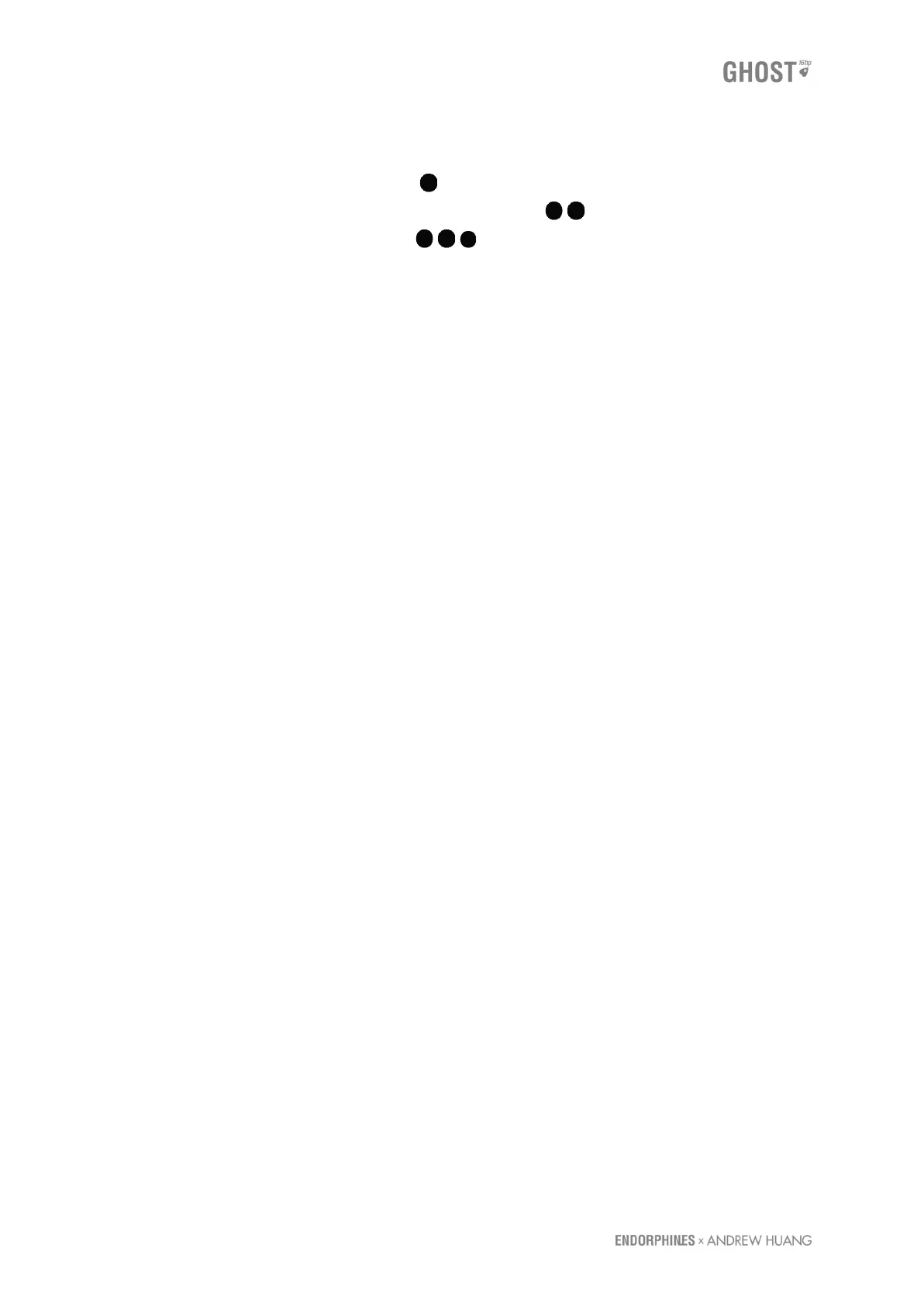
🠚 ROUTING + TAP BUTTON: switches the way the delay taps are
distributed (hard panned) in the stereo OUTPUTS 1/2. When certain mode is
enabled, the TAP button blinks once – the taps appear on OUTPUTS 1 and 2 in
an LRLR pattern. When the TAP button blinks twice – the tap pattern is LRRL .
When the TAP button blinks 3 times – STEREO mode is selected, where the
delay taps appear on either L or R output only when there is something present on L
or R input, aka true stereo operation. The true stereo mode shortens the maximum
delay time by half. Minimum delay time manually set with TIME/DIV knob
corresponds to approximate C4 note (~261 Hz) in LRLR and LRRL taps and
approximate C5 note (~523 Hz) and 1 octave more with external 1v/oct TIME CV
applied.
🠚 DELAY DRY/WET + REPEATS, BOTH CCW
FW.V.1.02
(or via CV):
buffer clear. When using long delay times, it may be desirable to clear the delay
buffer in order to quickly introduce new audio material into the delay line. To do so,
turn both the Delay dry/wet (11) and Repeats (12) knobs to their full CCW positions
to delete the buffer content.
🠚 LOOPER. When REVERSE REVERB is activated (see above), FREEZE button
(23) activates and deactivates LOOPER for the delay (recirculating delay’s audio
buffer) instead of the reverb’s freeze.
🠚 NOTE: Tap tempo via the TAP button (17) doesn’t work if an external clock is
applied.
ADVANCED REVERB PARAMETERS
🠚 ROUTING + TAIL KNOB: sets the PRE-DELAY amount for the reverb,
which is an important control that can add additional depth to your sounds,
particularly useful when processing percussion. Full CCW knob position (21)
corresponds to no pre-delay and full CW position corresponds to maximum
possible pre-delay time (up to 0,5 seconds). The pre-delay setting is especially
useful when used with REVERSE reverb.
🠚 ROUTING + REVERB DRY/WET KNOB
FW V2.0
controls the TILT
EQ that adjusts the / TONE brightness of both reverb tanks (so called DAMPING ): is
especially useful to cut low frequencies from the reverb to remove reverb’s
muddiness or vice versa. That TONE* range (20) for reverb is identical to TONE input
shaping control (3) or TONE * for delay repeats.


 To Next Page