9
For best grinding results and wheel life:
• Centralize the buttons precisely.
• Make sure there is a generous flow of coolant at the point of contact.
• Grind carefully and do not rush.
• Let the machine do the work.
• Do not try to speed up grinding by adding hand pressure to the
feed lever.
• Use original grinding wheels only.
• Use recommended pressures.
Grinding hints
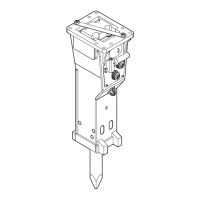
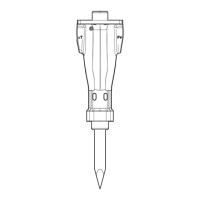
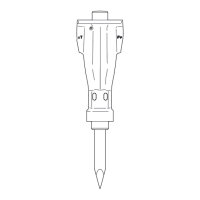
The rate of bit wear depends on the rock formation, and is highest
in rocks with a high quartz content. A suitable grinding interval
should be determined according to the rate of bit wear. It is more
economical to regrind too early rather than to suffer poor penetra-
tion rates and risk damaging the drill bit through overdrilling. A
few hints about the care of drill bits:
When to regrind
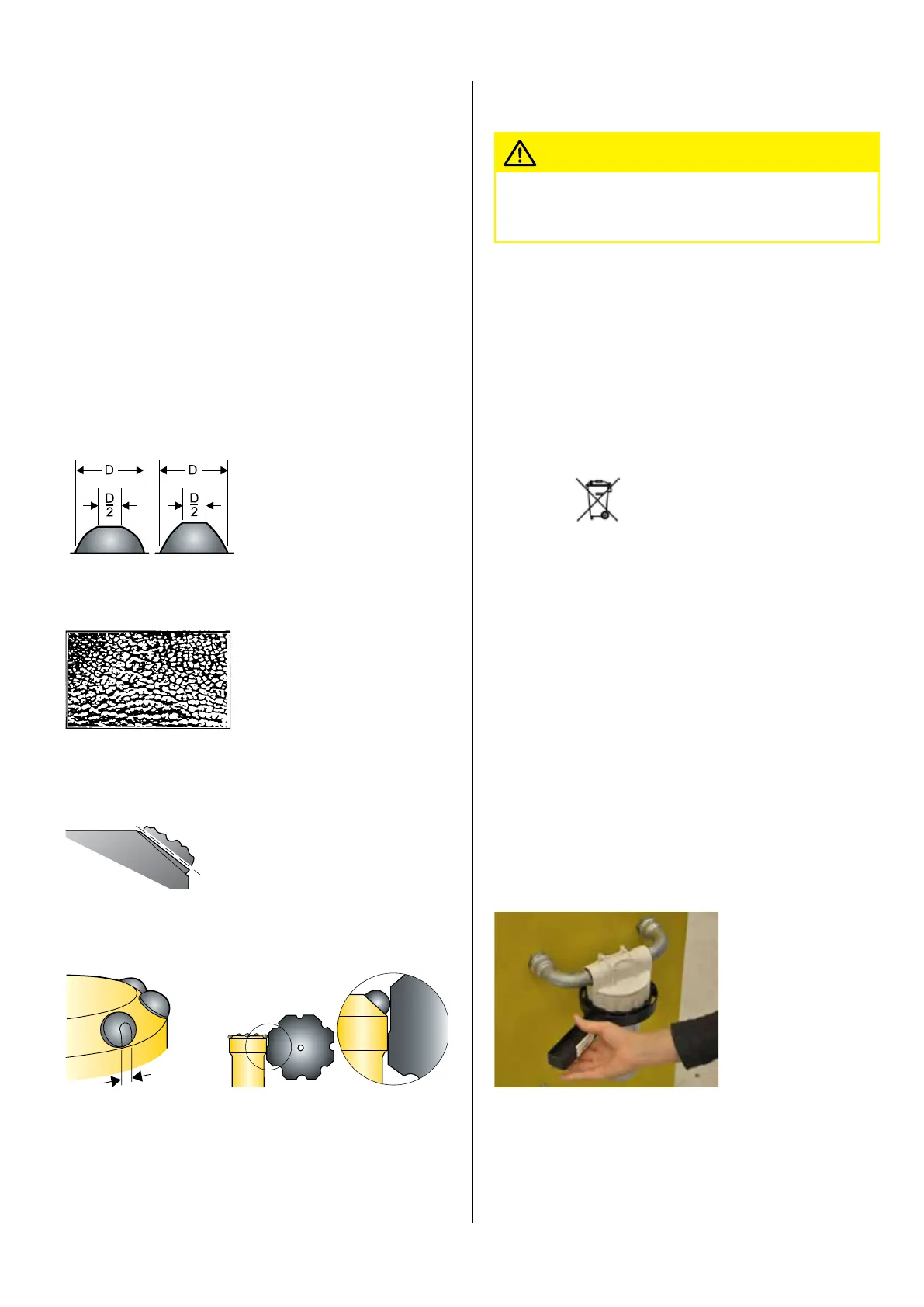
Button bits should be re ground
when the pene tration rate drops,
or if any of the cemented-carbide
buttons are damaged (fractured
buttons should be ground flat). It
is both practical and economical to
redress the buttons when the wear
flat reaches about 1/2 of the diameter of the button.
Look out for “snake skin“
If microscopic fatigue cracks – so-
called “snake skin“ – begin to
appear on the cemented car bide
buttons, the cracks must be ground
away. In any event, bits should be
reground after 300 metres of
drilling at the most. This should be
done even if there are no visible signs of wear and the penetra-
tion rate continues to be good. If snake -skin is not removed, the
cracks will deepen and ultimately result in button fracture.
Always grind broken buttons flat
A drill bit can remain in service as long
as the gauge buttons maintain the
diameter of the bit. Fractured buttons
must always be ground flat to prevent
chips of cemented carbide from
damaging the other buttons.
Avoid grinding the perimeter
2 mm
Min
0,5
Gauge button anti-taper has to be removed by grinding, although
excessive reduction of the bit diameter should be avoided. Leave
about 2 mm of the wear flat.
If necessary, remove some of the bit-body steel below the gauge
buttons, so that a clearance (taper) of 0,5 mm is maintained.
Make sure that the flushing holes are open.
Maintenance
• Before attempting service or repair work on the machine,
ALWAYS switch off and disconnect the electricity supply and
the compressed air supply.
CAUTION
Cleaning
Keep the machine clean at all times. This is the cheapest and easi-
est way to maintain the machine.
Lubrication
Most bearings and bushings in the machine are permanently
lubricated and do not normally need any maintenance. Use the
grease nipples to lubricate moving parts.
Follow our recommendations found in this instructions, section
"Recommended lubrication and cooling liquids".
Disposal
A used machine must be treated and disposed in such a way that
the greatest possible portion of the material can be recycled and
any negative influence on the environment is kept as low as pos-
sible, and with respect to local restrictions.
Cooling liquid
Particles of cemented carbide and steel gradually accumulate in
the sedimentation tank. Empty and clean out the tank regularly. If
the machine is used every day, the sedimentation tank should be
cleaned out at least once a week. Since the water in the tank con-
tains particles of cemented carbide, local regulations (in respect of
water contamination) must be observed when it is emptied.
Fill the sediment tank with new fluid consisting of a mixture of
cooling concentrate and water (mixing ratio 4-8%). Apart from
cooling the grinding wheel and cemented-carbide buttons, the
cooling fluid serves to prevent rust in the machine.
If the machine is not going to be used for some time, the cooling
system should be drained. If the machine is not going to be used
for a long time, it should be oiled generously.
Water filter
Use the wrench to open and/or close the cup.
Air filter
The air filter prevents particles of dirt and also water from enter-
ing the pneumatic system. It should be drained and cleaned
regularly. The water level in the bowl must not be allowed to rise
as high as the separator disc.


 To Next Page