IPES IR3 Flame Detector
Operating Manual
Page 11 of 37
5.0 Performance Characteristics
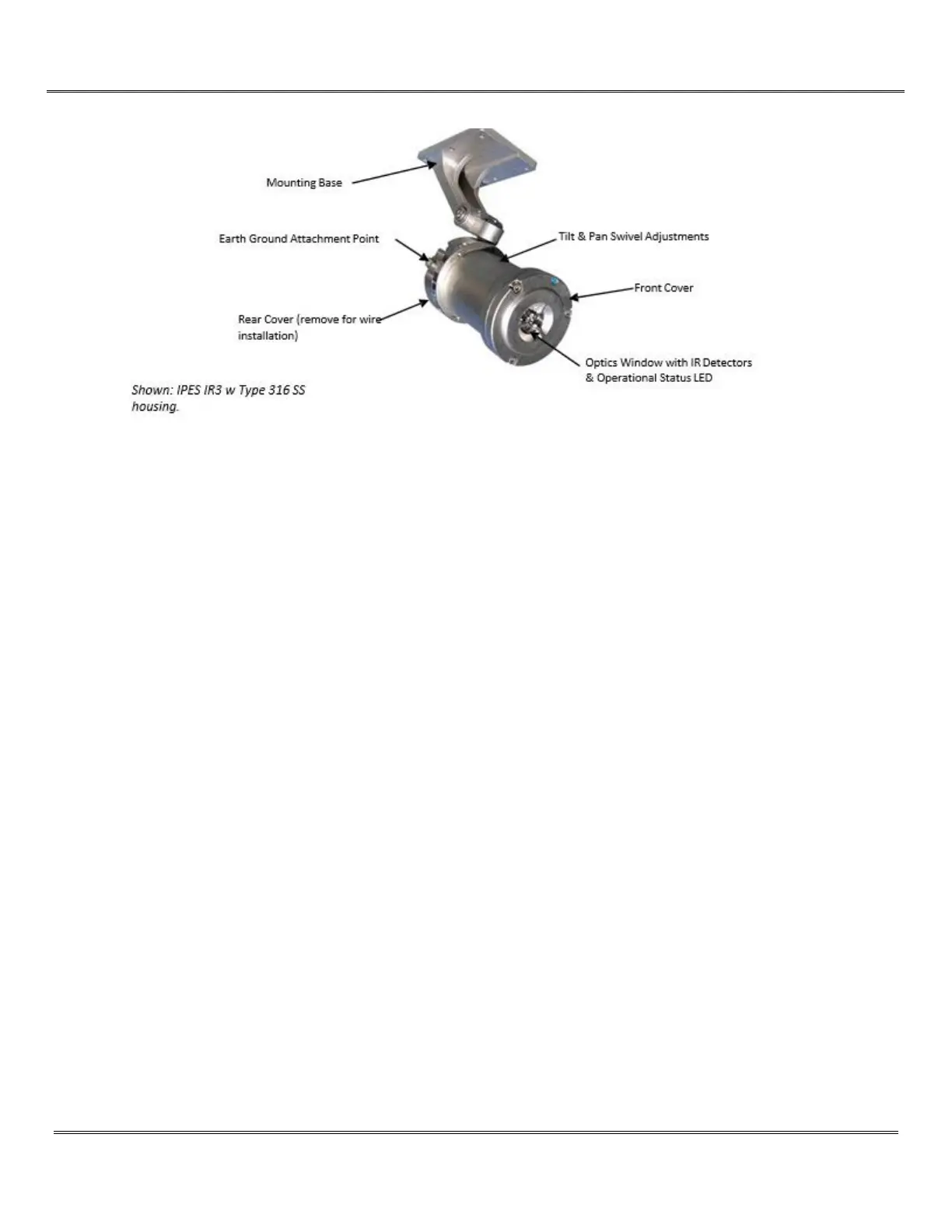
Figure 5-1: IPES-IR3 Components
The IPES‐IR3 consists of an explosion‐proof casing with sensors to detect electromagnetic radiation from flames at three points
within a spectral window of 4.0 to 5.0μm. Detection is performed using Infrared Sensors that capture heat and radiating gas
signatures emitted by fire. Significantly, the IPES‐IR3 can detect fires fueled by hydrocarbon‐based liquids and gases that may
not be visible to the human eye.
The basic technology is well tested and used for many devices designed for human interaction. These include night vision
equipment, FLIR navigation assist, and Spectral Telescopes used in astronomy.
The IPES‐IR3 uses microprocessors with proprietary algorithms that transform the detected signal into industry standard analog
and digital communication signals, alarms indicators.
The IPES‐IR3 response time detecting radiation emitted by test sources of n‐Heptane combustion in a 12” x 12” (0.3m by
0.3m) pan, and ethyl alcohol combustion in a 12” x 12” (0.3m by 0.3m) pan, at a distance of 150 feet (46 meters) does not
exceed 30 seconds.
The sensitivity and response time can be varied in order to reduce unwanted “noise” when the IPES‐IR3 identifies a fire, or
the distance to the probable place of fire is short (“near/far” and “slow/fast” modes).
Generation of Alarm
Signals
The IPES‐IR3 takes the following parameters into consideration when generating an alarm signal:
•
Magnitude of signals from different optical channels
•
Ratios between the signal amplitudes of different channels
•
Signal modulation frequency
•
Phase relationships among the channels


 To Next Page