10
damaging it. These precautions are very necessary. A
sharp wire tip can quite easily pierce both the wire guide
and the wall of the welding conduit and thus seriously
impair the function of the gun.
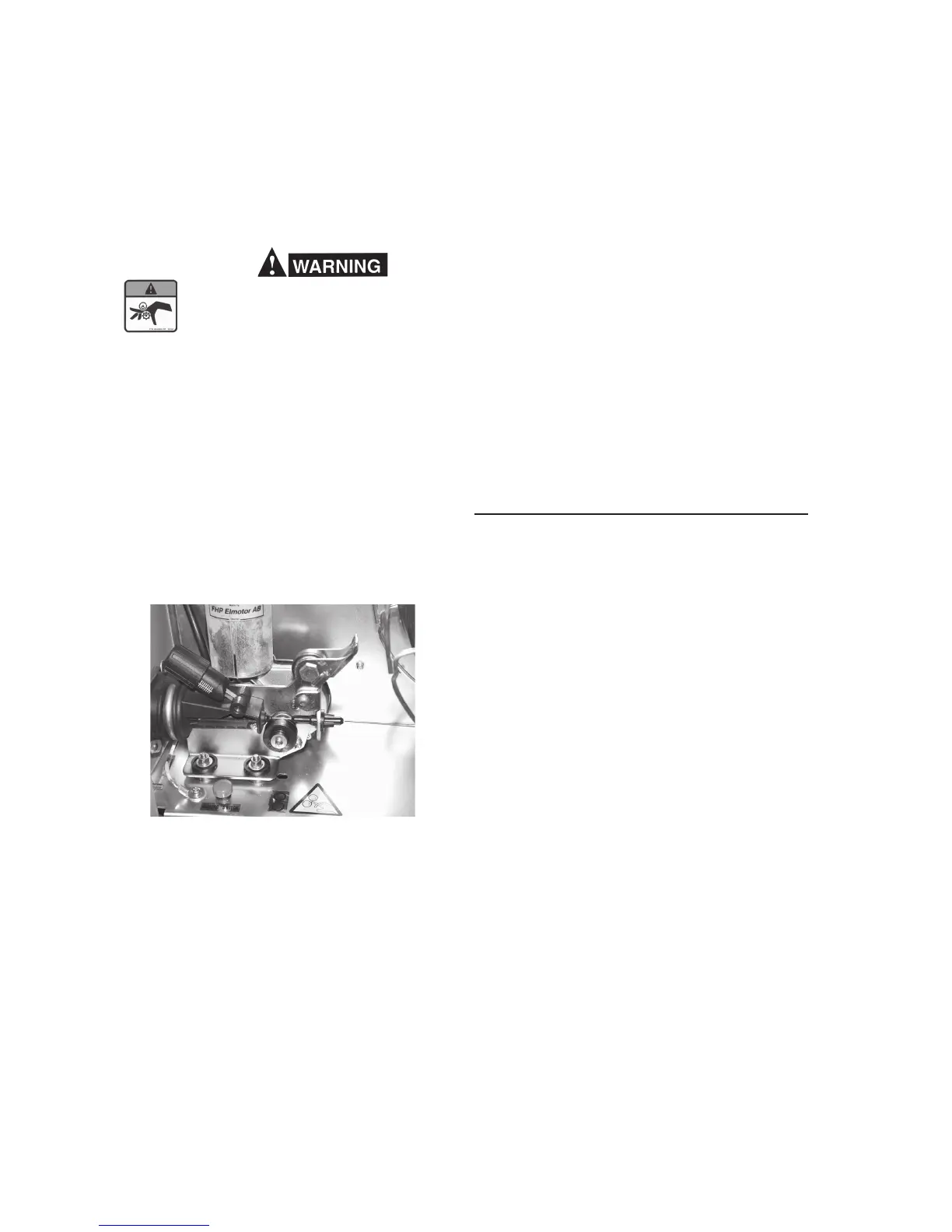
Feed the wire into the protruding wire guide on the inlet
side of the feed unit and then by hand feed the wire up to
the roll. Before the wire is fed further into the guide nozzle
of the feed unit, the pressure arm and roller must be lifted
up.
Keep your fingers clear of the drive rolls;
they will start turning when the torch trigger
is pressed.
The wire can now be fed in by hand through the guide
nozzle and into the welding conduit and the pressure roll
can be lowered again. The contact pressure of the feed
roll is adjusted at the factory, but if necessary it can be
modified by means of the screw on the pressure arm. A
rule of thumb for this type of secondary adjustment is that
the pressure must not be harder than makes it possible to
stop the forward travel of the wire through the Mig gun by
pressing the contact nozzle against a piece of wood or
equivalent so that the rollers of the feed unit slip. If the
pressure is too high when welding, the result may be that
the wire will build up and jam in the outlet nozzle of the
feed unit should the tip of the wire stick. This is
troublesome to straighten out and, with correct settings,
also unnecessary.
Mild Steel
Stainless
(Argon + CO
2
) (Argon + CO
2
+ Oxygen)
(Argon + CO
2
+ Oxygen) (Argon + Oxygen)
Fig. 4 - Feed Roll With Wire Inserted
Another drawback of excessive feed pressure is that the
welding wire can be rolled flat which causes unnecessary
wear on the wire guide and that contact in the gun will be
jeopardized.
Set the voltage selector switch on front of machine to po-
sition 1. The wire feed can be turned to one of the center
settings. Straighten out the gun hose. Wire is fed forward
either by pressing the inch button on the wire feed unit
(cold wirefeed), or by pressing the gun trigger.
Take care
when the wire emerges from the gun since the point can
cause injury.
Gas Selection
Select the appropriate shielding gas for the type of mate-
rial to be welded and filler metal being used. The shielding
gas is used to protect the molten weld pool from being
contaminated by the surrounding air. The shielding gas
also contributes to arc stability, weld strength and
appearance so care should be taken to ensure that the
correct gas type/mixture is selected for the metal being
welded. Contact your local ESAB distributor or gas
supplier for recommendations.
Typical Gas Selections




 To Next Page