Need help?
Do you have a question about the ESP MAGPRO16 and is the answer not in the manual?
Overview of the MAGPRO16 addressable fire panel's capabilities, including zone coverage and loop connectivity.
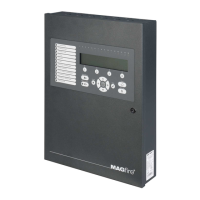
Details on the panel's physical and technical specifications, including front panel features and connectivity options.
Specific technical details of the MAGPRO16 panel, including loop capacity and zone numbers.
Information on minimal and maximal hardware configurations for the MAGPRO16 panel.
Environmental operating conditions for the fire alarm panel, including temperature and humidity.
Electrical characteristics and earth connection requirements for the MAGPRO16 fire alarm panel.
Guidelines and procedures for correctly mounting the MAGPRO16 fire alarm panel on a wall.
Identification and description of the various components that make up the MAGPRO16 system.
Detailed description of the front panel elements, including LEDs, LCD module, and buttons.
Explanation of the basic module configuration within the MAGPRO16 fire alarm panel.
Description of the main Printed Circuit Board (PCB) of the MAGPRO16 control panel.
Procedures for connecting various signaling devices, such as sounders and alarm outputs.
Instructions for connecting sounders to the MAGPRO16 panel's monitored outputs.
Guidelines for connecting signaling and control devices to monitored outputs like FIRE, FAULT, and EXT.
Diagrams for connecting specialized inputs, often used with extinguishing control panels.
Details on installing and connecting the MAGPRO16-L250 loop controller for additional loops.
Calculations and guidelines for determining the maximum permissible cable length for loops.
Instructions for connecting the main power supply and the accumulator battery to the panel.
Connecting additional modules like heat printers, network interface cards, and LAN communication modules.
Using the MAGPRO programming software for configuring the fire alarm panels.
Direct programming and settings configuration using the panel's front panel keyboard.
Procedures for updating the panel's firmware, either from a computer or USB drive.
Steps for updating the firmware using a computer via USB connection.
Instructions for updating the firmware using a USB drive connected to the panel.
Procedure for copying the panel's image file to a USB drive.
Overview of programming menus, access levels, and initial panel startup procedures.
Description of the three access levels (User, Maintenance, Installer) and their associated codes.
How to review active alarm messages displayed on the panel, with priority indication.
Procedure for reviewing fault messages and understanding their priority and clearing.
Information on how to review system disablements and their priority.
How to check the status of running tests and identify zones under test mode.
Procedure for reviewing warning messages, which have low priority in the system.
Covers silencing buzzer/sounders, activating evacuation, panel reset, and indication testing.
Accessing, reviewing, and managing the system's event log file.
How to view the complete list of recorded events in the panel's memory log.
Extracting and reviewing system events filtered by a specific date.
Procedure for clearing the entire system events list from the panel's memory log.
Instructions for printing events and configuring printer settings for the panel.
Managing zones, including status review, testing, disabling, and parameter programming.
Navigating zone status, general submenus, and device count within zones.
Procedures for performing tests on individual zones or all zones in the system.
How to disable or enable zones, affecting how the panel responds to zone events.
Setting zone names, operation modes, delays, and group assignments.
Managing connected devices, including finding, saving, deleting, disabling, and parameter setup.
Accessing general settings, device counts, and submenus for device management.
Procedure for saving newly detected devices in the system configuration.
Steps for removing devices from the system configuration.
How to disable or enable individual devices, affecting their system interaction.
Setting specific parameters for different device types like detectors and sounders.
Setting and changing device addresses, including self-addressing procedures.
Manually setting addresses for new devices in the system configuration.
Procedure for modifying the address of an existing device.
Using the panel's self-addressing function to assign addresses to devices.
Configuring and managing panel outputs like sounders, fire, fault, and relay outputs.
Setting delays and enabling/disabling sounder outputs based on operational modes.
Configuring the extinguishing output, including its enable/disable status.
Setting delays and status for fire and fault outputs.
Configuring the parameters for the panel's four relay outputs.
Adjusting panel-wide settings including access codes, date/time, and language.
Changing access codes for Maintenance and Installer levels, and setting auto-exit timers.
Setting the current date and time for the panel, with battery backup for saving.
Configuring day/night operation modes and setting alarm schedules.
Adjusting panel settings like language, brightness, and setting Delay T1.
Setting sounder modes, alarm tones, evacuation delays, and zonal operation.
Saving system configuration, restoring defaults, and reviewing software versions.
Procedure for saving the current system configuration after changes.
Resetting the panel to its factory default settings.
Reviewing software versions and initiating firmware updates.
Configuring network settings for redundant network connections between panels.
Setting panel numbers, names, and status within the redundant network.
Reviewing active isolators and their device addresses in the system.
Information on exiting higher access levels and returning to Access Level 1.
 General
| Type | Magnetic Contact |
|---|---|
| Mounting | Surface Mount |
| Colour | White |
| Operating Temperature | -10°C to +50°C |
| Contact Type | Normally Closed (NC) |
| Material | Plastic |
| Input Voltage | 12-24V DC |
| Output Voltage | 12-24V DC |

 To Next Page