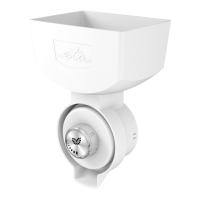
III. 12) Grein mill for Cereals, Legumes and Rice (Q)
PLEASE, PAY SPECIAL ATTENTION TO ALL THE WARNINGS
AND ADVICE PROVIDED BELOW!
THE GRINDER IS AN ATTACHMENT WITH PROPERTIES AND
GRINDING PROCEDURES THAT REQUIRE GOOD KNOWLEDGE.
AFTER SOME TIME, YOU WILL GET EXPERIENCE WITH THE
USE OF THE GRINDER THAT WILL LEAD TO GOOD RESULTS.
II.A. MATERIAL:
– The grinder is designed for processing most types of cereals and legumes
(e.g. wheat, rye, oats, rough barley, buckwheat, various lentils, peas,
beans, rice, millet).
– Do not process soya, chickpeas and other oilseed crops (e.g. poppy, hemp,
flax, sunflower, sesame and chia seeds, peanuts etc.) or very hard food,
such as popcorn, nutmeg, walnuts, hazelnuts, almonds.
– We do not recommend processing aromatic foods (such as coffee, herbs,
dried mushrooms, hard spices, black pepper, clover, mustard, dried
bread etc.). Such aromatic foods could have a negative effect on the flavour
and aroma of the following ground cereals, legumes or rice.
– Never process materials larger than 6 mm!
– Never process wet, moist or frozen cereals, legumes and rice!
– Use only dry material for grinding (under 13 % humidity)! The material must
be crushed, not pressed during grinding so that it stays loose and does not
lose its characteristic consistency.
– If you also process fodder crops in addition to food crops, do not use them for
food purposes and subsequent consumption.
– Use good quality material. We recommend checking the material before
grinding for any foreign matters (e.g. bits of stones) that could damage the
product (e.g. abrade the grinding stones). Any returns in the warranty period
caused by such impurities will not be accepted.
– Cereals, legumes and rice are natural and live “natural tins” and thus they
behave in a hygroscopic way. Therefore, they must always be stored in
a dry place. When the material is ground slowly, with problems and overheats
easily, it means that it is too moist. Stop grinding and dry the material.
Drying Material
Spread the material on a baking sheet and let it dry in the air for a sufficient
period of time (about 24 hours) to get rid of excess moisture. You can also use
an electric/gas/hot air oven set to the maximum temperature of 45 °C. Dry the
material for about 2 hours.
You can also use a fruit dehydrator. Make sure you use a suitable pad or
screen on the drying plates so that the material does not fall through.
Spread the material evenly in a thin layer to make drying more effective. Dry for
at least 2 hours.
GB
92


 To Next Page
 Loading...