7
Operating Instructions
Safety Switch TZ…
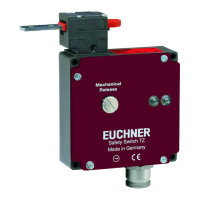
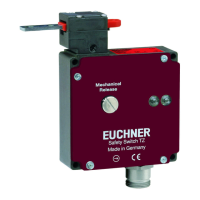
Manual release
Some situations require the guard locking to be
released manually (e.g. malfunctions or an emer-
gency). A function test should be performed after
release.
More information on this topic can be found in the
standard ENISO14119:2013, section 5.7.5.1. The
device can feature the following release functions:
Auxiliary release
In the event of malfunctions, the guard locking can
be released with the auxiliary release irrespective
of the state of the solenoid.
The contacts are opened when the auxiliary
release is actuated. A stop command must be
generated with these contacts.
Actuating auxiliary release
1. Remove key from sealing wire.
2. Remove screw plug.
3. Release by turning the key.
¨ Guard locking is released.
Important!
f The actuator must not be under tensile stress
during manual release.
f To prevent tampering, the auxiliary release must
be sealed before the switch is set up.
f Reset the auxiliary release after use and screw
in the screw plug (tightening torque 0.5Nm).
f Restore the sealing with a new seal.
Auxiliary key release/auxiliary
release with triangular wedge
Function as for auxiliary release.
Important!
f The actuator must not be under tensile stress
during manual release.
Escape release
This permits opening of a locked guard from the
danger zone without tools.
Important!
f It must be possible to actuate the escape re-
lease manually from inside the protected area
without tools.
f It must not be possible to reach the escape
release from the outside.
f The actuator must not be under tensile stress
during manual release.
f The escape release meets the requirements of
Category B according to ENISO13849-1:2015.
The contacts are opened when the escape
release is actuated. A stop command must be
generated with these contacts.
Emergency release
This permits opening of a locked guard from outside
the danger zone without tools.
Important!
f It must be possible to operate the emergency
release manually from outside the protected
area without tools.
f The emergency release must possess a mark-
ing indicating that it may be used only in an
emergency.
f The actuator must not be under tensile stress
during manual release.
f The release function meets all other require-
ments from ENISO14119.
f The emergency release meets the requirements of
Category B according to ENISO13849-1:2015.
The contacts are opened when the emergency
release is actuated. A stop command must be
generated with these contacts.
Mounting
NOTICE
Device damage due to improper mounting and
unsuitable ambient conditions
f Safety switches and actuators must not be used
as an end stop.
f Observe ENISO14119:2013, sections 5.2 and
5.3, for information about mounting the safety
switch and the actuator.
f Observe EN ISO14119:2013, section 7, for
information about reducing the possibilities for
bypassing an interlocking device.
f Protect the switch head against damage, as well
as penetrating foreign objects such as swarf,
sand and blasting shot, etc.
f The specified IP degree of protection is applica-
ble only if the housing screws, cable entries and
plug connectors are properly tightened. Observe
the tightening torques.
f The screw plug of the auxiliary release must be
sealed prior to setup.
Changing the actuating direction
Fig. 2: Changing the actuating direction
1. Insert the actuator into the actuating head.
2. Remove the screws from the actuating head.
3. Set the required direction.
4. Tighten the screws with a torque of 1.2 Nm.
Electrical connection
WARNING
Loss of the safety function due to incorrect
connection.
f Use only safe contacts ( and ) for safety
functions.
f When choosing the insulation material and
wires for the connections, pay attention to the
required temperature resistance and the max.
mechanical load!
f Strip the insulation from the ends of the individual
wires over a length of 6
±1
mm to ensure a safe
contact.
Use of the safety switch as guard locking for
personnel protection
At least one contact must be used. It signals
the guard locking state (for terminal assignment,
see Fig. 3 and Fig. 5).
Use of the safety switch as guard locking for
process protection
At least one contact must be used. Contacts
with the symbol can also be used (for terminal
assignment, see Fig. 3 and Fig. 5).
The following information applies to devices
with plug connector:
f Check that the plug connector is sealed.
The following information applies to devices
with cable entry:
1. Fit the cable gland with the appropriate degree
of protection.
2. Connect and tighten the terminals with 0.5
Nm (for terminal assignment, see Fig. 3 and
Fig. 5).
3. Check that the cable entry is sealed.
4. Close the switch cover and screw in place
(tightening torque 1.2 Nm).
Function test
WARNING
Fatal injury due to faults during the function test.
f Before carrying out the function test, make sure
that there are no persons in the danger zone.
f Observe the valid accident prevention regula-
tions.
Check the device for correct function after installa-
tion and after every fault.
Proceed as follows:
Mechanical function test
The actuator must slide easily into the actuating
head. Close the guard several times to check the
function. The function of any manual releases (except
for the auxiliary release) must also be tested.
Electrical function test
1. Switch on operating voltage.
2. Close all guards and activate guard locking.
¨ The machine must not start automatically.
¨ It must not be possible to open the guard.
3. Start the machine function.
¨ It must not be possible to release guard locking
as long as the dangerous machine function is
active.
4. Stop the machine function and release guard
locking.
¨ The guard must remain locked until there is no
longer any risk of injury (e.g. due to movements
with overtravel).
¨ It must not be possible to start the machine
function as long as guard locking is released.
Repeat steps 2 - 4 for each guard.
Inspection and service
WARNING
Danger of severe injuries due to the loss of the
safety function.
f If damage or wear is found, the complete switch
and actuator assembly must be replaced. Re-
placement of individual parts or assemblies is
not permitted.
f Check the device for proper function at regular
intervals and after every fault. For informa-
tion about possible time intervals, refer to
ENISO14119:2013, section 8.2.
Inspection of the following is necessary to ensure
trouble-free long-term operation:
f correct switching function
f secure mounting of all components
f damage, heavy contamination, dirt and wear
f sealing of cable entry
f loose cable connections or plug connectors.
Info: The year of manufacture can be seen in the
bottom, right corner of the type label.


 To Next Page
 Loading...