29
Operation
Maneuvering to the Dock
Approach the dock slowly at a 30 to 40 degree
angle. Whenever possible, approach against the
wind or current. Turn the engine straight & shift
to neutral when you feel you have enough momen-
tum to reach the dock. Use reverse while turning
the steering wheel towards the dock to slow the
boat and pull the stern towards the dock as the
boat approaches. Straighten the engine and use
the engine to stop the boat if it is still moving
forward against the pilings. If you executed your
approach properly, the boat will lightly touch the
pilings at the same time the forward momentum
is stopped. Have the dock lines ready and secure
the boat as soon at it stops. Use fenders to pro-
tect the boat while it is docked. Keep the engine
running until the lines are secured.
Backing into a Slip
Approach the slip with the stern against the wind
or current and the engine straight ahead. Use the
engine and turn the steering wheel to maneuver
the boat into alignment with the slip. Reverse the
engine and slowly back into the slip. Shift from
reverse to neutral frequently to prevent the boat
from gaining too much speed. Move the stern
right and left by shifting the engine in and out of
gear and turning the wheel in the direction you
want the stern to go. When nearly in the slip all
the way, straighten the engine and shift to forward
to stop. Keep the engine running until the lines
are secured.
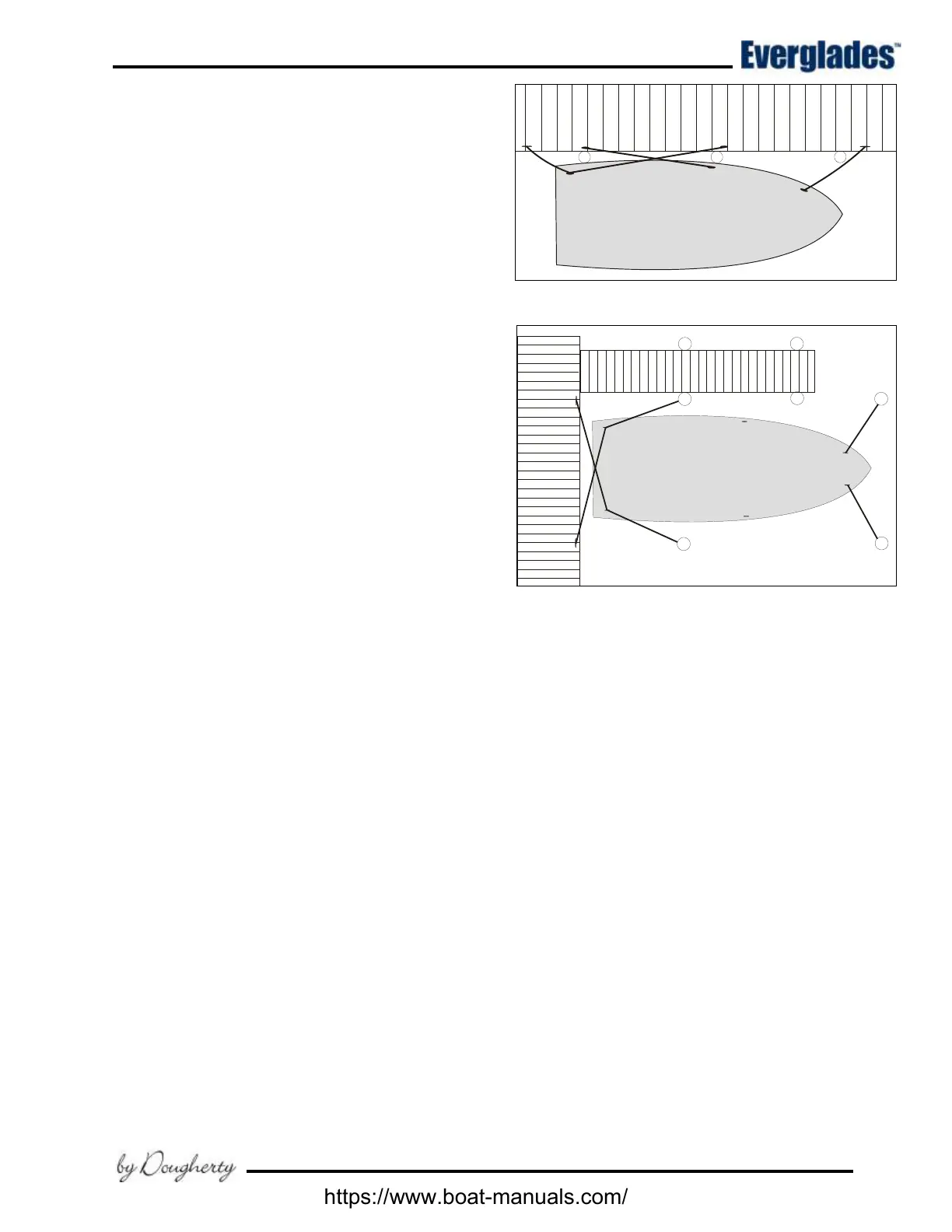
Securing Dock Lines
Securing a boat along side the dock typically re-
quires a bow and stern line and two spring lines.
The bow and stern lines are usually secured to
the dock at a 40° angle aft of the stern cleat and
forward of the bow cleat. The after bow spring
line is secured to the dock at a 40° angle aft of
the after bow spring cleat. The forward quarter
spring is secured to the dock at a 40° angle for-
ward of the stern cleat. The spring lines keep the
boat square to the dock and reduce fore and aft
movement while allowing the boat to move up and
down with the tide.
Securing a boat in a slip is somewhat different. It
typically requires two bow lines secured to pilings
on each side of the bow, two stern lines secured
to the dock and two spring lines that prevent the
boat from hitting the dock. The bow lines are
typically secured with enough slack to allow the
boat to ride the tide. The stern lines are crossed.
One line runs from the port aft boat cleat to the
starboard dock cleat and the other line runs from
the starboard aft boat cleat to the port cleat on
the dock. The stern lines center the boat, control
the forward motion and allow the boat to ride the
tide. Two forward quarter spring lines typically
are secured to the stern cleats and to mid ship
pilings or cleats. The spring lines keep the boat
from backing into the dock while allowing it to
ride the tide.
Leaving the Dock
Always start the engine and let it warm up for 10
to 15 minutes before releasing the lines. Boats
steer from the stern and it is important that you
achieve enough clearance at the stern to maneu-
ver the boat as quickly as possible. Push the
stern off and maneuver such that you get stern
clearance quickly. Proceed slowly until well clear
of the dock and other boats.
Mooring
Approach the mooring heading into the wind or
current. Shift to neutral when you have just
enough headway to reach the buoy. Position a
crew member on the bow to retrieve the mooring
line with a boat hook and secure the line. Keep
the engine running until the line is secured.
Securing The Boat Along Side A Dock (Typical)
Securing The Boat In A Slip (Typical)
Bo
w
L
i
n
e
F
or
w
a
r
d
Q
u
ar
t
e
r
S
p
r
i
n
g
L
i
ne
After Bow Spring Cleat
Bow Cleat
Stern Cleat
A
f
t
e
r
B
o
w
S
p
r
i
n
g
L
i
ne
https://www.boat-manuals.com/



 To Next Page