78
Cleaning the sensors
When cleaning the sensors, take the utmost
care not to scratch or damage them; there-
fore, do not use dry, rough or hard cloths.
The sensors must be washed with clean
water, possibly with car shampoo added.
In car-washes which use steam jet or high
pressure cleaning machines, keep the noz-
zle at least 10 cm away from the sensors.
Bumper repainting or touching up the
paintwork in the sensor areas may exclu-
sively be carried out by the Ferrari Serv-
ice Network. Incorrect paint application
could affect the parking sensor operation.
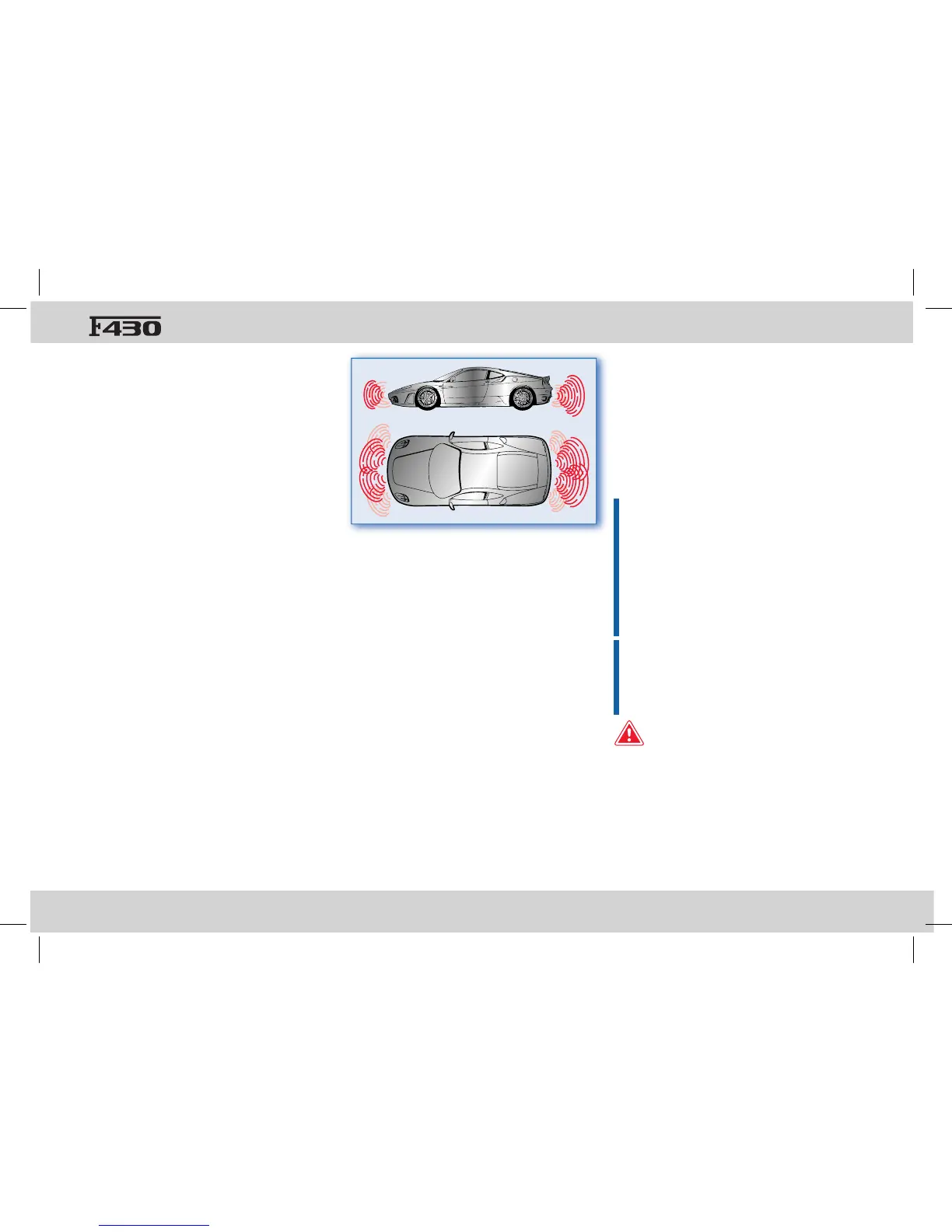
Sensor range
The sensors allow the system to monitor the
front and rear of the vehicle; in fact, they
are positioned so as to cover the central
and lateral areas at the front and rear of the
vehicle.
In the event of an obstacle located in a
central area, it will be detected at distances
of less than 1.50 m, depending on the type
of obstacle and its dimensions.
If the obstacle is located in a lateral posi-
tion, it will be detected at distances of less
than 0.8 m.
Fault signals
The system ECU tests all the components
each time the ignition key is turned to posi-
tion II.
The sensors and the respective electrical
connections are then constantly checked
throughout system operation.
In the event of failure of the parking sensor
system, the driver is warned with a beep.
In this case, stop the vehicle and turn the
ignition key to position 0 (Stop). Then try
cleaning the sensors or moving the vehicle
away from any possible ultrasound sources
(e.g. pneumatic truck brakes or pneumatic
hammers) and turn the ignition key back to
position II. In this way, if the cause of the
operating fault has been corrected, the sys-
tem resumes full operation and the warning
beep goes off.
Should this not occur, contact the Fer-
rari Service Network to have the system
checked even if it continues working. In
fact, if the failure detected by the ECU does
not affect operation, the system continues
working and the malfunction is stored
so that it can be checked by the Ferrari
Service Network during a subsequent
inspection.
During parking manoeuvres, always be
extremely careful with obstacles that might
be located above or below the sensors. In
particular, low-lying (e.g. curbs, stone posts),
broken (e.g. wire mesh fences, hedges), thin
(e.g. poles, lampposts) or suspended obstacles
(e.g. bars/overhead doors) may in certain
conditions not be detected by the system and
hence damage the vehicle or the obstacles.
The signals transmitted by the sensors can
also be altered by damage to the sensors or by
dirt, snow or ice on the sensors or even by ul-
trasound systems (e.g. pneumatic truck brakes
or pneumatic hammers) in the vicinity.
The driver is in any case always
responsible for parking and other
potentially dangerous manoeuvres. During
these manoeuvres, always make sure that
there are no persons (especially children)
or animals in the manoeuvring area. The
parking sensors must be considered as an
aid to the driver who, in any case, must nev-
er take less care during potentially danger-
ous manoeuvres, even if they are performed
at low speeds.









 To Next Page