Need help?
Do you have a question about the Festo DZF and is the answer not in the manual?
Details critical safety precautions and warnings for performing repairs to prevent injury and damage.
Outlines the necessary steps and precautions before starting the repair process, including tool and part checks.
Detailed steps for repairing the DZF flat cylinder, covering disassembly, component replacement, and reassembly.
Detailed steps for repairing the DZH flat cylinder, covering disassembly, component replacement, and reassembly.
Explains the different types of greasing required for cylinder components and seals, including application methods and quantities.
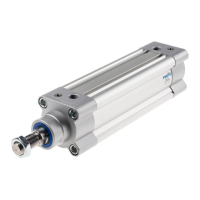
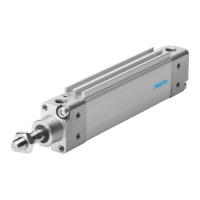
This document provides repair instructions for Festo DZF/DZH series flat cylinders with piston rods. It covers functional descriptions, technical specifications, usage features, and maintenance procedures.
The DZF/DZH flat cylinders operate on a pneumatic principle. When the rear cylinder chamber is pressurized, the piston moves forward within the cylinder barrel. The piston rod then transmits this movement to the outside of the cylinder. To retract the advanced piston rod, the front cylinder chamber is pressurized. This double-acting mechanism allows for controlled extension and retraction of the piston rod.
The cylinders come in various sizes and configurations, indicated by their type codes. Key specifications include:
The type code, found on the rating plate directly beneath the Festo logo, provides detailed information about the cylinder's features. For example, "DZF-32-100-A-P-A" indicates a DZF type cylinder, 32 mm piston diameter, 100 mm stroke, male piston rod thread, elastic cushioning, and magnetic piston for sensing. A comprehensive list and description of all possible equipment features can be found in the data sheet on the Festo website.
The DZF/DZH cylinders are designed for professional use and are repairable in the event of damage due to normal wear. However, if the cylinder barrel itself sustains significant damage, the entire cylinder must be replaced, as it is not repairable. Cylinders of type DZF-12-... and DZF-18-... are explicitly noted as non-repairable and must be replaced if damaged.
For repair procedures, it is crucial to use genuine spare parts of the appropriate type and version. Unauthorized repairs or the use of non-original parts are dangerous and not permitted. Before any repair, all attachments on the cylinder barrel, bearing, end caps, or piston rod must be removed according to the operating instructions. The working environment should be kept tidy.
A critical safety warning emphasizes depressurizing the cylinder completely by removing non-return valves and tubing connections before opening it, to prevent sudden pressure release and the bearing cap flying off. To avoid damage to sealing rims or guide surfaces, only flat and blunt-edged assembly aids should be used.
Maintenance and care primarily involve cleaning and greasing, which are essential for ensuring the cylinder's service life and proper function.
Cleaning: The seals are designed for "life-time lubrication," meaning the initial lubricant film should last the entire service life. To maintain this, the cylinder must be thoroughly cleaned of all foreign particles, machining residues, and old lubricants before re-greasing. Festo recommends Loctite 7063 and Loctite 7070 for cleaning. If other cleaning agents are used, their compatibility with the cylinder's seals must be verified to prevent corrosion.
Greasing: Different components and seals require varying levels of greasing:
To guarantee life-time lubrication after reassembly, the piston rod with assembled piston and piston seals must be moved multiple times across the entire stroke of the cylinder barrel to produce an even lubricant film.
Component Replacement and Reassembly: The repair process involves removing and replacing specific components such as hex nuts, piston rod seals, bearing bushes, O-rings, threaded pins, bearing caps, seals, pistons, washers, groove rings, guiding bands, cushioning bosses, and magnets. When replacing piston components, their original order and orientation must be noted. Any residue of screw locking agent must be removed from threads before applying new agent.
Screw locking agent, included in the set of wearing parts, must be applied to the inside of the hex nut (for the rear part of the piston rod on cylinders with through piston rod) before screwing it onto the piston rod with the specified torque. Torque values vary by cylinder type and size.
When inserting the piston rod into the cylinder barrel, the piston seal must be tilted slightly to insert it, ensuring the lip of the piston seal does not fold back. The piston should be pushed far enough into the cylinder barrel so that the first piston seal (or groove ring for DZH) protrudes slightly at the other end, then pulled back until the piston sits fully in the barrel. This ensures correct seating of the seals.
Mounting sleeves (special tools) are recommended to protect the piston rod seal and bearing in the bearing cap during reassembly. The mounting direction of seals and bearing caps is crucial; for example, individual sealing lips should face out, and through-holes for self-tapping screws must not be covered by the seal, with the closed lug pointing upwards towards the compressed air connection.
After reassembly, screws are tightened with specific torque values, which vary by cylinder type and size. Finally, a functional test must be performed as per the operating instructions to commission the repaired cylinder.
Regular cleaning of dirt from the piston rod with a soft cloth is recommended. Non-abrasive cleaning agents are permissible. However, regular removal of lubricant from the piston rod surface can reduce its service life.
 General
| Brand | Festo |
|---|---|
| Model | DZF |
| Category | Industrial Equipment |
| Language | English |

 To Next Page