3
11. During application through a hose, high pressure
can be exerted at the end of the hose. Hose-holding
personnel must establish good footing. The operator
should apply gradual pressure to the hose only after
hose-holding personnel are firmly positioned and
have firm control of the hose. Additional personnel to
direct hose may be necessary if working on slopes.
The proper technique for grasping the hose used by
hose-holding personnel is to route and firmly grasp
the hose over the shoulder or under both arms.
Never route/hold the hose so it goes between the
legs. If the hose-holding personnel finds that it is
uncomfortable for him to handle the hose by himself,
additional hose holders should be positioned at the
end of the hose.
12. The blower discharges material at pressures and
velocities that can cause severe bodily injury. Do not
aim discharge at people, animals, etc. Only aim the
discharge at the intended discharge area. Unless
properly protected, do not place hand into the dis-
charge stream.
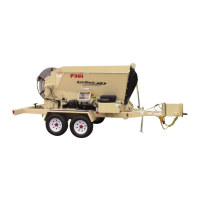
13. Do not open any doors
or access panels while
machine is in operation.
Severe injury may result
from rotating parts.
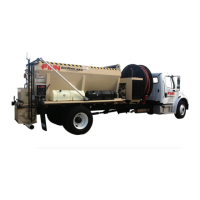
14. Do not attempt to pull
anything out of the blower
hopper while machine is in
operation. Shut down the
engine using the OSHA
lockout/tagout procedure
(29 CFR 1910.147) before
removing any foreign
objects. Signal visually or
audibly that all is clear before operating the machine.
15. When leaving the blower unattended for any reason,
be sure to:
A. Shut off conveyor drive.
B. Shut off vehicle engine and blower engine.
C. Place transmission of the vehicle in “NEUTRAL”
or “PARK”.
D. Set parking brake firmly.
E. Lock ignition and take keys with you.
F. Lock vehicle cab.
G. If parked on a steep grade, block the wheels.
These actions are recommended to avoid unauthor-
ized use, runaway, vandalism, theft, and unexpected
operation when the equipment is restarted.
16. Do not read, eat or otherwise lose or lessen your
attention in any manner while operating the blower.
Operating the equipment is a full-time job.
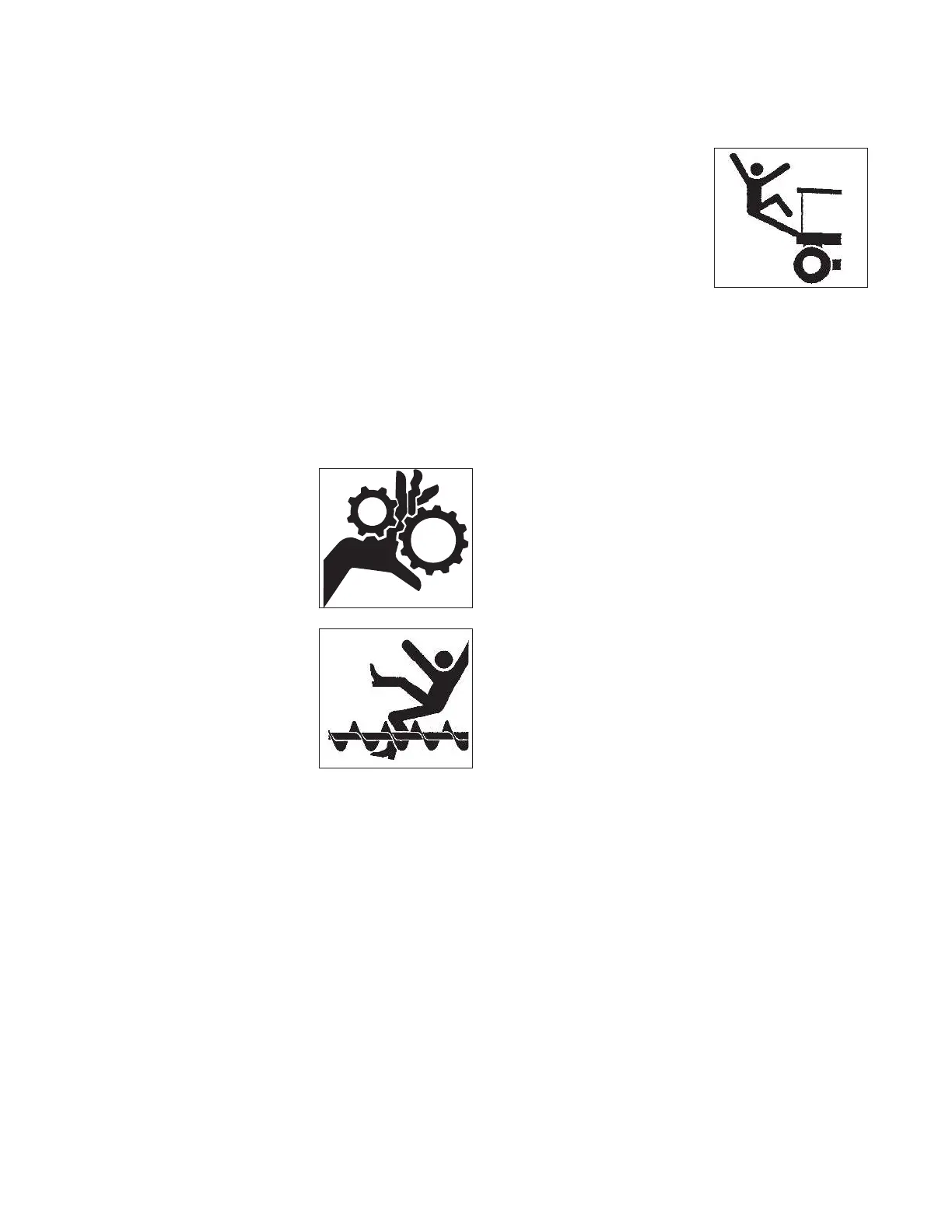
17. Be careful in getting on
and off the blower, espe-
cially in wet, icy, snowy, or
muddy conditions. Clean
mud, snow, or ice from
steps, fenders, and foot-
wear.
18. All personnel operating and/or around the machine
must be aware that the blower can be controlled via
remote control. For safety reasons and to prevent
accidental starting, always keep the power switch
on the remote receiver in the OFF position when the
remote control is not being used.
19. Be careful when operating the tarp near power
lines. Raising the tarp into power lines may cause
severe electrical shock. Always have the tarp either
fully open or fully retracted when transporting the
machine.
20. Turn slowly and travel carefully on rough surfaces
and side slopes, especially with a loaded blower
body.


 To Next Page