2
BARK BLOWER SAFETY SUMMARY SECTION
It is important that all operators of this machine are familiar with all the safety aspects mentioned
below before operating the machine. Always keep a copy of this manual with the machine. It is the respon-
sibility of the operator of the machine to fully understand this safety section. Remember that YOU are the
key to safety. Good safety practices protect not only you but also the people working with and around you.
Keep in mind that this safety sheet is written for this type of machine only. Practice all other usual and
customary safe working precautions; and above all, remember that safety is up to you.
I. PRE-START EQUIPMENT CHECK (equipment
check is to be made with the engine off):
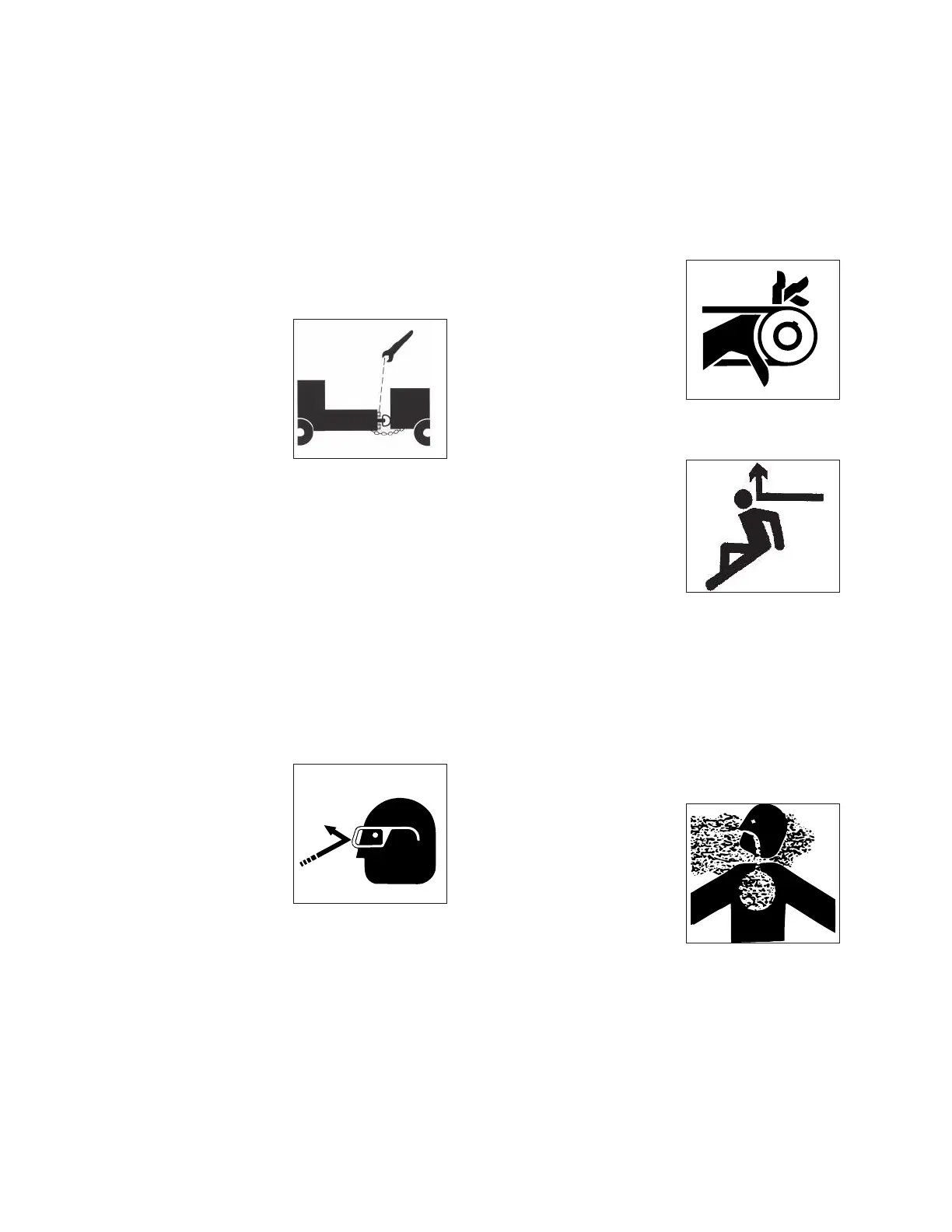
1. Check hitch and hitch
bolts, safety chains, lights,
brakes, and breakaway
switch. Verify that the hitch
ball or pintle hook is the
correct size for the coupler.
2. Verify that all guards are in place.
3. By carefully looking into the blower hopper and
transition, inspect for and remove any foreign
objects. Follow Occupational Safety and Health
Administration (OSHA) lockout/tagout procedure (29
CFR 1910.147)
4. Inspect all hydraulic hoses and tubes for cracks,
bulges, or damage. If hose is cracked, bulging, or
damaged, replace immediately.
5. Inspect the material discharge hose and connec-
tions for cracks or damage. If cracks or damage are
found, replace affected part immediately.
II. MACHINE OPERATION:
1. Always wear safety gog-
gles when operating or
feeding the machine.
Other safety attire, such
as safety shoes, ear pro-
tection, gloves, hard hats,
dust masks, etc., should
be worn as required
by warning decals on
machine, operator’s manuals, or job site require-
ments. Remove rings, watches, etc. Avoid wearing
loose-fitting clothing that may get caught in rotating
machinery.
2. Do not override or tamper with the safety-shutdown
switches on the folding door or discharge. If switch-
es fail, use OSHA lockout/tagout procedure (29 CFR
1910.147) until switches are repaired or replaced.
3. Do not operate the machine
without all guards in place.
4. Never attempt to connect, or disconnect the dis-
charge hose while the engine is running.
5. Make sure that no one
is working in or on the
machine. Make sure the
discharge area is clear of
all persons, animals, etc.
Signal visually or audi-
bly that all is clear before
starting the engine. Keep
unauthorized personnel
away from the machine and discharge hose at all
times.
6. The driver of the towing vehicle is responsible for
the safety of the operator(s) and feeder(s) of the
machine. Make sure the driver is aware of and
avoids all possible hazards, such as tree limbs, low
power lines, etc.
7. Do not allow anyone to ride on the trailer or any other
part of the blower for any reason.
8. Never operate machine in
an enclosed area without
venting the engine exhaust
of both the equipment and
vehicle on which the equip-
ment is mounted. Deadly
carbon monoxide fumes
can accumulate.
9. Never operate this or any other machinery when
fatigued, tired, under the influence of alcohol, illegal
drugs, or medication. You must be in good physical
condition and mentally alert to operate this machine.
10. Never modify the machine. Never remove any part
of the machine (except for service and then reinstall
before operating).


 To Next Page