EQUIPMENT: FIRECLASS Prescient III WRITTEN BY: RKP
PUBLICATION: OMFCPRES3IN CHECKED BY: AP
ISSUE No. & DATE: 0 02/02/12
PAGE 28 of 43
8. Panel Installation
The control panel must be installed by suitably
qualified technicians familiar with the installation of
fire detection & extinguishing systems. In addition, it
is recommended to refer to the following
information:
1. Current edition of the IEE wiring regulations.
2. Current edition of BS5839-1 or the installation
standards for the relevant country.
3. Any site-specific requirements.
4. Any field device installation instructions.
5. Any data sheet provided for the installation of
Intrinsically Safe devices.
WARNING: Read this section completely before
commencing installation.
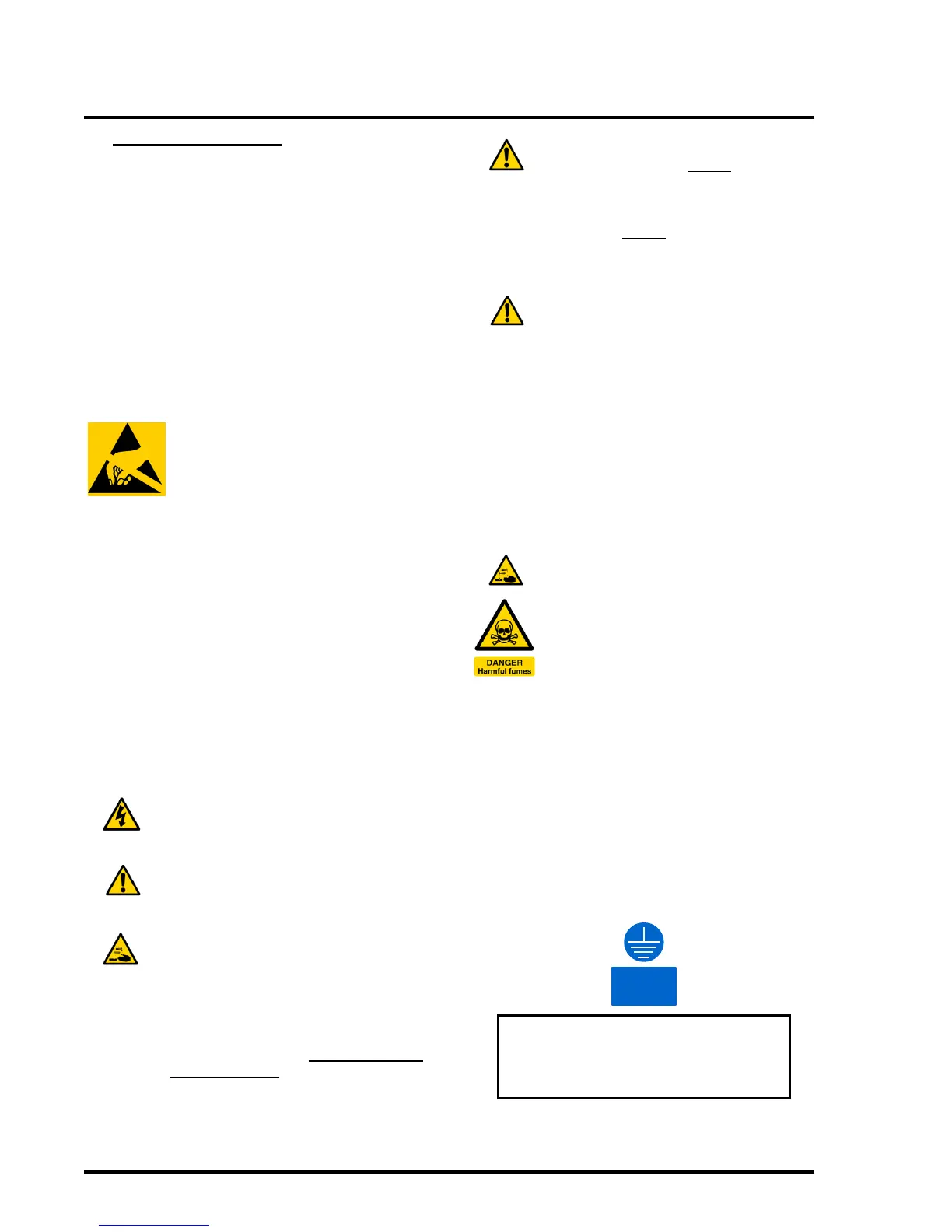
Prior to commencing installation of
the control panel, ensure that
adequate precautions are taken to
prevent damage to the sensitive
electronic components on the control
board due to electrostatic discharge. You should
discharge any static electricity you may have
accumulated by touching a convenient earthed
object such as an unpainted copper radiator pipe.
You should repeat the process at regular intervals
during the installation process, especially if you are
required to walk over carpets.
The panel must be located in a clean, dry position,
which is not subject to shock or vibration and at
least 2 metres away from pager systems or any
other radio transmitting equipment. The operating
temperature range is -5ºC to +40ºC; maximum
humidity is 95%.
8.1 Important Safety Considerations
For Batteries
DANGER: Batteries are electrically live at all
times, take great care never to short
circuit the battery terminals.
WARNING: Batteries are often heavy; take great
care when lifting and transporting
batteries. For weights above 24 kilos,
lifting aids should be used.
DANGER: Do NOT attempt to remove the battery
lid or tamper with the internal workings
of the battery. Electrolyte is a highly
corrosive substance, and presents
significant danger to yourself and to
anything else it touches. In case of
accidental skin or eye contact, flush
the affected area with plenty of clean,
fresh water and seek immediate
medical attention.
Valve Regulated Lead Acid (VRLA) batteries
are “low maintenance”, requiring no
electrolyte top-up or measurement of
specific gravity.
WARNING: Only clean the battery case with a cloth
that has been soaked or dampened
with distilled water. Do not use organic
solvents (such as petrol, paint thinner,
benzene or mineral spirits) or other
materials that can substantially weaken
the case. Do not use a dry cloth as this
will generate static electricity, which in
turn may lead to an explosion.
WARNING: Avoid operating temperatures outside
the range of -15C/5F to +50°C/122°F
for float/standby applications.
The recommended normal operating
temperature is 20°C.
HIGH TEMPERATURE will reduce
battery service life. In extreme cases
this can cause Thermal Runaway,
resulting in high oxygen/hydrogen gas
production and battery swelling.
Batteries are irrecoverable from this
condition and should be replaced.
LOW TEMPERATURE will prolong
battery life but reduce output capacity.
DANGER: Do not incinerate batteries. If placed in
a fire, the batteries may rupture, with
the potential to release hazardous
gases and electrolyte. VRLA batteries
contain substances harmful to the
environment.
Exhausted batteries must be recycled.
Return them to the battery
manufacturer or take them to your
Council waste disposal site for
appropriate disposal.
8.2 Electrical Safety
The volt-free relay contacts provided within the
panel must not be used to directly switch any
voltage that exceeds 50VAC or 75VDC. (Please
also refer to relay rating data).
This equipment requires a 230V AC supply. All
installation work should be carried out in
accordance with the recommendations of BS5839
Part 1 and the current edition of the IEE regulations
by suitably qualified and trained personnel.



 To Next Page