lights are lacking at the steering position in the
cockpit (plate 9), a buzzer is fitted in the steering
pedestal (see paragraph 3.5) to give an acoustic
warning if anything should go wrong.
The engine control in the dog-house is still of the
single lever type, but at present is top-mounted and
thus of a different type than mentioned earlier. To
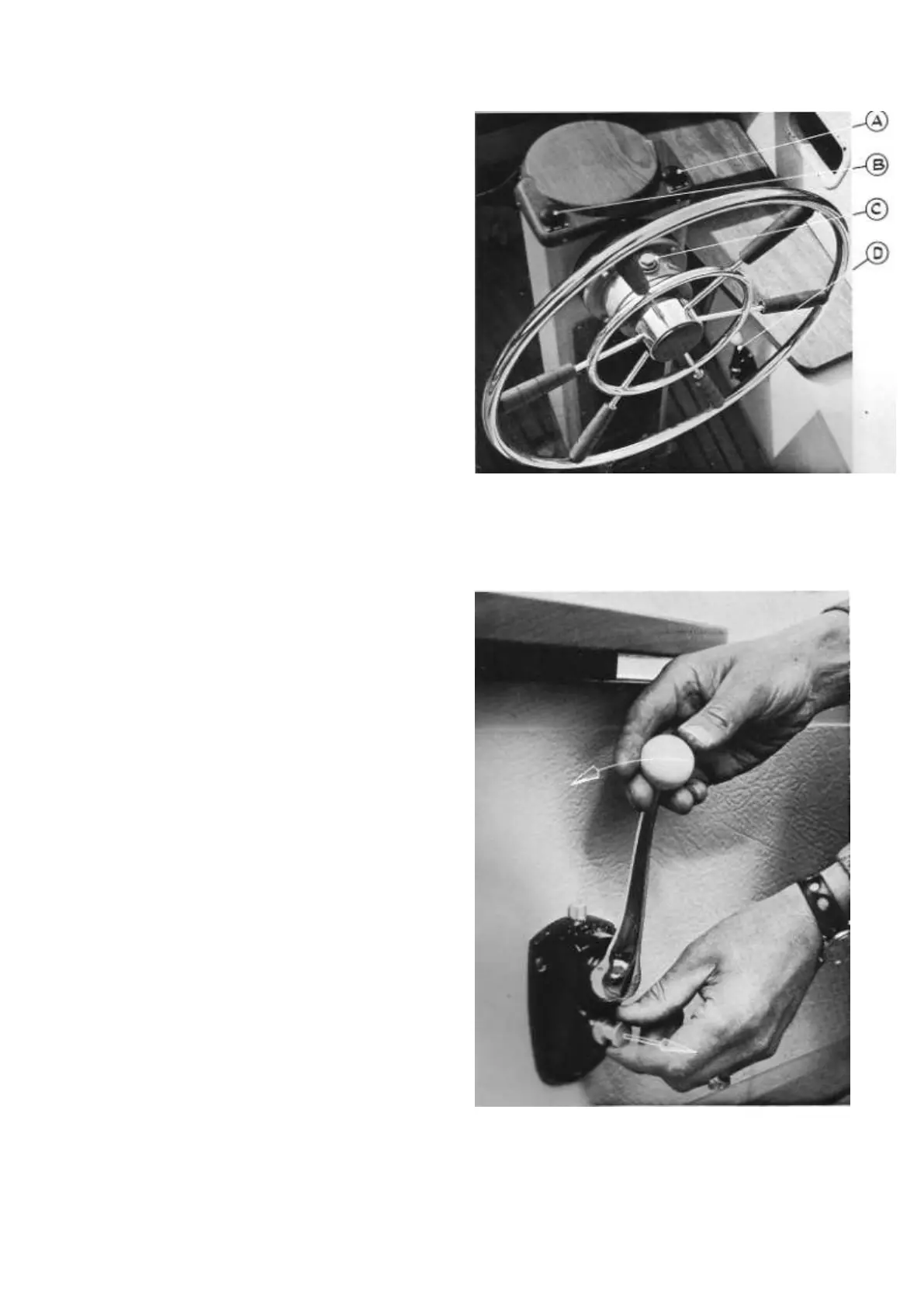
disengage the gear control of this control box, the
lever has to be pulled sideways at the hub when
in neutral position (plate 10), and then pushed
forward. To re-engage the shift mechanism, just
move the lever back to neutral position, and it snaps
into the original engagement.
The engine stop is located on the right hand side of
the control box. Pull for stopping the engine, and do
not forget to push it back again before re-starting.
The propeller stop in the Version B is fitted in the
locker for fuse panel and main switches. (It is shown
on plate 1). When pushed down, the propeller shaft
is locked (the two-bladed propeller in vertical
position for minimum resistance when
under sail). and this handle MUST be pulled out
before the engine is started and the gearbox is
engaged!
On top of the steering pedestal in the cockpit, only
two push-buttons are fitted: One for operating the
electrical horn, and one for engine starting (plate 8).
As hydraulic steering gear is fitted in Version B, no
manipulating is needed for changing
from the one steering wheel to the other when
changing steering positions. Because of the locking
valves incorporated in the hydraulic system, both
steering wheels are engaged simultaneously,
although the one not in use will not be moving.
Both Versions
A fuel tank gauge and engine revolution counter are
fitted in the main control panels of both versions.
The engine fitted is derated at the factory to its work-
boat rating, which means that it can be driven at top
R.P.M. (3000) continuously Without
causing trouble. At 3000 R.P.M. the engine develops
37 shaft horse power. However, as the FJORD MS
33 is given a true heavy displacement hull
configuration, maximum hull speed in smooth water
is obtained at far less engine speed than 3000 R.P.M.
Pushing the throttles wide open does nothing but
generate a lot of waves and an unpleasant wake, as
well as more than necessary engine noise, and it is
our opinion that nothing more than, say, 2000
R.P.M. is needed for normal cruising. The marginal,
obtainable power may, however, be of great
importance from a safety point of view, if heavy
weather has to be fought head on.
Plate 9
Steering Position in Cockpit — Version B
A) Electric Horn Switch
B) Engine Starting Switch
C) Oil filler Cap — Hydraulic Steering
D) Engine Throttle and Gear Control
Plate 10 .
Disengaging Gear Control — Main Steering Position,
Version B



 To Next Page