18
CRADLE PAD PIVOT BUNKS
Cradle pivot bunks are ideal for most lightweight
V-hull watercraft. They can be located in a
V-position at both the front and rear of your
boat, or turned so that the padded extrusions
on the rear pair run parallel with the boat’s hull.
Like the full-length bunks, the cradle pads will
adjust both vertically and horizontally (Fig 40).
The support tube clamps adjust in the same way
as the bunk clamps (Fig 41).This extensive
adjustment capability gives you the exibility to t
the system to your boat’s hull design.
The best set-up will ensure that, as the boat is
being raised, it does not lean to one side or the
other and that once it is raised, the boat will be
held completely stable.
DETERMINING THE PROPER WIDTH
The proper width of the bunk system depends on
the contour of the boat hull. As a rule of thumb,
the bunks should be spread as wide as possible.
If the boat is on a trailer, measure the width that
will provide optimal support and hull t. The setup
of the trailer bunks may provide a helpful guide.
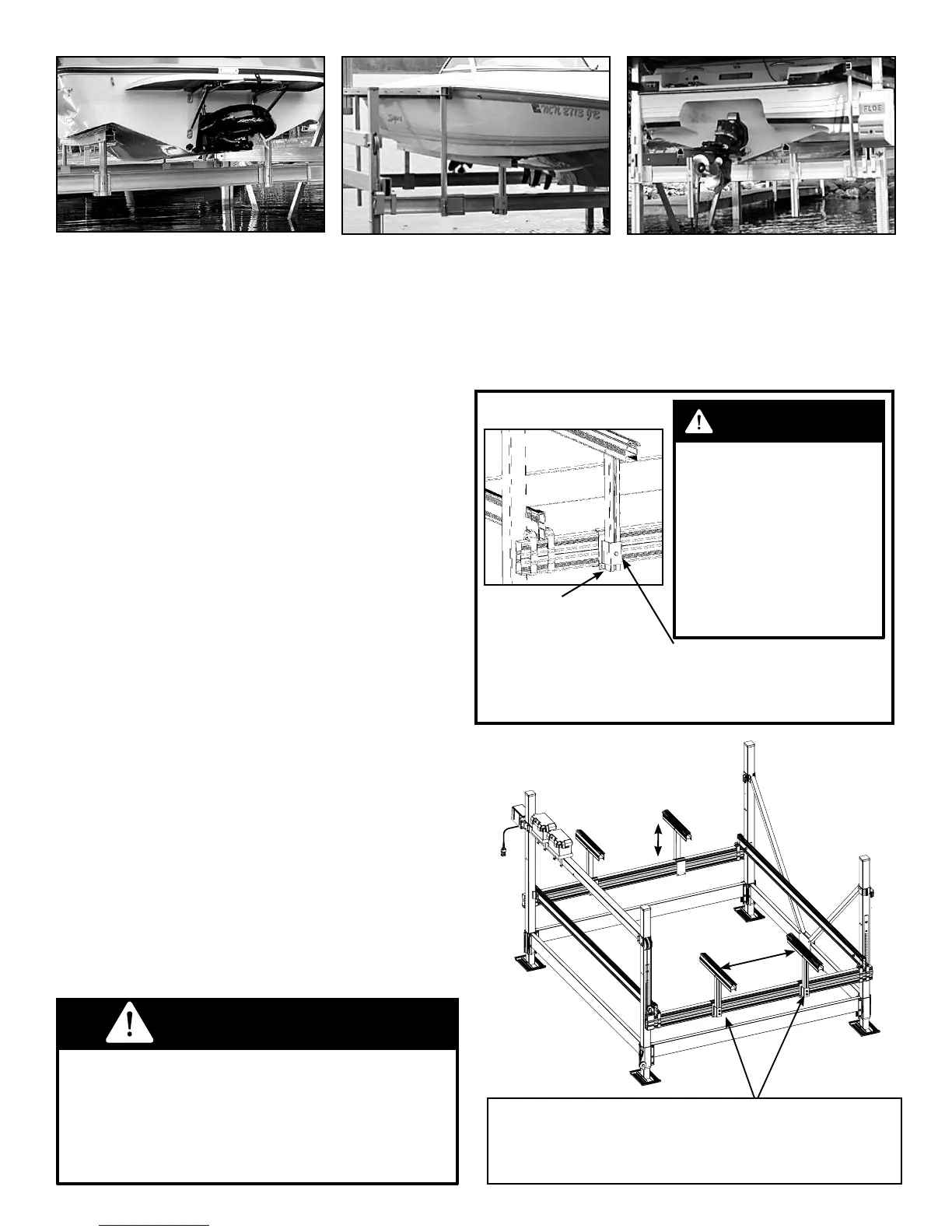
See Figs. 37a, b, c & d. Fig 37e shows pads for
an outboard motor.
Fig. 37a - Ideal bunk placement -
Note that the bunks are spread out to the
widest position on the boat hull. They sit
nicely into the contour of the hull and the
keel has plenty of clearance above the
main lift beam. If possible, this is the most
ideal bunk placement for non-inboards.
Fig. 37b -
Bunk height recommended
for inboards
- The bunks are spread
wide and the hull is lifted so that the
running gear on an inboard can pass
over the main lift beam without making
contact.
Fig. 37c - Less desirable bunk
placement - Ideally in the above
example, the lift bunks would have
been
positioned wider as in Figs. 37a & b.
Doing so would have allowed the bunks
to be set higher, preventing the vertical
tubes from sticking so far below the main
lift beam.
If the lift is in shallow water, and after nal adjustment these
tubes stick too far below the main lift beam, they may need
to be cut off ush so that they do not hit the lake bottom and
prevent the lift from lowering completely.
Never operate a boat lift that is not level. Under
normal conditions a boat lift operates under extreme
force. When the lift is not level, these forces are
greatly multiplied and bodily injury or damage to
the lift can result.
WARNING
FIG 40
Adjust vertically
and horizontally
FIG 41
To adjust the width,
loosen the bolts on the
lower part of the clamp
and slide it into position.
Torque to 35 ft. lbs.
To adjust the height, loosen the
clamp bolt and raise the tube to
the proper location. Torque to
45 ft. lbs.
Never attempt to adjust
the bunk system (or any
boat lift component) with
the weight of the boat
on it. Doing so could
kill or cause serious
bodily injury due to
a fast dropping boat.
DANGER



 To Next Page